(BIVN) – The USGS Hawaiian Volcano Observatory issued an information statement Thursday evening concerning the continued pressurization of the Kīlauea summit region.
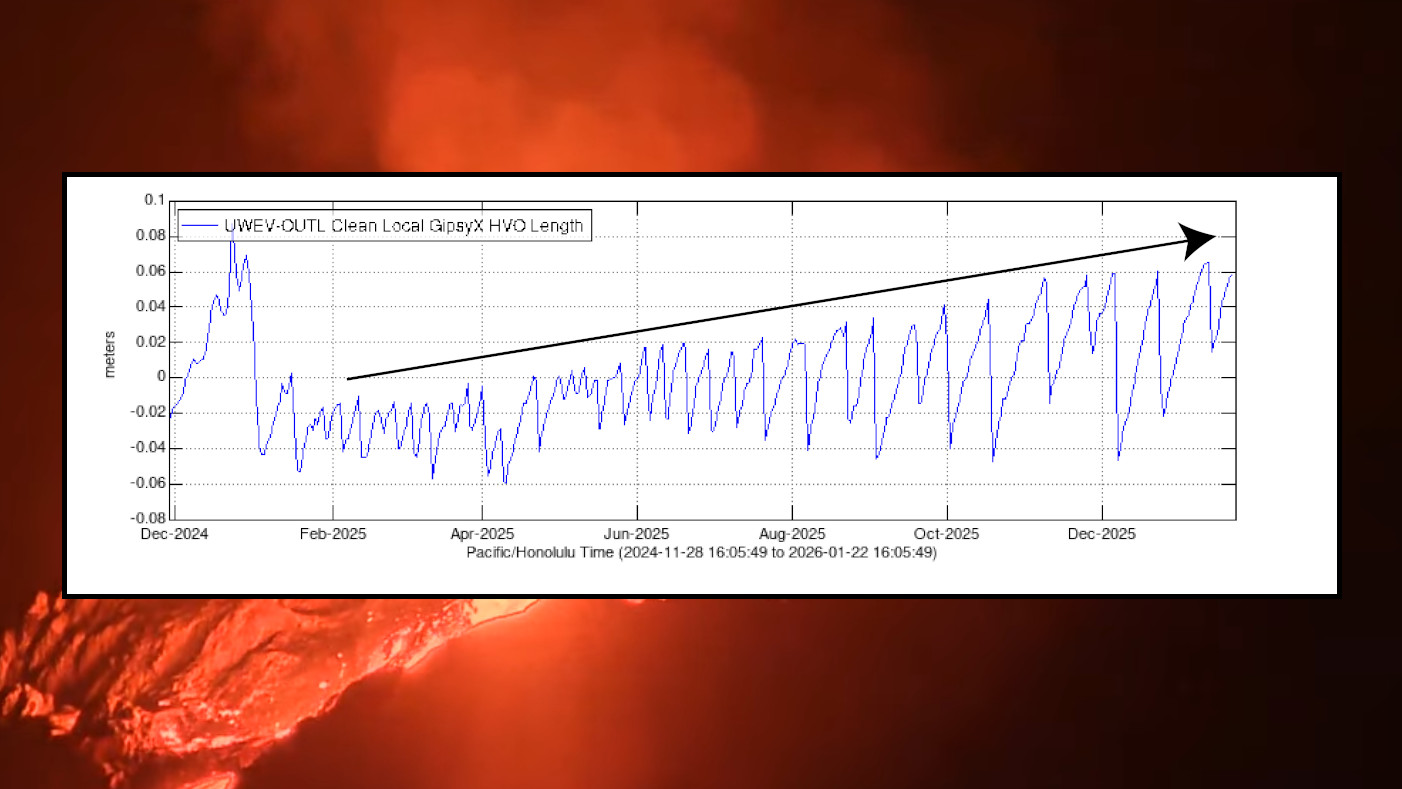
With the next episode of lava fountaining expected to begin at any moment, Observatory scientists are letting the public know that their monitoring data “show that the modeled pressurization within the shallow Halemaʻumaʻu magma chamber beneath Kīlauea’s summit has been slowly increasing over time and could eventually result in a change to the eruption dynamics.”
The statement follows a week of earthquake swarms at the summit, which scientists say “appear to be related to a broad change where pressure is accumulating within the summit region.”
From the USGS Information Statement:
Summary of Recent Activity
The ongoing Kīlauea summit eruption has progressed through 40 episodes of lava fountaining from two vents in Halemaʻumaʻu, separated by pauses in eruptive activity. The increase in eruption rate during lava fountaining rapidly deflates the source—the shallow Halemaʻumaʻu magma chamber. Pauses between lava fountaining episodes are accompanied by reinflation of the shallow Halemaʻumaʻu magma chamber and new episodes usually occur upon full recovery of pressure from what was lost in the previous episode. This consistent repeating pattern has allowed the USGS Hawaiian Volcano Observatory (HVO) to forecast windows of time when new lava fountaining episodes may begin.
Monitoring data from the Kīlauea summit region Global Positioning System (GPS) network is used to generate models of pressurization over time in the two magma chambers below: the shallow Halemaʻumaʻu magma chamber and a deeper magma chamber located beneath the south caldera region. As this eruption has progressed, the modeled amount of pressurization reached in the Halemaʻumaʻu magma chamber before each new lava fountaining episode has slowly increased. Modeled pressurization in the deeper south caldera magma chamber has been slowly decreasing since this eruption began in late 2024. This process is offsetting the increased pressurization that occurred there beginning in October 2023 and continuing to the start of this eruption in December 2024. Increased shallow pressurization may reflect increased magma supply to drive the higher effusion rate of the ongoing eruption, which is about double that of the long-term magma supply rate at Kīlauea.
The magma plumbing system connecting the two eruptive vents in Halemaʻumaʻu to the shallow magma chamber below has been remarkably stable over the past year, with very little earthquake activity. Following the end of episode 40, on the evening of January 12, short-duration swarms of small earthquakes in the region 1.5–4 km (1–2.5 miles) below Halemaʻumaʻu have occurred intermittently, accompanied by abrupt and brief disruptions in the summit’s inflationary tilt trend.
Most of these recent earthquakes have been smaller than magnitude-1.0 and broadly distributed beneath Halemaʻumaʻu and the south caldera region of Kīlauea’s summit, suggesting that the stress changes generating the earthquakes are not highly localized. Rather, the swarms appear to be related to a broad change where pressure is accumulating within the summit region. By contrast, when a new eruptive fissure formed in the southwest wall of Halemaʻumaʻu during episode 30 on August 6, 2025, earthquakes were tightly clustered along the path that magma followed to the surface. Additionally, changes in the patterns of summit region ground deformation indicated that magma intruded a new area, which was apparent in the new but short-lived eruptive vent.
The impact of the recent earthquake swarms on the next episode of lava fountaining, if any, is unknown at this time, but there have not been changes in ground deformation patterns to suggest that magma has intruded or is intruding into a new area. Between swarms, Kīlauea’s inflationary deformation continues, and the window for the start of episode 41 is currently estimated to be between January 23 and 25 if the inflation rate remains consistent.
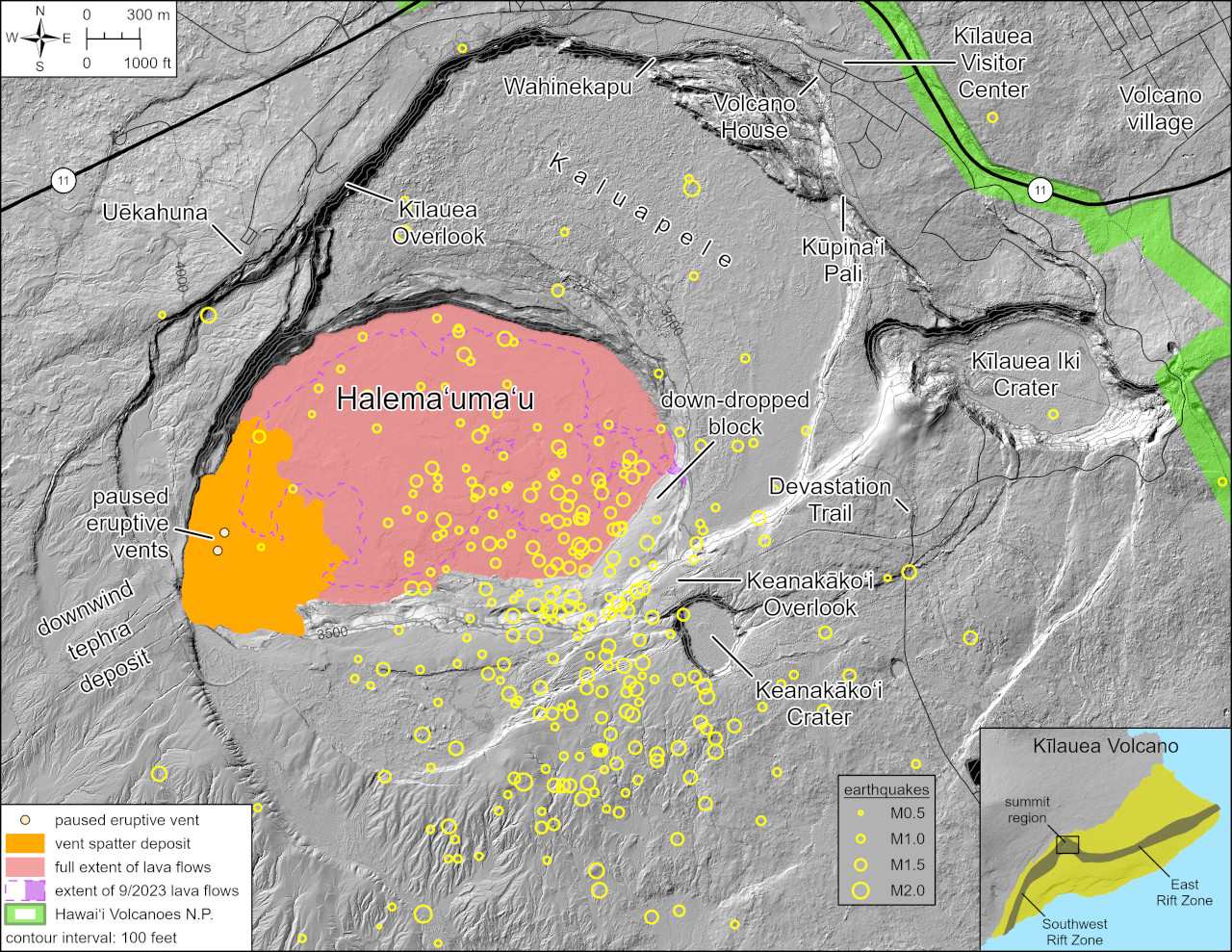
USGS: “This map depicts the locations of approximately 300 earthquakes that have occurred between January 12 and 22, 2026, in the summit region of Kīlauea volcano. Most earthquakes have been smaller than magnitude-2, with locations broadly distributed beneath Halemaʻumaʻu and the south caldera region of Kīlauea summit.”
Possible Outcomes
It is not possible to forecast an exact outcome of this activity. Some potential scenarios in the coming months, based on past events, are described below. Past episodic eruptions of Kīlauea at the start of the 1983 Puʻuʻōʻō and the 1969 Maunaulu eruptions (44 and 12 episodes each) on the East Rift Zone both continued after lava fountaining episodes ended, with fissures opening nearby that erupted more continuous lava flows. Following the end of the 1959 Kīlauea Iki summit eruption (17 episodes), magma eventually moved into the East Rift Zone and erupted in a new location.
Eruption continues: Magma could continue to erupt from the north and south vents in Halemaʻumaʻu for an unforeseeable amount of time or number of episodes. The vents could break down at some point and begin to erupt lava more continuously.
New vent forms in summit region or upper Southwest Rift Zone: Magma could form a new shallow pathway toward the surface, potentially resulting in a new vent erupting lava near the existing vents in Halemaʻumaʻu, or nearby within the summit caldera. Intrusive activity in the Southwest Rift Zone in 2024 resulted in numerous new cracks, many of which have been covered with tephra from the recent lava fountains. Given the vent locations in this eruption, and the 2024 intrusive activity, new vents could also form in the upper Southwest Rift Zone. In 1919, a long-lived eruption within Halemaʻumaʻu transitioned into the Southwest Rift Zone, resulting in the Maunaiki eruption that was active for 9 months in the middle portion of the Southwest Rift Zone. In this scenario, we would expect earthquakes with tightly clustered locations, along with changes in the patterns of ground deformation indicative of shallow crack formation, similar to what occurred in the new vent formation during episode 30 on August 6.
East Rift zone intrusion or eruption: Magma could migrate into East Rift Zone, potentially resulting in an eruption there. However, given the vent locations and summit region deformation patterns, this is the least likely scenario. In this scenario, we would expect increased rates of earthquakes migrating from the summit towards the East Rift Zone along with ground deformation indicative of summit magma chamber deflation.
HVO ActionsKīlauea’s summit region is monitored with a dense network of instruments recording seismic activity, ground deformation, visual and thermal imagery, and volcanic gas emissions. HVO staff closely monitor these various datasets for changes. Kīlauea Daily Updates are published each morning with a summary of the past 24 hours of activity, and we will issue additional messages as needed based on any significant changes detected. Should volcanic activity change significantly, a Volcanic Activity Notice will be issued. HVO is in frequent communication with Hawai‘i Volcanoes National Park and Hawai‘i County Civil Defense to keep them apprised of Kīlauea’s activity.

by Big Island Video News
on at
STORY SUMMARY
HAWAIʻI VOLCANOES NATIONAL PARK - The shallow magma chamber beneath Kīlauea's summit has been slowly pressurizing over time, and could eventually result in a change to the eruption dynamics.