(BIVN) – Lava emerged from the north vent at the summit of Kilauea on Thursday night, as the Hawaiʻi island volcano builds to its next eruptive episode.
High lava fountains could begin at any moment. Scientist forecast episode 41 in the year-long summit eruption could start between today, January 23, and Sunday, January 25, based on current inflationary tilt models.
But scientists are also watching the summit seismicity very closely. Earthquake swarms have been observed following the end of episode 40 earlier this month. Those swarms have transitioned into multi-hour periods of elevated micro-seismicity. The earthquake locations continue to be spread fairly widely beneath the summit region. Scientists believe they are related to migrating magmatic pressure within the summit region.
Overall, the increasing pressurization at the summit – along with the earthquakes – could indicate a change in the eruption is on the way.
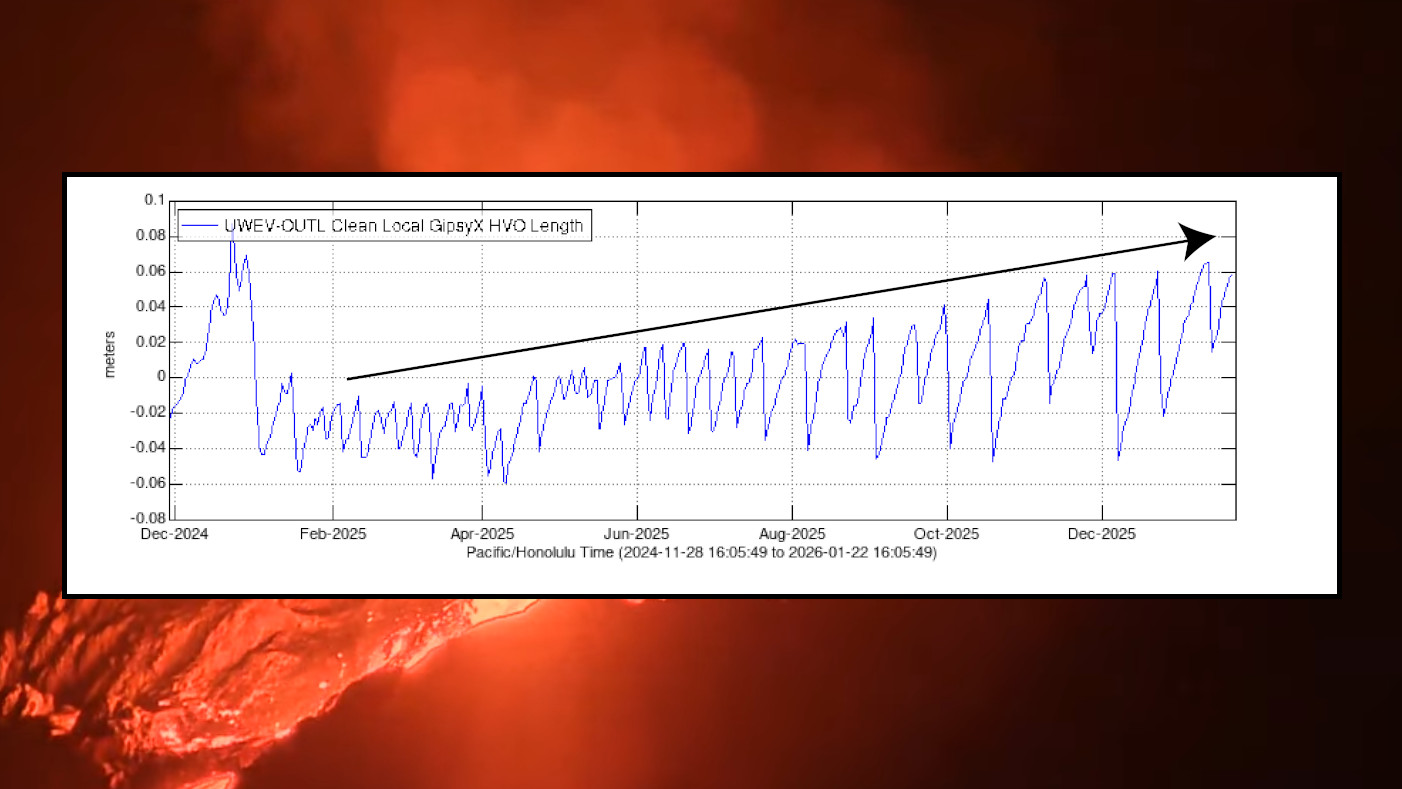
USGS: “This plot shows the line length between two GPS stations in Kīlauea summit region (UWEV and OUTL) since the episodic summit eruption began on December 23, 2024. These stations are located on opposite sides of the caldera and the distance between them can be used as a proxy for pressurization within the shallow Halemaʻumaʻu magma chamber. The saw-tooth pattern is associated with eruptive episodes over the past year, with each fountaining episode beginning at a peak and ending at a trough. Overall, more pressurization is required to start each fountaining episode, as shown by the black arrow.”
On Thursday night, the USGS Hawaiian Volcano Observatory issued an information statement, saying that as this eruption has progressed, the modeled amount of pressurization has slowly increased. Scientists say the nature of the recent swarms suggests that the stress changes generating the earthquakes are not highly localized. Rather, the swarms appear to be related to a broad change where pressure is accumulating within the summit region. There have not been changes in ground deformation patterns to suggest that magma has intruded or is intruding into a new area, and between swarms, inflation continues.
Later in the statement, the Observatory details three possible outcomes of this behavior. One is that the eruption continues for an unforeseeable amount of time, until vents break down and begin to erupt lava more continuously.
Another possibility is a new vent forming in the summit region or on the upper Southwest Rift Zone. Scientists would expect to see earthquakes with more tightly clustered locations, along with ground deformation indicative of shallow crack formation.
The last and least likely scenario is the migration of magma into the East Rift Zone, which could lead to either an intrusion or an eruption. Scientists would expect to see earthquakes migrating from the summit towards the rift, with summit magma chamber deflation at the same time.
On Friday, the USGS HVO detailed latest summit observations:
Overnight webcam views of Halemaʻumaʻu showed consistent strong glow from both the north and south vents, with frequent spattering from the north vent. Spattering increased in intensity through the evening culminating in low spatter fountains (about 10 feet or 3 meters high) that fed short overflows from the north vent beginning at 10:40 p.m. HST on January 22. This was followed by 8 other events until 12:25 a.m. HST this morning, when summit tilt deflated in association with a small earthquake swarm at the summit. Overflows were short travelling about 50 feet (15 meters) from the vent and lasted from 1-5 minutes. Spattering decreased in intensity to pre-overflow levels at the north vent during the rest of the morning. Constant low-level tremor continues this morning.
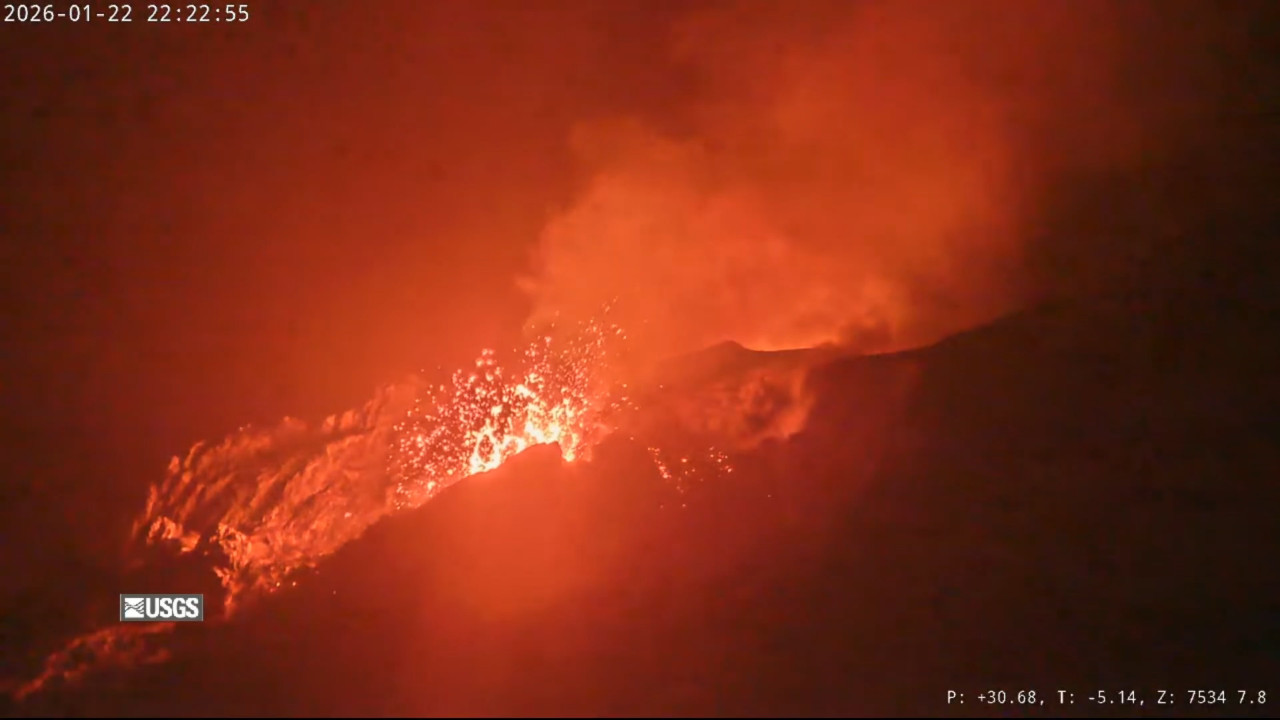
USGS webcam captures lava spattering at the summit overnight.
Four multi-hour periods of elevated micro-seismicity occurred over the past day. The first, and strongest, starting around 12:10 a.m. HST (just after midnight) and followed by smaller swarms beginning at 1:05, 2:10, and 8:35 a.m. HST this morning. However, none of the swarms had earthquake activity anywhere near as strong as the swarms earlier this week. Only five earthquakes were large enough to be located over the past 24 hours (all magnitude 1 or less) beneath the summit. Earthquake locations continue to be spread fairly widely beneath the summit region, as the swarms are related to migrating magmatic pressure within the summit region. Their impact on the next episode of lava fountaining, if any, is unknown at this time.
Since the end of episode 40, the UWD tiltmeter has recorded 16.9 microradians of inflationary tilt, with net 0.7 microradians of inflation over the past 24 hours. The period of elevated seismicity that started just after midnight over the past day coincided with brief deflationary tilt of about 0.8 microradians, with inflation resuming around 3 a.m. HST, after the third period of elevated seismicity. The final weak seismic swarm caused a tiny drop followed by flattening of the tilt at UWD.
For now, the USGS Volcano Alert Level remains at WATCH. The Observatory is monitoring all the activity at Kilauea, and continues to provide information on the situation.

by Big Island Video News
on at
STORY SUMMARY
HAWAIʻI VOLCANOES NATIONAL PARK - Elevated micro-seismicity continues in the summit region, and the next high lava episode could begin at any moment.