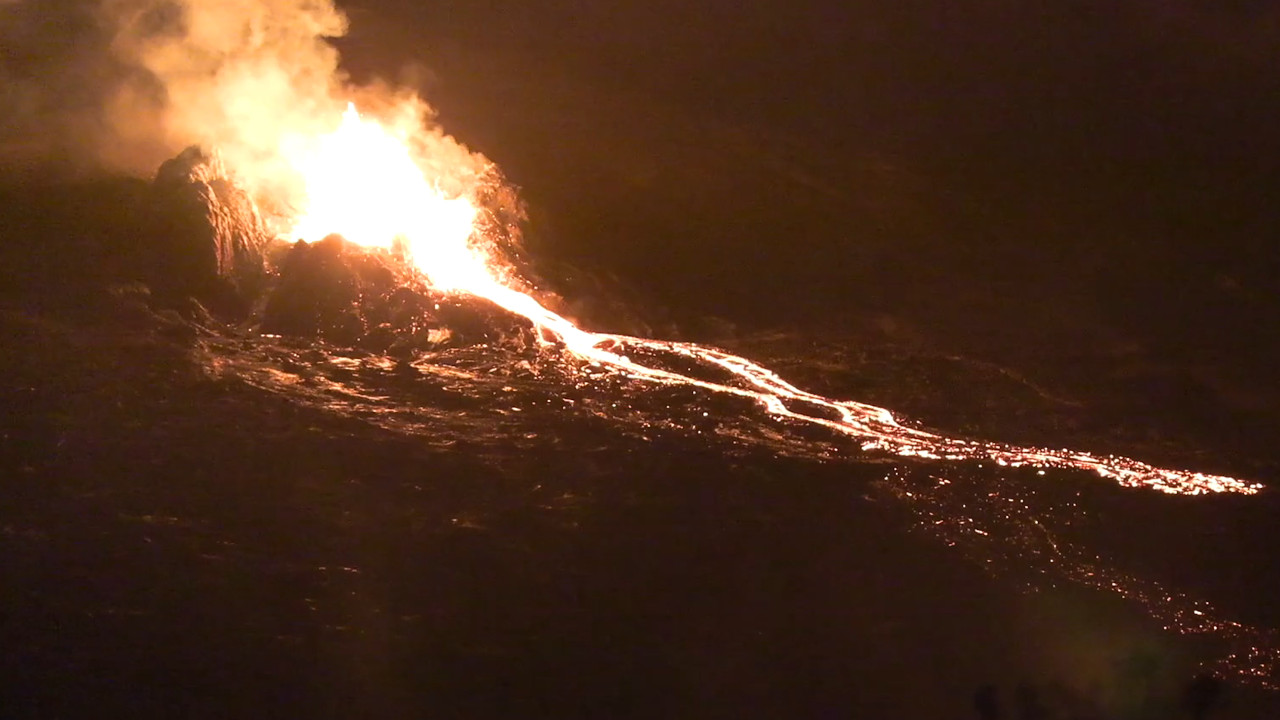
(BIVN) – Precursory lava activity is occurring at the summit of Kīlauea volcano, and scientists say the onset of high lava fountaining (episode 41) is most likely today, January 24th.
Lava overflows began from the north vent at 3:52 a.m. HST and continue. The USGS Hawaiian Volcano Observatory says micro-seismicity “continues in the summit region, but is much less energetic than earlier this week.”
Episode 41 lava fountains could possibly begin tommorrow, January 25, if inflation is interrupted, geologists added. “While seismic swarms continue, their intensity is reduced as well as their impact on reinflation of the summit,” the Observatory noted.
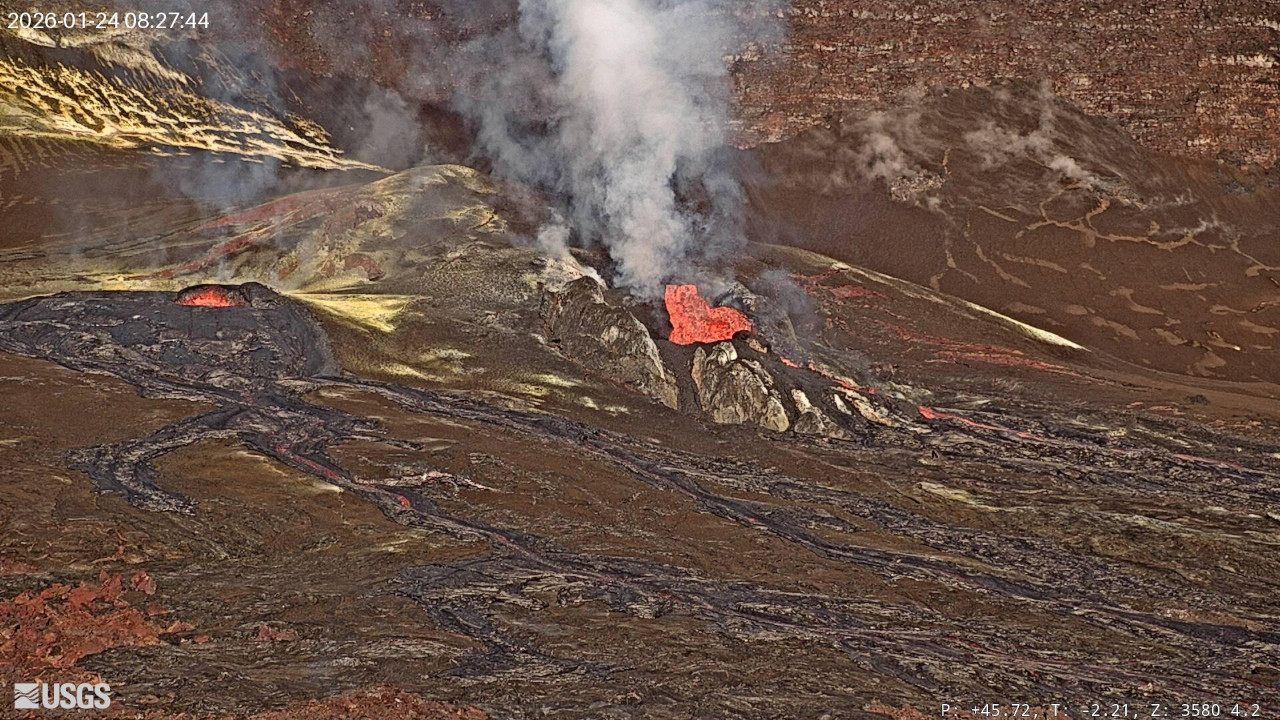
USGS webcam shows lava activity at the Kīlauea summit vents on Saturday morning
From the USGS HVO observations posted on Saturday morning:
Webcam views of Halemaʻumaʻu showed consistent strong glow from both the north and south vents, with frequent spattering at flames from the north vent until early morning. Spattering increased in intensity and the north vent began overflowing at 3:52 a.m. HST. Low fountains increased in height to 10-15 feet (3-5 meters) and effusion rate from the north vent at about 4:47 a.m. HST and overflows increased in size. The north vent has remained continuously active since the onset of overflows. The south vent has overflowed eight times this morning (4:11, 5:18, 6:13, 6:28, 6:40, 6:57, 7:14, 7:22 a.m. HST). The first four were short-lived and remained close to the vent. The four latest overflows were larger lasting 10-15 minutes and sent flows out onto the floor of Halemaʻumaʻu crater. Constant low-level tremor continues this morning.
There was only one very short period of elevated micro-seismicity occurred over the past day at around 8:30 p.m. HST January 23, but it had no impact on tilt rate at UWD. Only eight earthquakes were large enough to be located over the past 24 hours (all magnitude 1 or less) beneath the summit. Earthquake locations continue to be spread fairly widely beneath the summit region, as the seismicity is related to migrating magmatic pressure within the summit region. Currently, seismic events don’t appear to be having a direct impact on the eruption.
All images and video are courtesy the U.S. Geological Survey. A synthesized text-to-video voiceover was used in the narration for this story.
Since the end of episode 40, the UWD tiltmeter has recorded 18.5 microradians of inflationary tilt, with net 1.6 microradians of inflation over the past 24 hours. The one small period of micro-seismicity had no impact on the tilt at UWD.
The sulfur dioxide (SO2) emission rate from the summit was last measured on January 14 at 1,550 tonnes per day, which is within the typical range of 1,000 to 5,000 tonnes of SO2 per day observed during previous eruptive pauses. This is considerably lower than rates observed during lava fountaining episodes. Current winds at the summit are light and variable with plumes rising nearly vertically. The NWS predicts light winds from the east and southeast today, suggesting that plumes might move to the west and northwest if episode 41 begins today.

by Big Island Video News
on at
STORY SUMMARY
HAWAIʻI VOLCANOES NATIONAL PARK - Precursory lava overflows began overnight at the summit of Kīlauea volcano.