
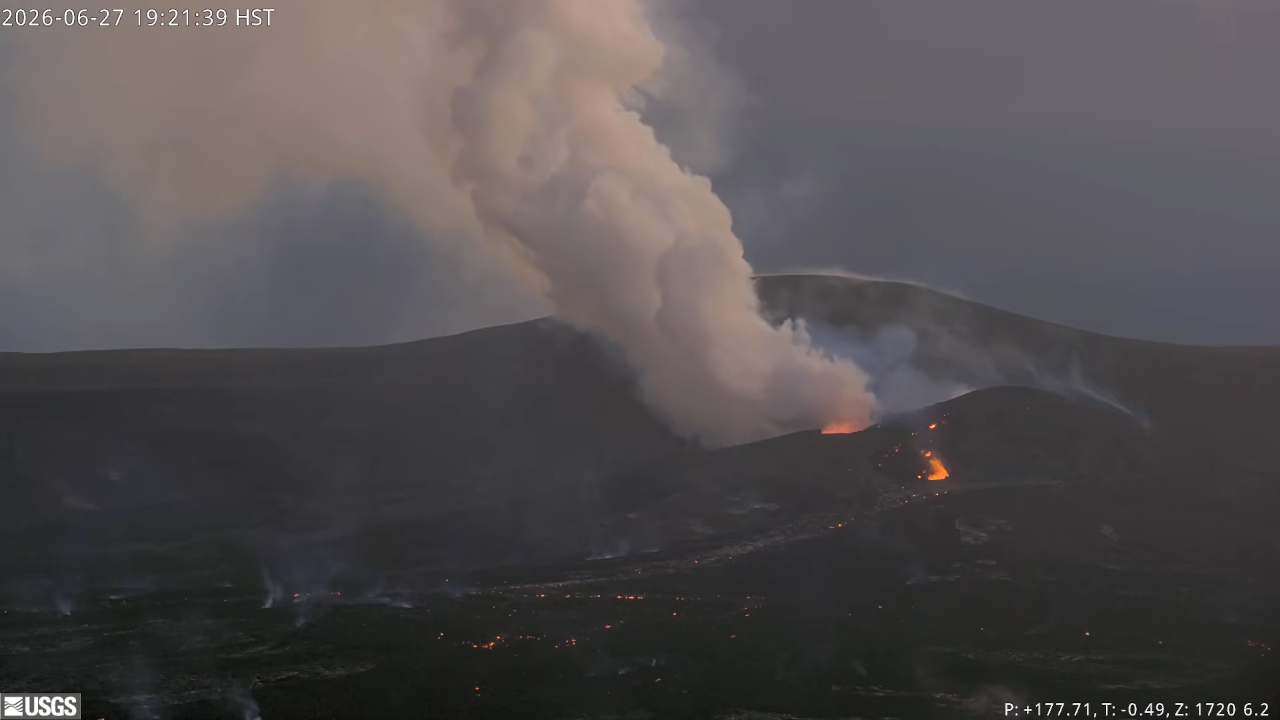

(BIVN) – Episode 50 in the ongoing Kīlauea summit eruption came to an end early Saturday evening, after 7 hours of continuous lava fountaining from the north vent.
The eruption is once again paused. The USGS Volcano Alert Level has been lowered from WATCH to ADVISORY, and the Aviation Color Code from ORANGE to YELLOW.
Tephra fall from the episode was restricted mostly to the closed area of Hawaiʻi Volcanoes National Park, southwest of the active vents in Halemaʻumaʻu. Some Pele’s hair was reported in the town of Pāhala.
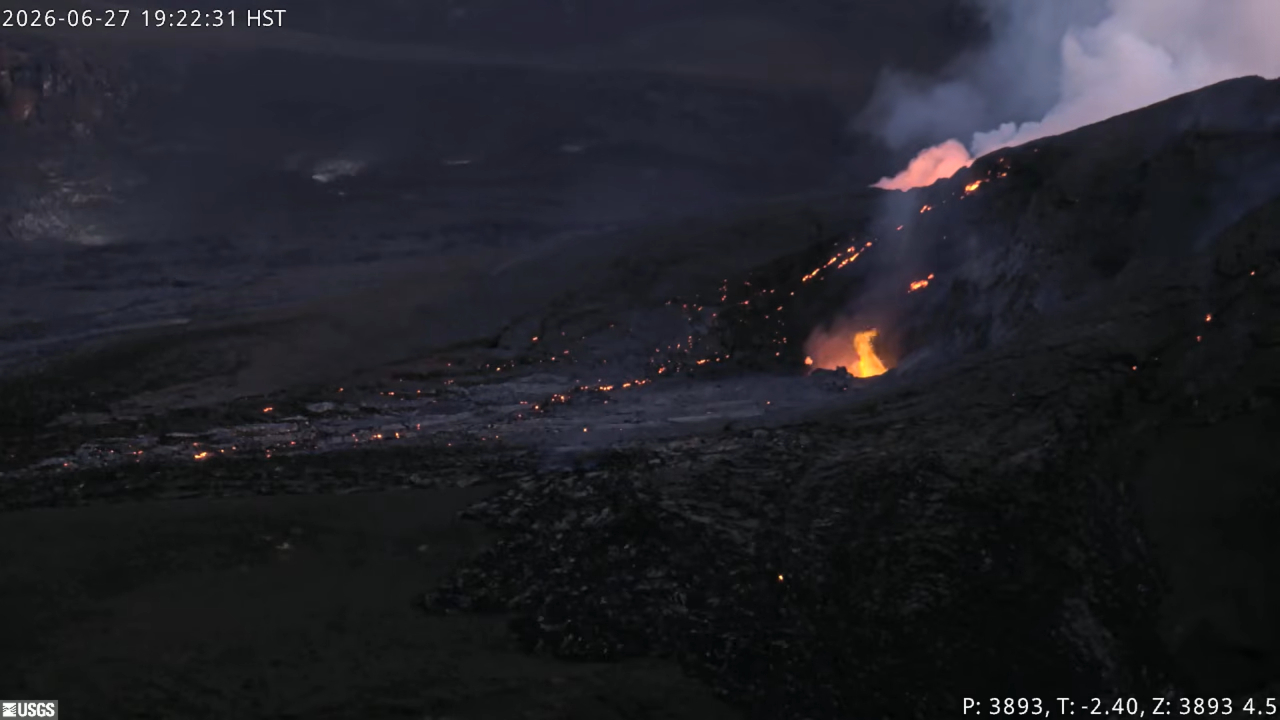
The USGS Hawaiian Volcano Observatory issued this “Episode 50 Chronology” following the event:
Lava fountaining episode 50 in Halemaʻumaʻu at the summit of Kīlauea began at 10:10 a.m. HST on June 27 and stopped abruptly at 5:10 p.m. HST, after 7.0 hours of continuous fountaining from the north vent. The last 2-3 minutes were marked by gas jetting from the north vent. The south vent never fountained during this episode. The instantaneous effusion rate peaked at about 430 cubic yards (330 cubic meters) per second between 10:30 and 11:00 a.m. HST, with an average effusion rate of 280 cubic yards (210 cubic meters) per second for the entire fountaining episode. An estimated 6.4 million cubic yards (4.9 million cubic meters) of lava erupted and covered about 50% of the Halemaʻumaʻu crater floor. The Uēkahuna tiltmeter (UWD) recorded about 15.3 microradians of deflationary tilt during episode 50. Seismicity followed the normal change in tremor patterns seen after most fountain episodes. There were no locatable earthquakes associated with the end of the eruption.
The initial signs of the approach of episode 50 began with brief periods of spattering associated with gas jetting and tremor spikes from the south vent that were first observed at 7:22 p.m. on the evening of June 24. These intensified over the next day and were joined by small spattering events from the north vent. Around 3:00 a.m. HST on June 26, activity from both the south and north vents increased, leading to the first precursory overflows. Episode 50 lava fountaining began a little over 25 hours after the onset of very short (<50 feet or 15 meters) precursory lava overflows at 8:50 a.m. HST from the north vent on the morning of June 26. The initial overflow lasted about 13 minutes and was followed by another north vent overflow from 9:25 to 9:40 a.m. HST. This was followed by an approximately 21-hour long break in eruptive activity only punctuated by brief episodes of spatter associated with gas jetting and tremor spikes from the south vent.
Eruptions of precursory lava flows resumed from the north vent at 6:56 a.m. to 7:15 a.m. HST on the morning of June 27. This was followed by another large precursory overflow that extended well onto the crater floor that began at 8:38 a.m. HST. The second precursory flow lasted for over an hour until the vent began to drain back at 9:41 a.m. HST. The drainback was associated with multiple large tremor spikes and led directly into the next precursory overflow at 9:46 a.m. HST. Dome fountains gradually increased from about 15 feet (5 meters) high to over 50-100 feet (15-30 meters) high by 10:10 a.m. HST as increasing tremor and rapidly dropping tilt marked the onset of episode 50 fountaining.
The north vent lava fountain reached a peak height of around 1,000 feet (300 meters) just after 11:30 a.m. HST and produced significant heat and ash, feeding a plume cloud that reached a maximum height of about 18,000 feet (5,500 meters) above sea level based on radar data and verified by webcam images. Winds were out of the northeast for most of the eruption causing the plume to move to the southwest during the most energetic part of the eruption. The National Weather Service issued an updated Special Weather Statement (SWS) at 11:28 a.m. HST discussing the possibility of ash and Peleʻs hair falling in the Kaʻū district near the towns of Pāhala and Naʻalehu. The plume track largely remained within Hawaiʻi Volcanoes National Park with most tephra falling in the closed area. The more distal part of the plume track roughly followed the Southwest Rift Zone and USGS field crews found a light fall of Peleʻs hair in the town of Pāhala around 1:30 p.m. HST. By this time the north vent fountain had dropped to 700 feet (210 meters) in height and the plume dropped slightly to 17,000 feet (5,000 meters) above sea level. The fountain and plume heights continued to gradually decrease in height to about 330 feet (100 meters) and 10,000 feet (3,000 meters) above sea level by 4:50 p.m. HST. Then the episode ended at 5:10 p.m. HST. No ash or tephra was reported from any other populated areas except for Pāhala during the eruption.
