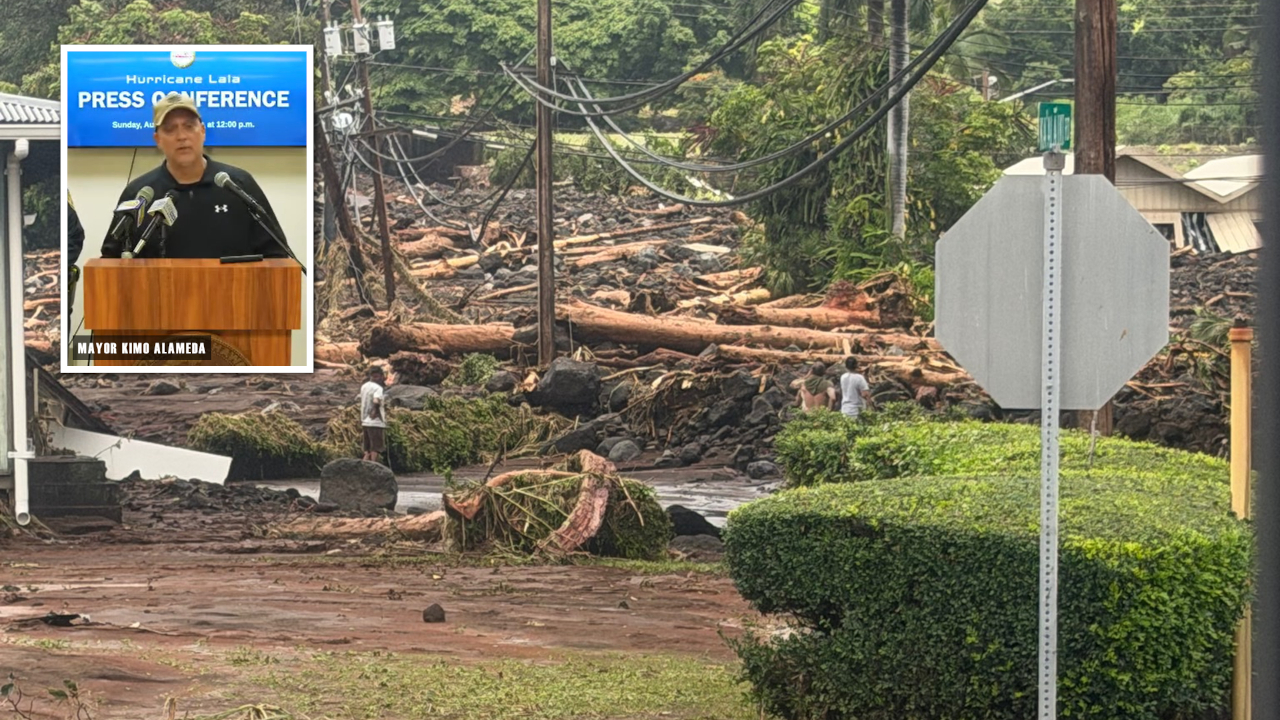

The following is a transcript of the above video, which features a portion of the August 16, 2026, Hawaiʻi County news conference concerning Hurricane Lala:
MAYOR KIMO ALAMEDA: Good afternoon, everybody. Um, so I got to tell you this. Weather conditions are improving with some rain and scattered showers around the island, and that’s the good news, all right. The bad news is that we just experienced a Category 1 hurricane with 80 miles an hour winds and flash floods, especially on the south side, like I’ve never seen before, okay. This storm progressed.
All right, we kept seeing a progression of issues from 5 inches of rain to 10 inches to 15 to 20, right? 10 road closures, then 30 road closures, all right, 15,000 people without electric, and then 30,000, now 65,000 people don’t have electric. I mean, all of this devastation, and right now, there’s no reports of storm-related fatalities, and we pray that remains true.
In preparing for this hurricane, we opened up shelters on Friday at 6 p.m. A month prior, we cleaned culverts, flood channels, water canals, we trimmed trees, everything we thought would help as if we were experiencing another Kona (low), okay. Um, and, and, and this storm was especially critical for the south side, which, stronger than ever, flash floods, like I said, like we’ve never seen. Our fire chief will come up shortly, and he’ll talk a little bit about the preparations that we’ve had on the first responder side, which we’ve almost doubled in preparation. So we sought support from the National Guard, who provided high-water vehicles that were positioned in Kealakekua, Waimea, Hilo, and Nāʻālehu. I mean, we were ready, okay.
And almost every part of the island was impacted in some way. All right, and we are going to assess those needs today and every day this week.
The biggest impacts were in the Kaʻū district. I spoke to the governor this morning, and he sends deep concern and support, as Kaʻū is his early career hometown. You know, his support and relationship with the federal government is critical, and he assured me that whatever we need – financially – to rebuild, he and I will fight tooth and nail for it.
And I can share that search and rescue operations were conducted last night in response to emergency calls and flooded roadways. Targeted Civil Defense alerts were put out in that area to tell people to move to higher ground or to stay in place if they are safe.
So today’s reports came in, told us 41 occupants are at the Nāʻālehu shelter, about 13 at the Pāhala shelter, and about 15 sheltered in place at a neighbor’s home in Nāʻālehu. Others chose to stay in their homes because it was deemed safe to them. So, part of our first response is getting access to that area. And right now, Public Works and our deputy directors assured us that their crew, along with the state, is working together, and we’re going to get some help from the National Guard as we speak to gain access, especially for the Pāhala residents.
So, we have a great team, you folks. Um, I promise to do the best we can as a team with the resources that we have to alleviate the burdens that were caused by this horrible hurricane. With that being said, I’d like to ask the fire chief to say a few words. Chief?
ACTING FIRE CHIEF DAN VOLPE: Thank you, Mayor Roth. Dan Volpe, temporary fire chief. And I just want to say, first of all, this is an amazing testament to the resiliency of the Big Island. Leading up to the storm, the Fire Department was able to position resources across the island, and we increased staffing. We increased an extra med ambulance for the Pāhala region, understanding where the primary impacts will be. We do make adjustments, and like the mayor mentioned, we work with the National Guard. We get high-water vehicles as well as resources for helicopters. We get rain—at the same time you get rain, we get wildfire conditions. So managing both threats at the same time becomes a challenge. But working with our partners, working with the County and the mayor, and the National Guard, we’re able to kind of meet that challenge. We had significant impacts. Last night, overnight. Continuing. Again, resiliency of the Big Island. We had very limited amounts of injuries. We are very grateful. We’re grateful to those who stayed prepared, who stayed sheltered. We continue to operate.
Currently, there’s some communities that are isolated. We continue search and rescue missions throughout those communities, and we’ll continue to do so until we have cleared that every area has been searched. At this time, we have no additional reports of anyone missing. Our efforts will continue to replace services that have been cut off or lost at this moment. Thank you.
ALAMEDA: Thank you, Chief. You know, your team is wonderful. You’ve been with us from day one, and I got to tell you, I mean, our first responders are bar none. I appreciate you and your team’s work. I’d like to ask our police chief Reed Mahuna to say a few words. Chief.
POLICE CHIEF REED MAHUNA: Thank you, Mayor. Uh, thank you. I just have a few quick remarks. You know, on behalf of the Hawaiʻi Police Department, thank you, Hawaiʻi Island, for showing strength, patience, and aloha that has carried this community through this difficult time following Hurricane Lala. We know many families are still facing challenges and difficult conditions, and we’re grateful to everyone who checked on neighbors, followed emergency guidance, and supported one another.
As recovery work continues, I ask everyone to please stay off the road unless travel is absolutely necessary, especially in our hard-hit areas. Please avoid sightseeing or traveling to damaged locations so Public Works, State Highways, HELCO, first responders, and other recovery crews can safely reach and repair these sites to restore essential services as quickly as possible. Your cooperation helps keep our community safe and allows crews to do their work without unnecessary delay. Again, mahalo for your resilience, your patience, and your continued care for one another. Thank you very much.
ALAMEDA: Thanks, Chief. And it is true. I mean, you know, I’ve been saying it all along. One of the reasons why our first responders didn’t have to go out so much is because you heeded to our instructions of staying off the roads. And we really appreciate that. So, thank you so much for that. Yet, we still experience some hardships, and there’s some burdens that our families are going through right now because of this hurricane. Very fortunate, our Civil Defense, our Emergency Operations Center, the timing is perfect for us. I feel blessed to be able to introduce our next speaker, and he is Mr. Darryl Oliveira, our acting administrator for Civil Defense. Mr. Oliveira, would you like to say a few words?
HAWAII COUNTY CIVIL DEFENSE ADMIN, DARRYL OLIVEIRA: So, I just want to complement a few things that the mayor shared, as well as what the chiefs have shared. So one is, our Civil Defense office has been active, full-level activation, since Thursday evening when the system was upgraded to a hurricane. Prior to that, we were on partial activation, which means we have key stakeholders in the room poised and ready to deploy, but also gathering information so that we can provide the public or community with good information to make well-informed decisions for your own safety. And I have to say thank you again, like the chief said, for people cooperating with the messages going out, staying off the roads, prepping as we’ve always asked, and being patient with things. The other thing is that, in addition to the messaging that we try to put out, our job at Civil Defense is also to coordinate and facilitate the acquisition of resources to support our stakeholders and our partners. So that includes bringing in the non-profits and our community organizations to supplement and complement what the front line has been doing, all in an effort to make sure we keep our community safe.
And as we move into recovery, we will need the community’s help there, again. As the mayor said, he and I did an overflight this morning of the Kaʻū area. We actually flew from Hilo through Puna. It gave us some reassurance that we didn’t see the type of wind damage that we saw with Iselle through these areas, but definitely the worst flooding damage that I’ve seen out in the Kaʻū area. So, we will have long-standing road challenges, bridge challenges, access issues for residents that might be isolated. And again, our role at Civil Defense is to provide the resources, coordinate the response and recovery efforts, as well as to then facilitate moving forward with possible relief and assistance from our federal and state governments. Thank you.