
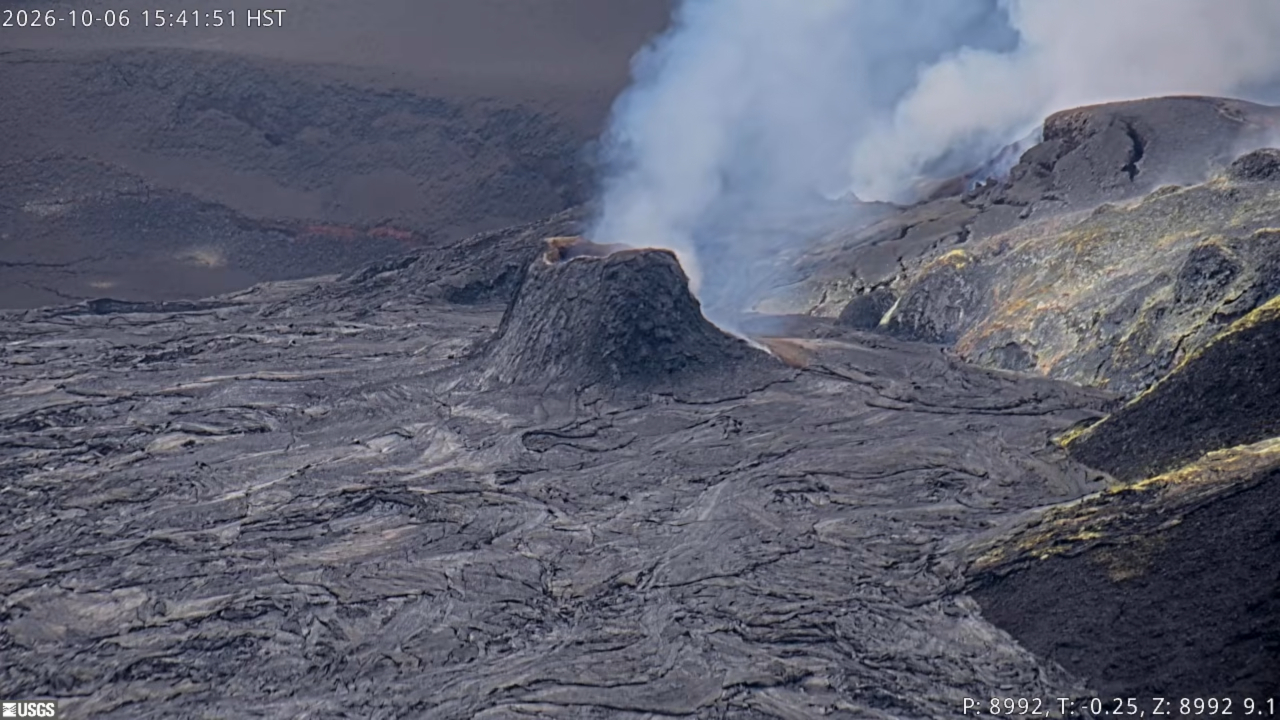

(BIVN) – The alert level for Kīlauea volcano is at WATCH, as the magma summit intrusion that happened the night of September 30 to October 1 has not reactivated.
Minor spattering was seen overnight at both north and south vents within Halemaʻumaʻu, along with strong glow and flaming. Summit tiltmeters recorded minor inflation.
No anomalous seismic activity or deformation has occurred outside of the summit region, the USGS Hawaiian Volcano Observatory reported Tuesday, and no significant activity has been noted along Kīlauea’s East Rift Zone or Southwest Rift Zone.
“Episode 55 fountaining remains a possibility during the ongoing Kīlauea summit eruption,” the Observatory wrote. “It is also possible that intrusive activity below Kīlauea summit caldera could resume and potentially lead to the eruption of lava in a new location within the caldera.”
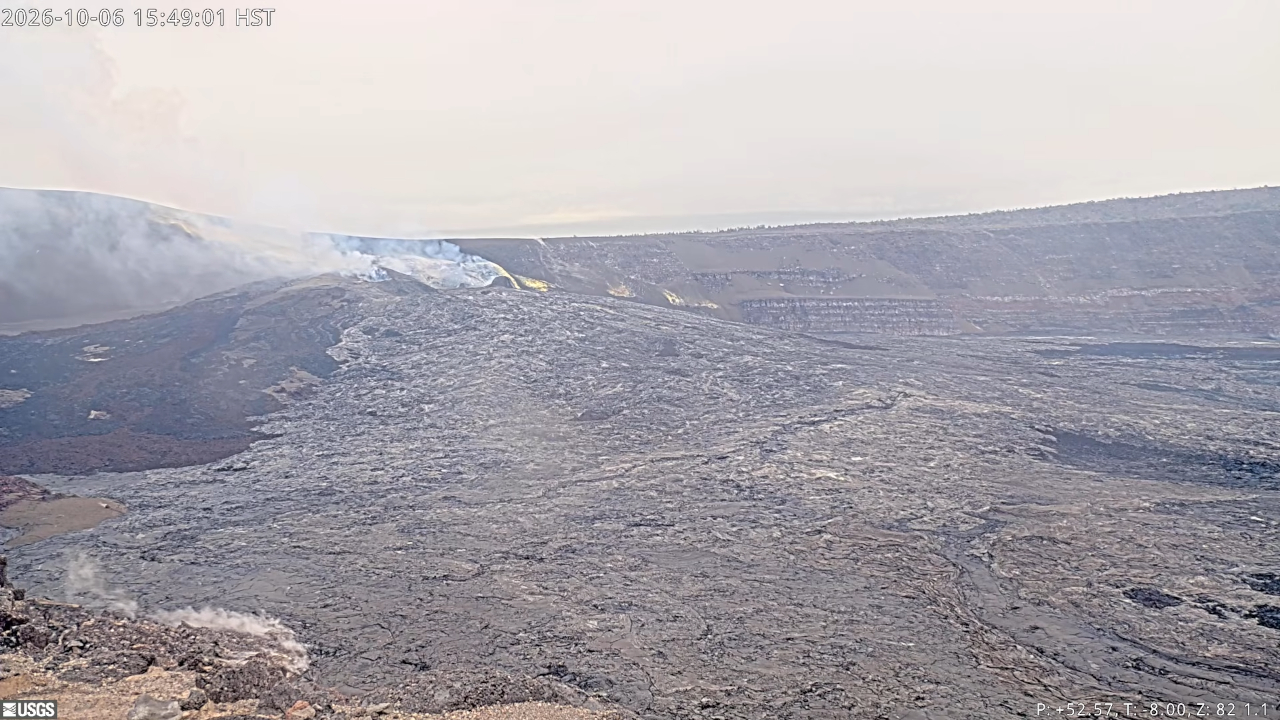
From the USGS HVO on Tuesday morning:
Summit Observations:
Both north and south vents had minor spattering overnight, along with strong glow and flaming. An intrusion underneath Kaluapele, the Kīlauea summit caldera, started the afternoon of September 30 and ended on October 1 at around 4 a.m. H.S.T. South vent only had one overflow after the intrusion, ending just before 6 a.m. on October 1, and north vent’s last overflow was also on October 1, just after 6 a.m. H.S.T.
Earthquakes activity below Kaluapele has decreased following the intrusion. In the past 24 hours, there was 1 shallow earthquake located across the summit region. The Uēkahuna tiltmeter (UWD) recorded approximately 0.6 microradians of inflation.
During inter-episode pauses, the sulfur dioxide (SO2) emission rate from the summit typically varies between 1,000 and 5,000 tonnes per day. Winds are currently forecast from the northeast.
Rift Zone Observations:
Rates of seismicity and ground deformation remain low in the East Rift Zone and Southwest Rift Zone. SO2 emissions from the East Rift Zone remain below the detection limit. No significant ground deformation was recorded in either rift zone.
Analysis:
Monitoring data indicate that a shallow intrusion occurred the afternoon of September 30 through to the morning of October 1 underneath Halemaʻumaʻu. The intrusion did not reactive in the past 24 hours, although conditions can change rapidly, including eruption from a new vent with little or no seismicity or deformation.
In the past 24 hours, there was minor spattering from both north and south vents. Forecast windows for a potential episode 55 can no longer be modeled due to the irregular changes in inflation and deflation. The north vent has produced the last 11 high fountain events (episodes 44–54). It is not possible to say with certainty that this activity will lead to the onset of another fountain event at this time, although conditions remain favorable.
Because the summit system remains active and highly pressurized, the two most likely possibilities are that activity continues at the north-south-west vent complex, or it activates another existing weak crack system in the summit region. Neither of these events are likely to produce a strong seismic precursor, so the alert levels have been left at ORANGE/WATCH as the volcano continues to “exhibit heightened unrest with an increased potential for eruption”.
