
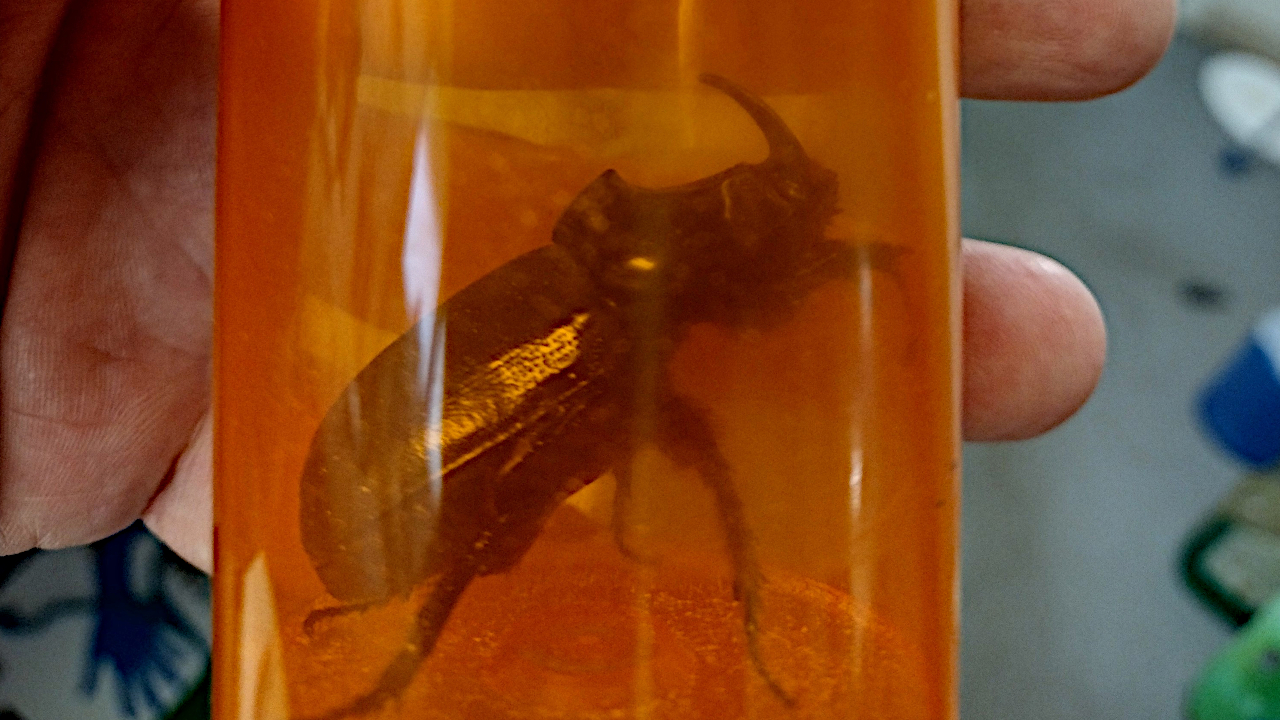

(BIVN) – For the first time, a coconut rhinoceros beetle (CRB) was discovered in the Puna district on Hawaiʻi island.
The Hawaiʻi Department of Agriculture and Biosecurity reports the live, male CRB was recently found in a trap in the Kurtistown area. The Hawaiʻi Department of Agriculture and Biosecurity (DAB) notified partner agencies about the latest finding.
The department says biosecurity officers will set up a one-mile perimeter to search for any other CRB and possible breeding grounds. More traps will be put up in the area where the beetle was found.
The invasive CRB was first discovered in Hawaiʻi in late 2013. It took ten years for the beetle to make its way to the Big Island. The CRB was found for the first time on the west-side of Hawaiʻi island in October 2023, when the insect was detected in the Waikoloa area. The first CRB reported in East Hawaiʻi was spotted near the Hilo Airport in 2025.
From the DAB news release issued on Friday:
CRB is a serious pest of palm trees, primarily coconut palms, as the adult beetles bore into the crowns of the palms to feed on the tree’s sap. New unopened fronds are damaged in this way and when fully opened, may break and fall unexpectedly. If CRB kill or damage the growing point of the palm, the tree may die. Secondary fungal or bacterial pathogens may also attack the wounds caused by CRB, thereby also killing the tree. CRB is a major pest of palms in Guam, India and the Philippines, as well as many other areas across the South Pacific.
Natural enemies of CRB include pigs, rats, ants and some beetles, which may attack CRB eggs, larvae, pupae and adults. They may also be killed by two diseases, a fungus and a virus; however, both are not known to occur in Hawaiʻi.
Residents are encouraged to go to the CRB Response website at: crbhawaii.org to learn more about how to detect the signs of CRB damage, how to identify CRB life stages and how to report any suspected signs of damage or beetles/grubs via the CRB reporting feature. Possible CRB can also be reported on the PEST HOTLINE at 643-PEST (3787).
