
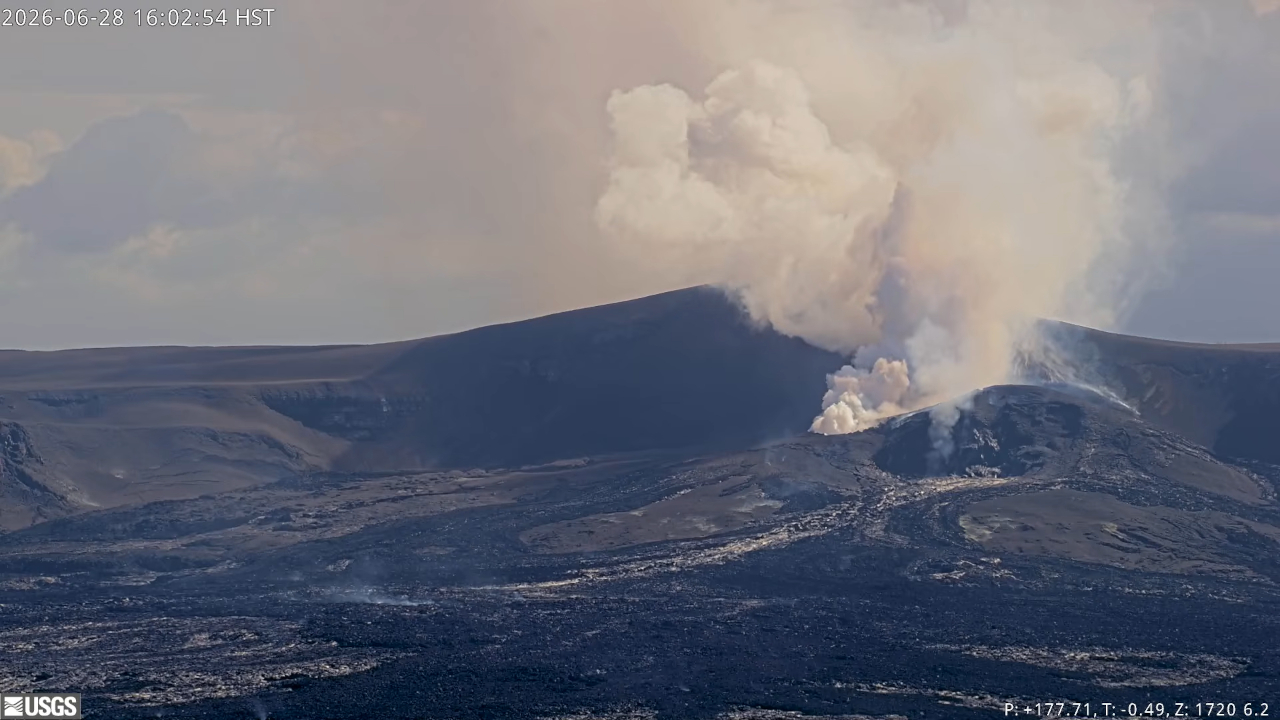

(BIVN) – The eruption at the summit of Kīlauea volcano is once again paused following the high lava fountains of episode 50 that occurred on Saturday.
On Sunday, the USGS Hawaiian Volcano Observatory reported “re-inflation indicates another episode is likely between July 6 and July 12, more data are needed to refine the forecast.”
From the daily update posted by the Observatory:
Bright glow and flames were visible from the south vent in Halemaʻumaʻu overnight, with intermittent glow visible from the north vent. Flames continue to be seen from the south and north vent this morning. Degassing plumes from both vents are being blown toward the southwest. Numerous bright, shifting incandescent spots were visible overnight from lava flows that erupted onto the floor of Halema’uma’u crater and the slopes of the active vents during episode 50. Strong glow was visible from cracks and around the edges of these flows and from overturns and breakouts that exposed still-molten lava. One large lava flow on the north side of the crater continued to creep slowly away from the north vent towards lower parts of the crater floor under its own weight as it cooled. Cooling and gravitational slumping of lava and tephra deposits on the slopes of the north vent is also occuring. There were several instances last night of incandescent blocks slumping toward the north vent, sometimes cascading directly into the vent. Some of these cascades caused flames to erupt from the vent after they fell inside. Slow movements from cooling lava flows and gravity induced slumps on the vents is expected to continue in the coming days and nights.
Low-frequency seismic pulsing began with the cessation of episode 50 and continues this morning, which is typical during the onset of pauses between eruptive episodes. There were eight earthquakes within Kaluapele (Kīlauea caldera) in the past 24 hours, the largest of which was a M1.8 beneath the south rim of Halemaʻumaʻu.
Kīlauea summit deflation totaled 15.3 microradians during episode 50. Once the episode ended, inflation resumed and has since recovered 2.2 microradians of tilt at the summit tiltmeter at Uēkahuna (UWD).
The sulfur dioxide (SO2) emission rate from the summit is likely now varying within a typical range of 1,000 to 5,000 tonnes per day.
