
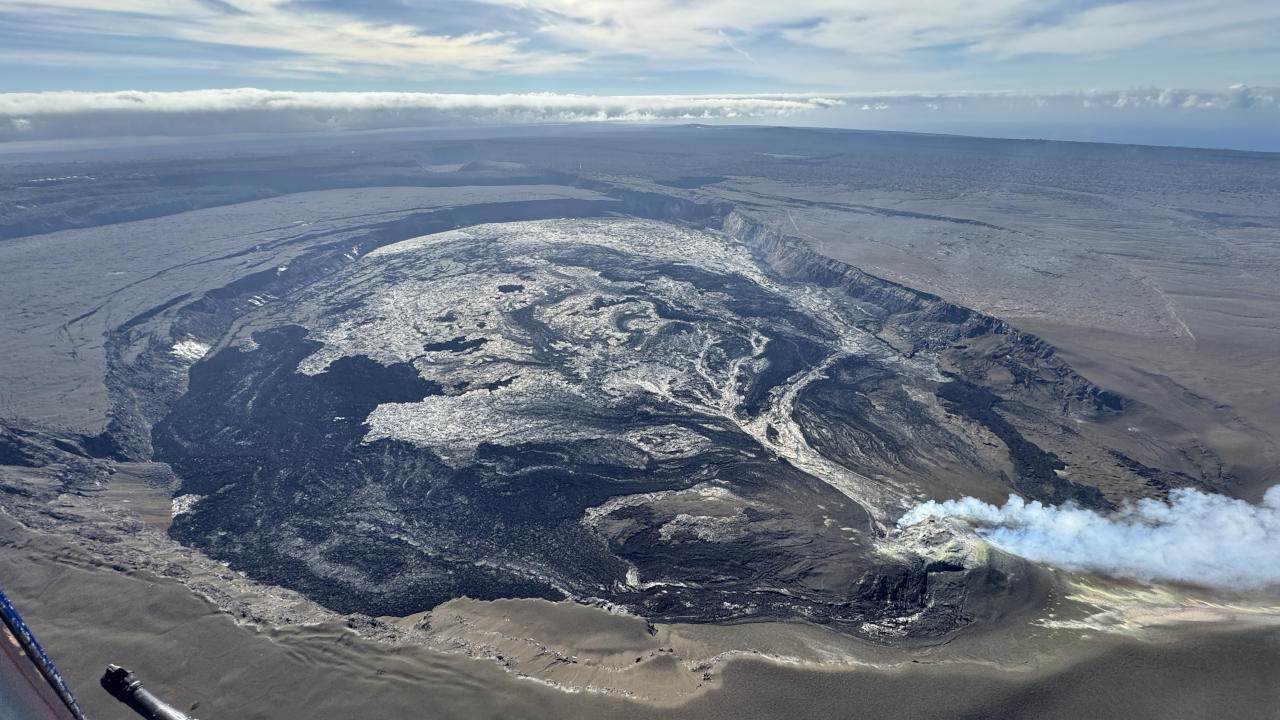

(BIVN) – The ongoing eruption at the summit of Kīlauea volcano remains paused, although the next episode of high lava fountaining is expected as early as today.
Rapid inflation began Tuesday morning. The USGS Hawaiian Volcano Observatory says 3.9 microradians of inflationary tilt were recorded by the Uēkahuna (UWD) tiltmeter in the past 20 hours. Inflation rates slowed Wednesday morning.
“Inflation models forecast the start of episode 53 fountains sometime later today, August 12, through Friday, August 14, depending on inflation rates,” the Observatory reported on Wednesday.
From the USGS HVO daily udpate:
Summit Observations:
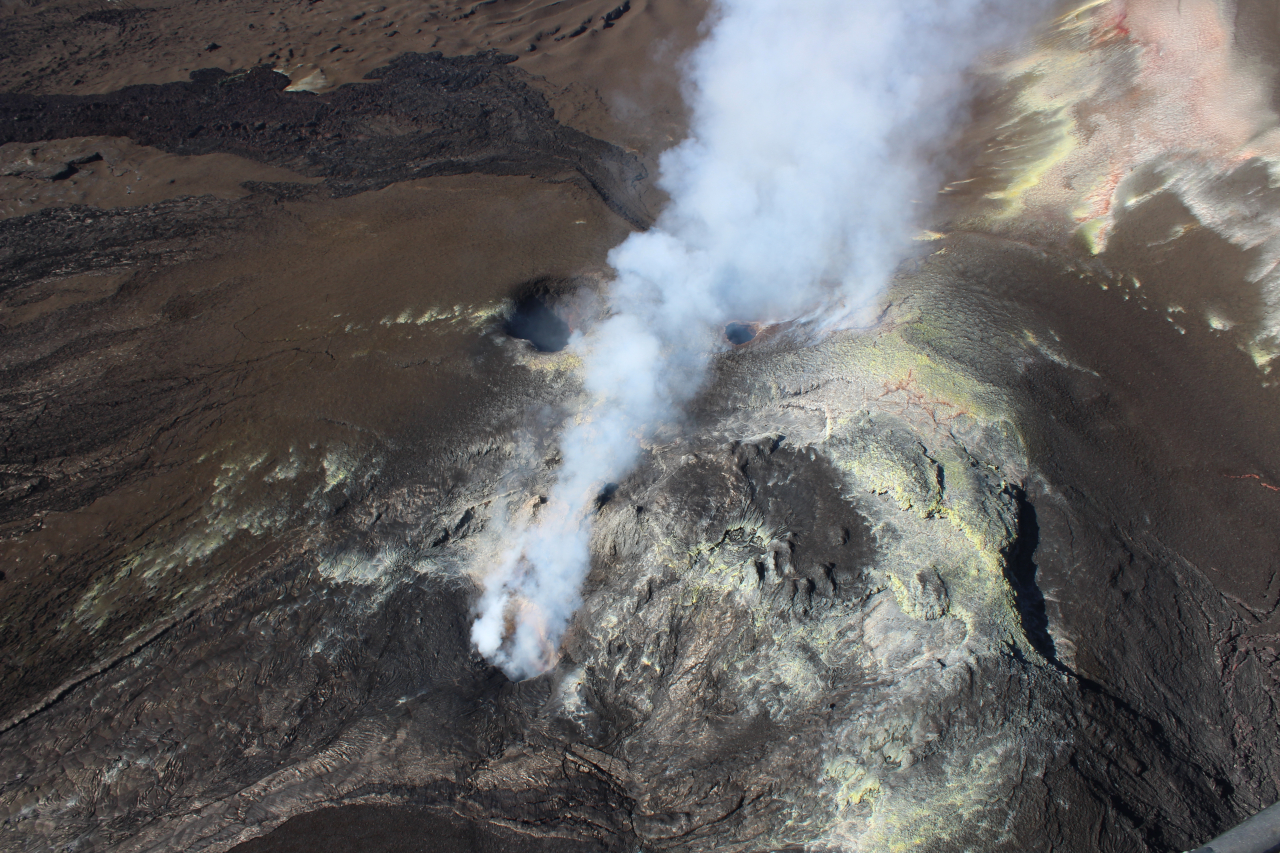
In the early evening, continuous weak to moderate glow was observed from the north vent, while the south vent remained dark. Around 8:45 p.m. HST, weak glow began to be visible from the new collapse (formerly called the new crack or fissure until overflight photos yesterday showed it to be a collapse). Glow strengthened to moderate from both north vent and the new collapse just before 10 p.m. HST, but the south vent remained dark. In the early morning hours, glow gradually brightened, becoming brightest with the return of tremor bursts associated with gas pistoning at 4:00 a.m. HST. In addition to bright glow, large flames were observed every 5-10 minutes from the collapse, correlating with tremor bursts. Moderate glow also returned to the south vent during these events.
Low-moderate tremor continued overnight with the addition of periodic tremor bursts beginning at 4:00 a.m. HST. The tremor bursts were associated with strong glow and flames from the new collapse and the return of glow to the south vent, all of which suggest a return to gas pistoning behavior. One very small (less than M1.0) earthquake was detected near the center of Halemaʻumaʻu crater over the past 24 hours.
The Uēkahuna (UWD) tiltmeter recorded the onset of rapid inflation beginning at 10:30 a.m. HST yesterday, gaining 3.9 microradians of tilt overnight before slowing down around 6 a.m. HST this morning. The UWD tilt meter has regained 13.9 microradians of the 14.4 microradians of deflationary tilt lost during episode 52. An offset in tiltmeter data at 5:48 pm yesterday is due to a M5.2 earthquake occurred near Kamaʻehuakanaloa.
During inter-episode pauses, sulfur dioxide (SO₂) emission rates typically vary between 1,000–5,000 tonnes per day. Winds are currently from the northeast and are expected to remain that way until sometime Friday when weather may be influenced by the approaching tropical disturbance.
Rift Zone Observations:
Rates of seismicity and ground deformation remain low in the East Rift Zone. SO2 emissions from the East Rift Zone remain below the detection limit.
Seismicity has returned to normal background in the Southwest Rift Zone after a swarm of 18 small earthquakes were recorded Monday morning between 4:00 – 6:20 a.m. HST.
Analysis:
The abrupt switch from summit deflation to inflation at the end of episode 52, along with continued glow from the vents, indicates that episode 53 fountaining is likely. Inflationary tilt since the end of episode 52 was interrupted by deflation from August 2 to 3. A second deflationary step began at 6:00 a.m. HST Friday and continued through Tuesday at 10:30 a.m. HST when rapid inflation began. The rapid inflation gained nearly 4 microradians in the past 22 hours regaining most of what was lost during the episode 52 fountain event. However, inflation slowed at about 6 a.m. HST and is continuing at a very slow rate. Small steps of slow to no inflation preceded the onset of episodes 51 and 52 fountains. The combination of prior deflations and tilt-based models have been used to forecast the onset of episode 53 fountaining between later today, August 12 through Friday, August 14. The forecast window may be adjusted if summit tilt rates continue to change.
Kīlauea has been erupting episodically since December 23, 2024, from two vents (north and south) in Halema‘uma‘u. Lava fountaining episodes, which generally last for less than 12 hours, are separated by pauses that can be longer than three weeks.
HVO continues to closely monitor Kīlauea and is in contact with Hawai‘i Volcanoes National Park and the Hawai‘i County Civil Defense Agency about eruptive hazards.
