
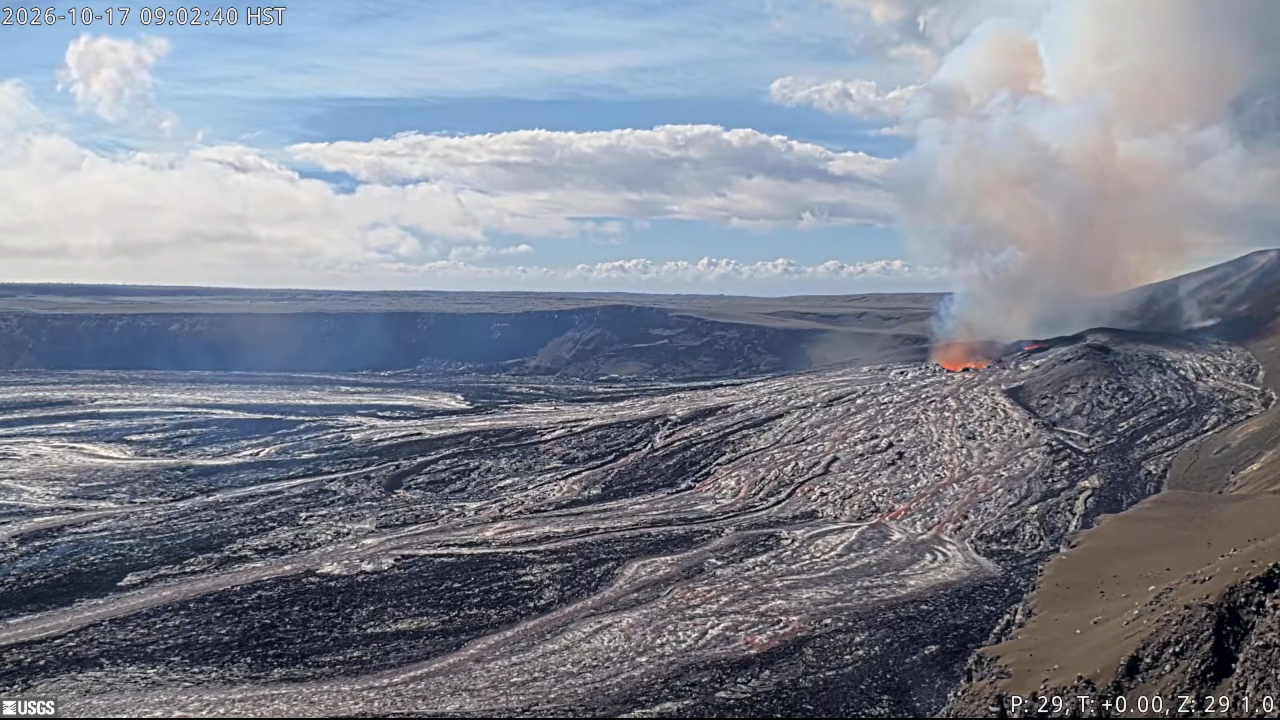

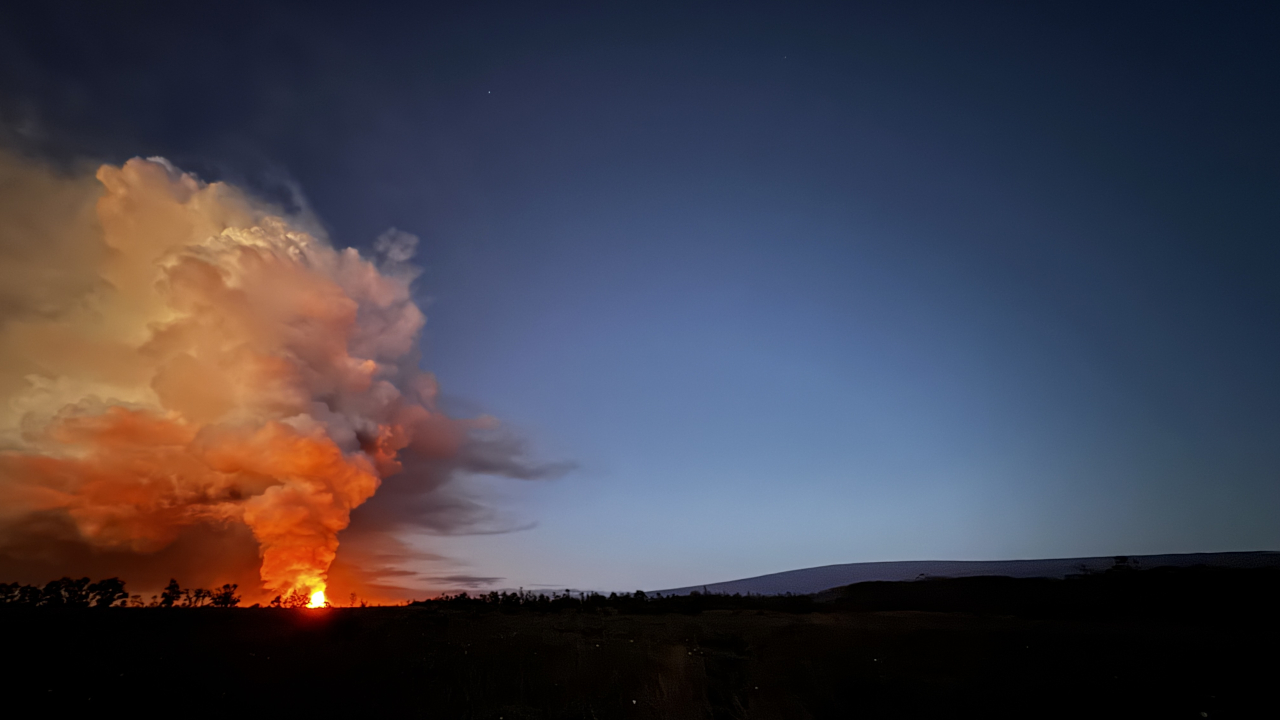
(BIVN) – Episode 55 in the ongoing Kīlauea summit eruption ended at 9:03 a.m. Saturday, after only 6 hours of continuous lava fountaining from the north vent.
The USGS Volcano Alert Level has since been dropped from WATCH to ADVISORY and the Aviation Color Code from ORANGE to YELLOW.
The north vent lava fountain reached a maximum height of 720 feet during the short morning episode.
Plumes of volcanic gas and tephra reached as high as 25,000 feet (7000 m) above sea level but dropped rapidly to under 20,000 feet above sea level. Tephra fall was expected to occur southwest of the vent area within the closed area of Hawaiʻi Volcanoes National Park. The USGS Hawaiian Volcano Observatory said traces of fine ash and Peleʻs hair were possible in Pāhala and other communities to the southwest in Kaʻū.
Summit tilt followed the expected pattern: Rapid deflationary tilt began at 3:19 a.m. when the episode began. Inflationary tilt started when the episode ended.
“The vigorous overflows from the south vent starting yesterday morning and joined by the north and west vents late last night appear to have purged the system of older degassed magma and allowed more water-rich magma into the conduit to trigger episode 55 fountaining from the north vent,” the Observatory noted in a post-episode report.
From the Observatory:
Summit Observations:
Lava fountain episode 55 in Halemaʻumaʻu at the summit of Kīlauea began at 3:19 a.m. HST October 17, 2026, and ended at 9:03 a.m. HST on October 17, 2026, after about 6 hours of continuous fountaining from the north vent.
The onset of episode 55 fountain began at 3:19 a.m. HST as fountains from the north vent began to rapidly increase in height. Maximum fountain heights of 720 feet (220 m) were recorded between 4:50 and 5:10 a.m. HST with the plume cloud reaching up to 25,000 feet (7500 m) above sea level (a.s.l.) during that time. The fountain dropped quickly back to 650 feet and then to 500 feet by 7:00 a.m. HST this morning and was down to about 300 feet (100 m) high by 8:00 a.m. HST. Likewise, the plume cloud dropped to under 13,000 feet (4000 m) a.s.l. by 7:30 a.m. HST. Waning behavior was noted at around 8:50 a.m. and by 9:03 a.m. fountaining had ended. This was accompanied by a return of inflationary tilt patterns and a decrease in summit RSAM. The instantaneous effusion rate peaked at about 1000 cubic yards (770 cubic meters) per second at approximately 5:00 a.m. HST, with an average effusion rate of 380 cubic yards (290 cubic meters) per second for the entire fountaining episode. Preliminary estimates indicate about 9 million cubic yards (7 million cubic meters) of lava erupted during this episode. The repose period leading up to episode 55 was the longest and most complex since the eruption began on December 23, 2024. Initial precursory flows erupted on September 7 preceding episode 55 fountains by 39 days. The next longest period of precursory activity was 6 days. The repose period prior to episode 55 included a series of new vents opening up on September 14-16 along the base of the cliffs on the west side of Halemʻamaʻu as well as an intrusion beneath the northwestern part of Kaluapele September 30 to October 1.
Lava flows flooded the western part of Halema’uma’u crater and by 8:30 a.m. HST were covering 75% of the crater floor. Fountaining was preceded by continuous overflows from the south vent that began at 5:56 a.m. HST on October 16 and continued until the start of fountaining from the north vent early this morning. Intermittent overflows began from the north vent at 6:11 p.m. HST on October 16 and after 6 small flows started to erupt continuously at 11:35 p.m. last night. Rare overflows from the west vent began at 10:49 p.m. HST last night, with three small overflows preceding the onset of continuous eruption of lava at 2:23 a.m. HST. The north vent fountains doubled in size right around 3:19 a.m. HST at the onset of episode 55, while the south and west vents had small dome fountains that continued to feed flows. The south vent overflows ended at 3:55 a.m. HST while the west vent fountains and overflows were drowned by the north vent at 4:13 a.m. HST.
Tremor had been continuous and steady throughout most of yesterday but began to increase around 2:45 a.m. HST this morning. By 3:19 a.m. HST background tremor measured by RSAM indicate that the intensity of tremor had doubled at the same time rapid deflationary tilt started at the summit. This along with the doubling of the north vent fountain height defined the onset of episode 55 fountaining even though the fountain was less than 100 feet (30 m) high at the time. Tremor rapidly increased to about 10 times background by 4:30 a.m. HST about 20 minutes prior to the fountain reaching its maximum height of 720 feet. Tremor slowly dropped since that time, until the end of fountaining at 9:03 a.m., when it decreased to lower values typical of the immediate post-fountaining period. There were 22 small earthquakes beneath the summit region in the last 24 hours, but only 3 of those occurred in the last 8 hours.
The Uēkahuna (UWD) tiltmeter recorded gradual inflationary tilt throughout the day yesterday until it plateaued around midnight. The tiltmeter recorded minor deflationary tilt beginning around 1:30 a.m. HST. Rapid deflationary tilt began at 3:19 a.m. when the summit magma chamber began to rapidly deflate at the onset of episode 55 fountaining. This quickly turned to inflationary tilt once again with the end of fountaining at 9:03 a.m., as is typically observed following fountaining episodes.
During fountain episodes, the sulfur dioxide (SO2) emission rate from the summit typically 100,000 tonnes per day. Plumes of volcanic gas and tephra reached as high as 25,000 feet (7000 m) above sea level but dropped rapidly to under 20,000 feet above sea level. Winds below 20,000 feet were out of the northeast, pushing the plume to the southwest. Most tephra fall is expected to occur southwest of the vent area within the closed area of Hawaiʻī Volcanoes National Park, but traces of fine ash and Peleʻs hair in Pāhala and possibly other communities to the southwest in Kaʻū. Sulfur dioxide (SO2) emission rates from the summit are expected to drop back to 1,000-5,000 tonnes per day.
Rift Zone Observations:
Rates of seismicity and ground deformation remain low in the East Rift Zone and Southwest Rift Zone. SO2 emissions from the East Rift Zone remain below the detection limit. No significant ground deformation was recorded in either rift zone.
Analysis:
Kīlauea had been erupting episodically between December 23, 2024, and August 25, 2026, from two vents (north and south) in Halema‘uma‘u at the summit. Lava fountaining episodes generally lasted for less than 12 hours and were separated by pauses of two or more weeks. Irregular patterns of ground deformation at Kīlauea summit since the previous lava fountaining episode, number 54 on August 25, 2026, prevent forecast modeling for when the next fountaining episode can occur. Ground deformation patterns indicate the magma chamber beneath Halemaʻumaʻu became pressurized beyond the level typically seen before recent fountaining events. This pattern was disrupted by the dike intrusion on September 30-October 1 and since then tiltmeters have recorded inflationary tilt interspersed with periods of deflationary or flat tilt. The vigorous overflows from the south vent starting yesterday morning and joined by the north and west vents late last night appear to have purged the system of older degassed magma and allowed more water-rich magma into the conduit to trigger episode 55 fountaining from the north vent.
