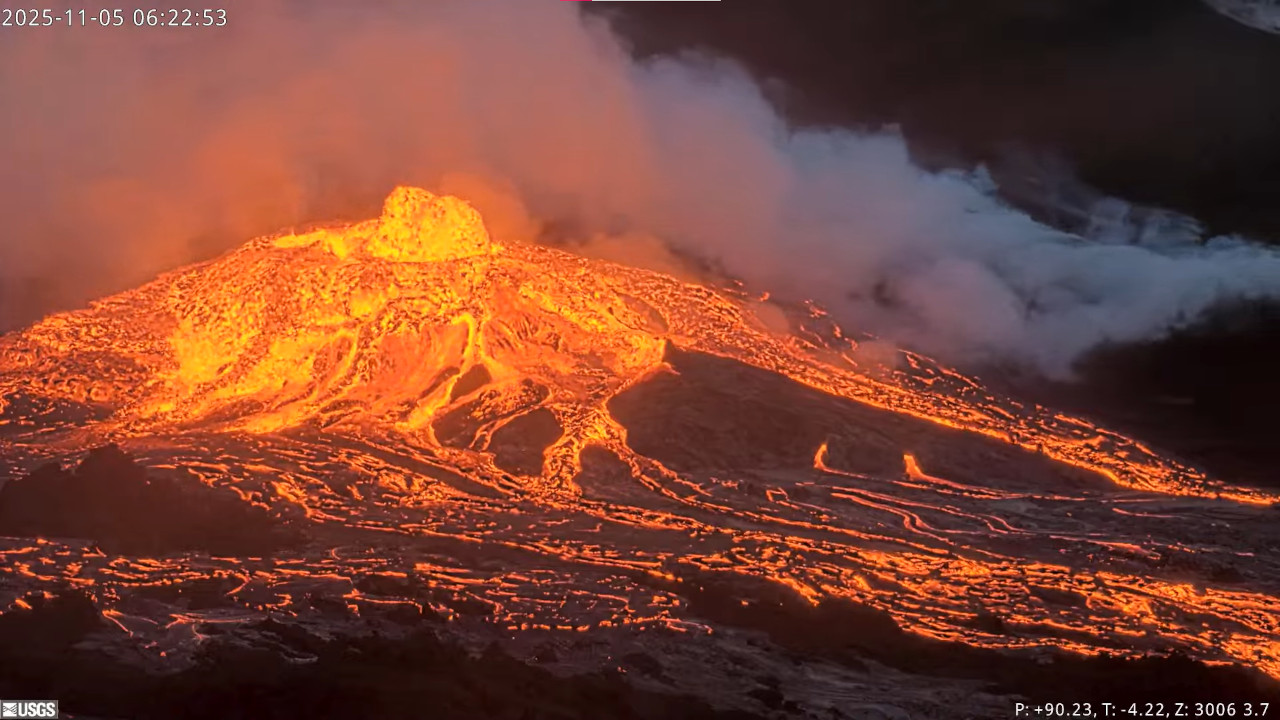
All images and video are courtesy the U.S. Geological Survey. A synthesized text-to-video voiceover was used in the narration for this story.
(BIVN) – Episode 36 high lava fountains have yet to begin at the summit of Kīlauea volcano, however models suggest they are most likely to start in the next few days.
“Overflows of degassed lava continued from the south vent last night and grew in size and duration,” the USGS Hawaiian Volcano Observatory reported on Wednesday morning. “While the north vent glowed intermittently overnight, all of the overflows have come from the south vent since just before 3 a.m. HST on October 4. Slow inflation of Kīlauea summit continued over the last 24 hours; however, repeated overflows from the north and south vents indicate the start of episode 36 is close.”
The forecast window for high lava fountaining is between today and November 8, and is most likely to occur before November 7th.
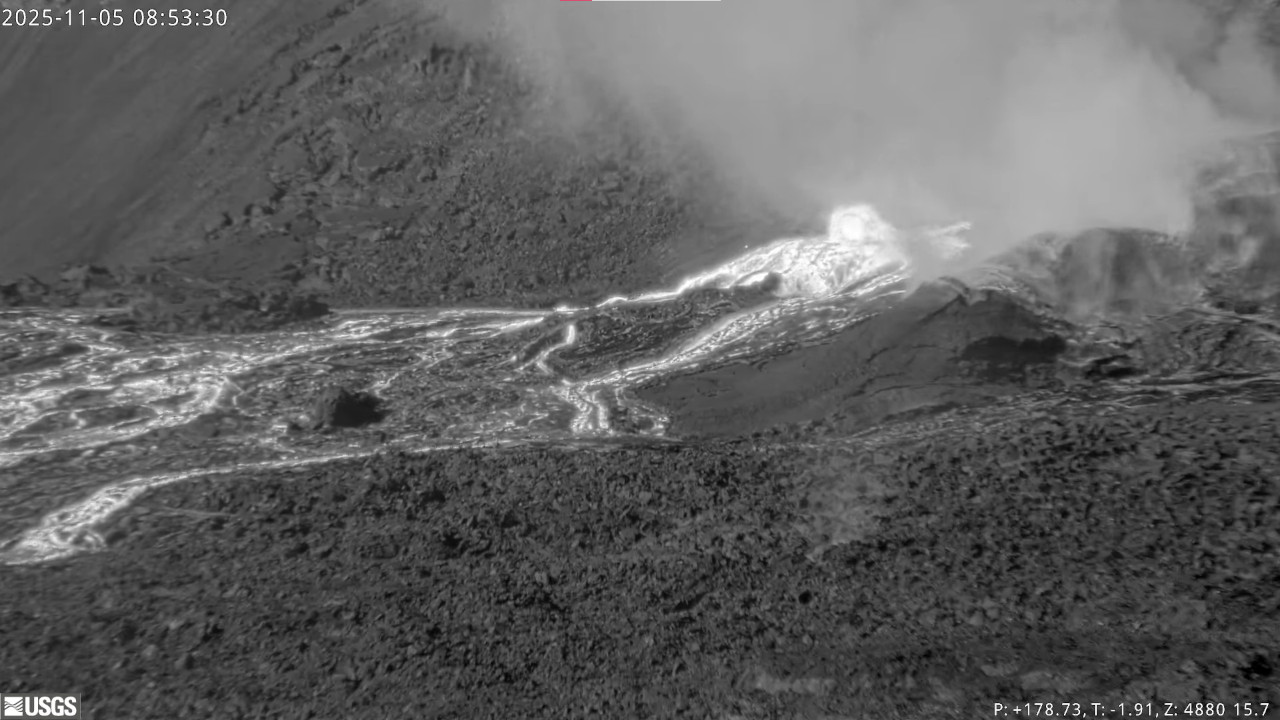
USGS webcam shows a lava flow at from the south vent. The USGS notes the infrared filter was turned off, making the lava appear much brighter and white in color.
From the USGS HVO update, posted on Wednesday morning:
Summit Observations:
The early morning hours were dominated by large overflows from the south vent that lasted up to 1 hour and 20 minutes. During these events lava overflowed from all sides of the south vent cone and greatly enlarged the small channelized pāhoehoe flow field growing around the cone. The last 3 events were the largest and longest lasting of the 14 overflows that have occurred since yesterday morningʻs update. These large overflows differed from the passive pond overflows of the previous events and instead had well developed hemispherical dome fountains 15-30 feet (5-10 meters) in diameter. Both the passive pond overflows and the dome fountains had very little spattering until drainback, indicating that mostly degassed magma is being erupted at this time. The north vent glowed intermittently last night, but there were no standing lava or overflows since early yesterday morning, October 4.
The summit continues to inflate. The Uēkahuna tiltmeter (UWD) has recorded approximately 0.5 microradian of inflationary tilt over the past 24 hours and 25.7 microradians of inflationary tilt since the end of episode 35. Tremor patterns were consistent through most of the last 24 hours with periods of low tremor correlating with pond filling and/or overflows followed by short 5-10 minute tremor spikes related to drainback. That pattern changed just after 3 a.m. HST with much longer overflows (up to 1 hour 22 minutes) followed by long periods of higher tremor that decreased slowly over the next hour.
Plumes of gas continue from both vents this morning and sulfur dioxide (SO2) gas emissions remain at background levels, typically between 1,200 and 1,500 tonnes per day. Yesterday wind conditions were favorable and the SO2 array southwest of the vent detected “puffs” of gas related to drainback events as is expected during gas pistoning events.
Episode 35 lava fountains began at approximately 8:05 p.m. HST on October 17 and ended at 3:32 a.m. HST on October 18. South vent fountains reached heights of nearly 1,500 feet (460 meters) and north vent fountains reached heights of about 1,100 feet (330 meters). These were the highest single fountain and highest pair of fountains seen during this eruption so far. Episode 35 fountains produced an estimated 13 million cubic yards (10 million cubic meters) of lava. The combined average eruption rate was over 500 cubic yards per second (400 cubic meters per second) from the dual fountains. Lava flows from the fountains covered about two thirds of the floor of Halemaʻumaʻu crater.

by Big Island Video News
on at
STORY SUMMARY
HAWAIʻI VOLCANOES NATIONAL PARK - High fountaining is most likely to begin in the next few days, as lava overflows at summit vents increase in vigor.