
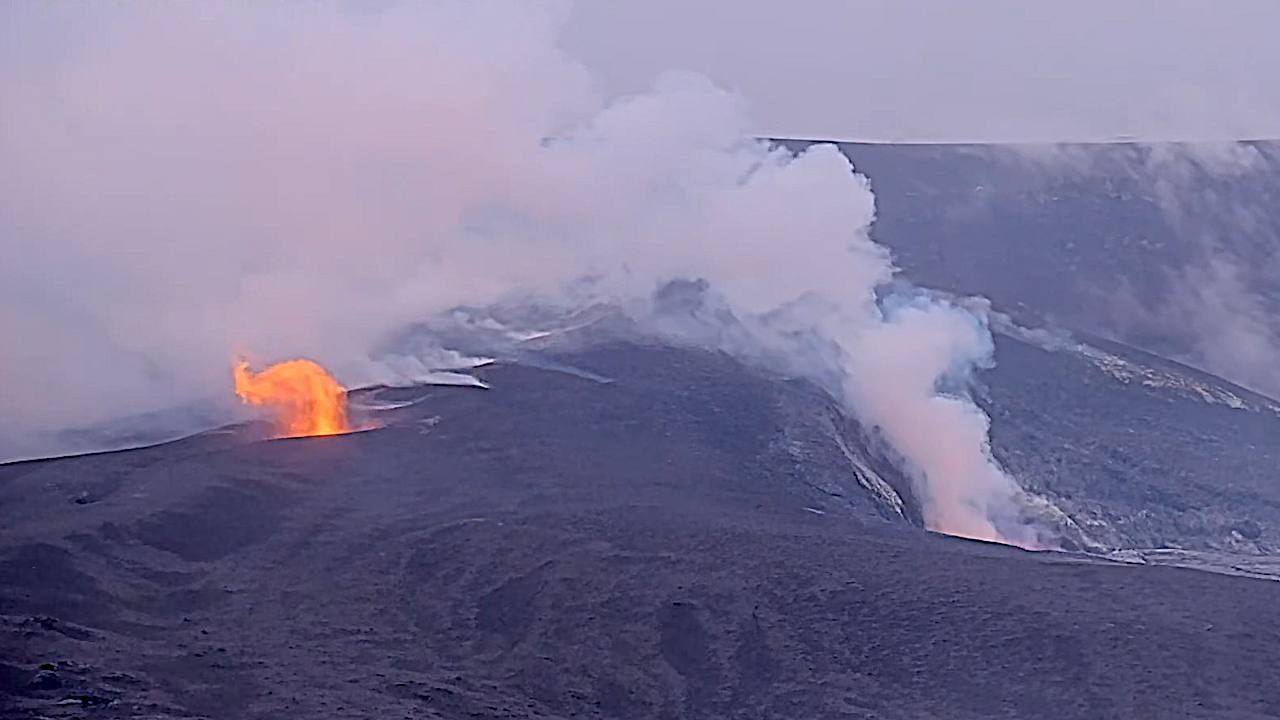

(BIVN) – Large flames have been observed at the Kīlauea summit vents in recent days, especially at the south vent within Halemaʻumaʻu, indicating magma is close to the surface and the next episode of high lava fountaining is near.
On Tuesday, the USGS Hawaiian Volcano Observatory reported the onset of episode 50 is likely between Thursday, June 25th, and Saturday, June 27th. Scientists say Friday, June 26th is the most likely date for lava fountains.
The Observatory has been noting the south vent continues to produce large flames “caused by the burning of gas within the top of the conduit”. The activity is also visible on USGS webcams.
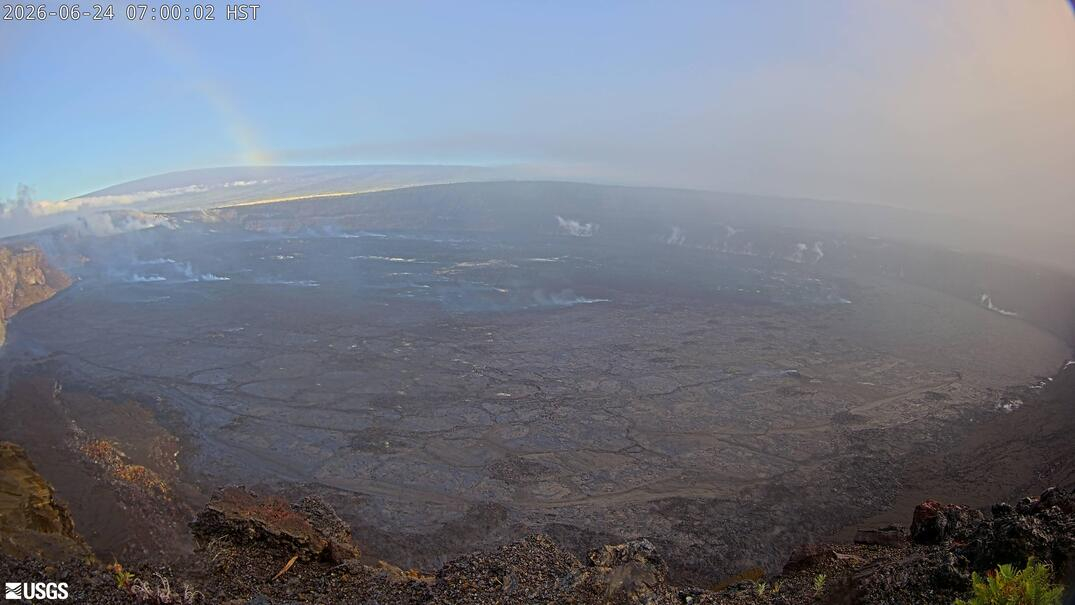
The eruption is currently paused and the USGS Volcano Alert Level for Kīlauea is at ADVISORY.
UPDATE – (10:10 A.M.) – From the USGS Hawaiian Volcano Observatory on Wednesday morning:
Summit Observations:
Continuous strong glow was visible on webcams from both vents in Halemaʻumaʻu overnight. The south vent continued to produced large flames caused by the burning of gas within the top of the conduit. Magma is close to the surface.
Pulses of seismic tremor continued (every 10-20 minutes) in the last 24 hours. No earthquakes were located beneath Kīlauea volcano’s summit in the past 24 hours.
Kīlauea summit deflation totaled 15.5 microradians during episode 49. Once the episode ended, inflation resumed and has since recovered 13.6 microradians of tilt at the summit tiltmeter at Uēkahuna (UWD).
With the eruption now paused, the sulfur dioxide (SO2) emission rate from the summit is likely now varying within a typical range of 1,000 to 5,000 tonnes per day.
Rift Zone Observations:
Rates of seismicity and ground deformation remain low in the East Rift Zone and Southwest Rift Zone. SO2 emissions from the East Rift Zone remain below the detection limit.
Magnitude-3.6 earthquake south of the village of Volcano, Island of Hawaiʻi, June 24, 2026, 8:29 a.m. HST
A magnitude-3.6 earthquake occurred this morning at 8:29 a.m. It was located 9 mi (14 km) south of the village of Volcano on the Island of Hawaiʻi at a depth of 5 mi (7 km) below sea level. The earthquake had no apparent impact on either Mauna Loa or Kīlauea volcanoes. Most earthquakes in this region are caused by motion of Kīlauea volcano’s south flank, which moves to the southeast over the oceanic crust. The location, depth, and waveforms recorded as part of today’s earthquake are consistent with slip along Kīlauea’s south flank. No damage to buildings or infrastructure is expected based on earthquake intensity. This earthquake is not directly related to the ongoing eruptive activity on Kīlauea volcano.
Analysis:
The abrupt switch from deflation to inflation at the end of episode 49 along with continued tremor and glow from the vents indicates that episode 50 fountaining is likely. Magma remains close to the surface although no spattering or overflows have been observed at this time. Forecast models suggest another fountaining episode may occur between June 25-27 with June 26 most likely.
Kīlauea has been erupting episodically since December 23, 2024, from two vents (north and south) in Halema‘uma‘u. Lava fountaining episodes, which generally last for less than 12 hours, are separated by pauses that can be longer than three weeks.
HVO continues to closely monitor Kīlauea and is in contact with Hawai‘i Volcanoes National Park and the Hawai‘i County Civil Defense Agency about eruptive hazards.
