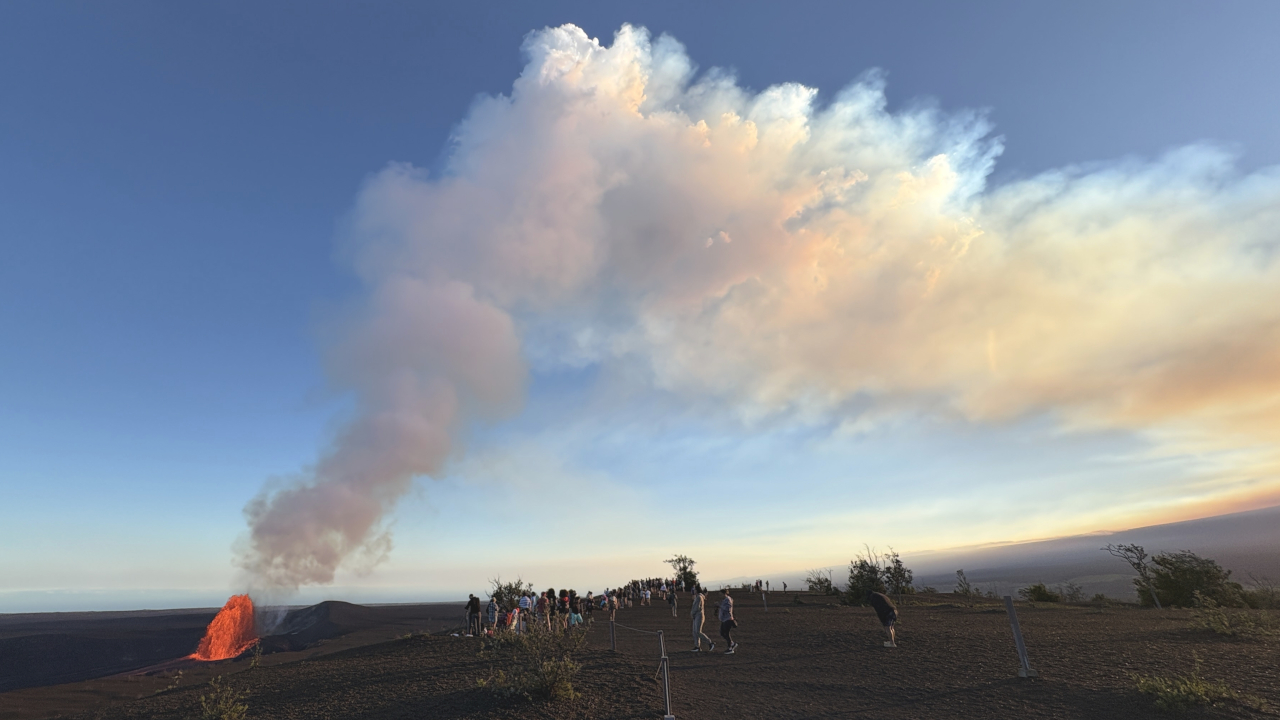

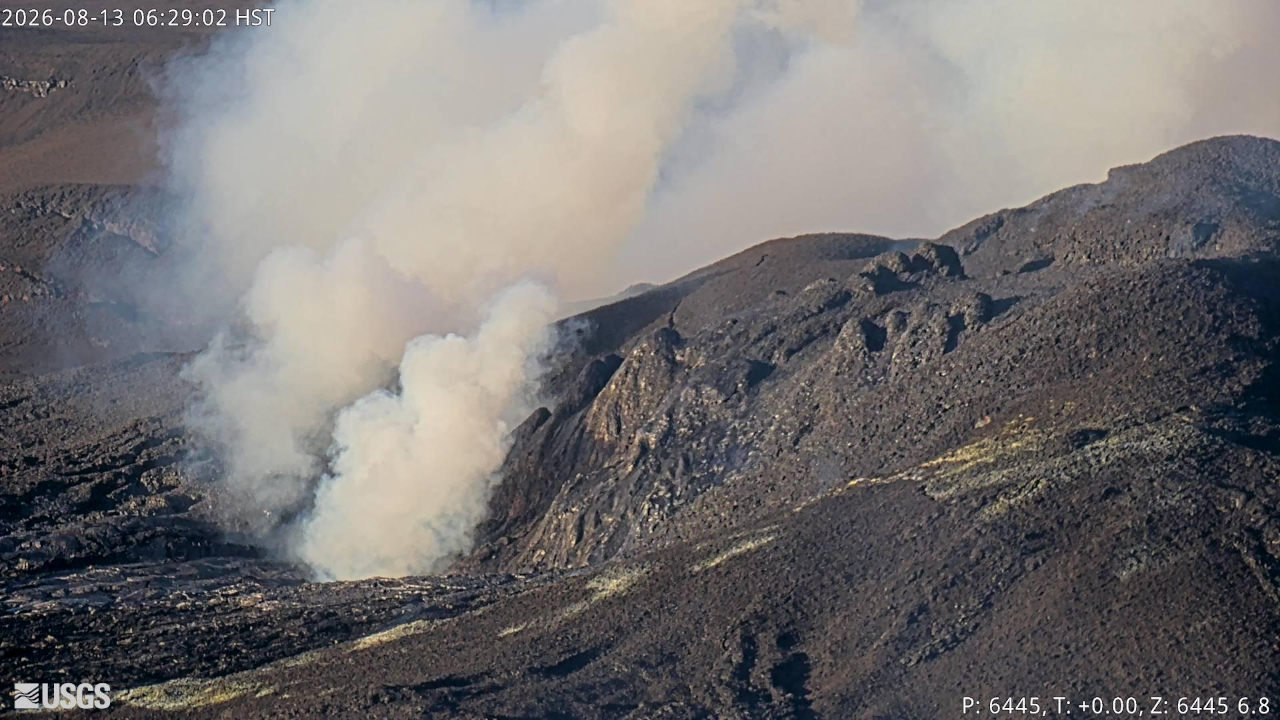
(BIVN) – The high lava fountains of episode 53 in the ongoing Kīlauea summit eruption ended abruptly at 1:23 a.m. HST on Thursday morning.
The high lava fountain phase of the episode lasted for 9.6 hours. The switch from summit deflation to inflation at the end of episode 53 indicates that another lava fountaining episode is likely in the coming days to weeks.
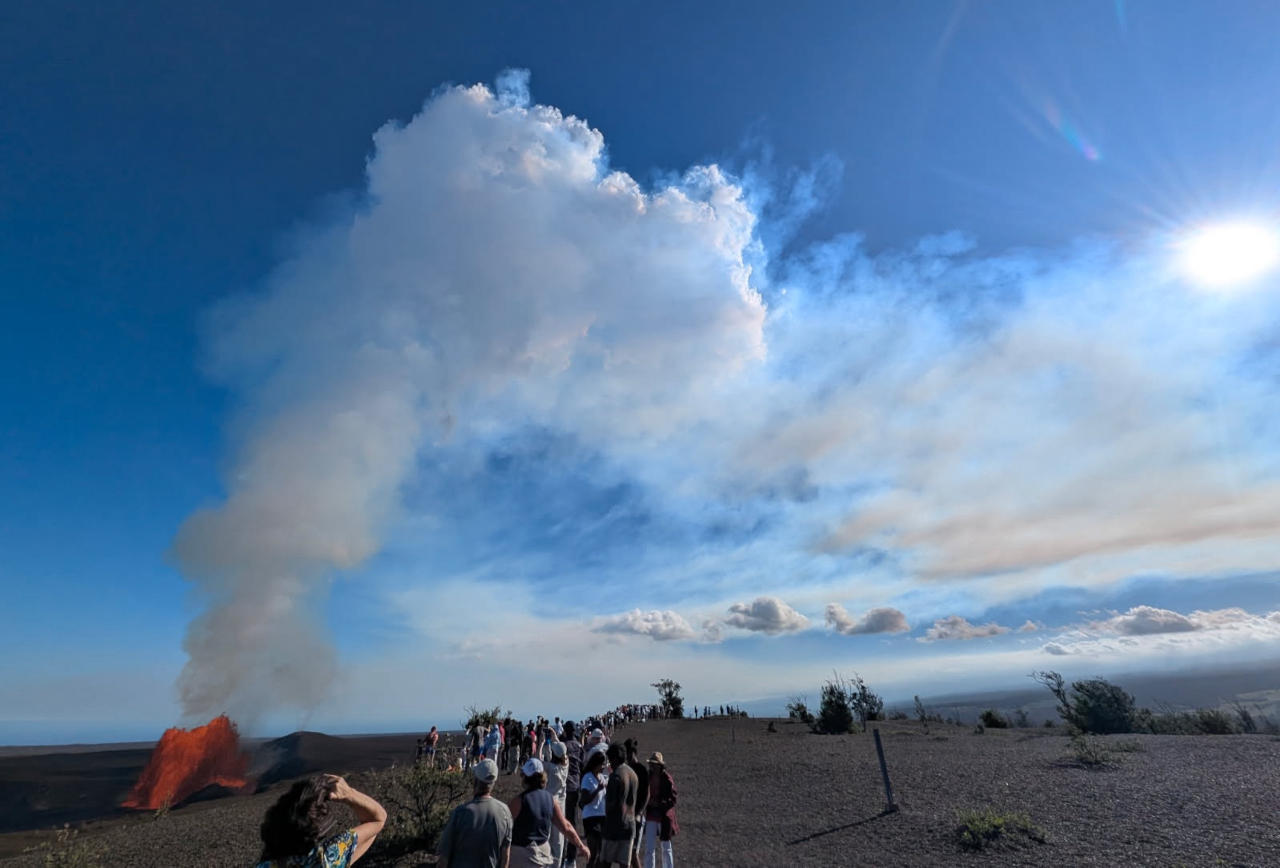
The USGS Hawaiian Volcano Observatory reports the maximum lava fountain height during the episode was approximately 500 feet (150 meters) above ground level from the north vent. The south vent never fountained during this episode.
Lava emerged from the new crack, or collapse pit, above the south vent during the initial stages of the episode, making the feature an official volcanic vent – now referred to by the Observatory as the west vent. The west vent did not produce a visible fountain, but periodically emitted flames during the episode that were most visible after 7 p.m. HST.
The maximum plume height was approximately 18,000 (5,500 meters) above mean sea level. Scientists say tephra fall was restricted completely to the closed area of Hawaiʻi Volcanoes National Park to the southwest and west of the active Halemaʻumaʻu vents.
From a USGS HVO summary issued overnight:
Episode 53 Chronology:
Lava fountain episode 53 in Halemaʻumaʻu at the summit of Kīlauea began around 3:45 p.m. HST August 12, 2026, and ended at 1:23 a.m. HST on August 13, 2026, after 9.6 hours of continuous fountaining from the north vent. The last four minutes were marked by gas jetting and flames from the north vent. The south vent never fountained during this episode but did overflow along with the new west vent (formerly the collapse pit) near the beginning of the episode. The new west vent (formerly the collapse pit) periodically emitted flames that were most visible after 7:00 p.m. HST. The instantaneous effusion rate peaked at about 300 cubic yards (230 cubic meters) per second at approximately 5:15 p.m. HST, with an average effusion rate of 180 cubic yards (135 cubic meters) per second for the entire fountaining episode. An estimated 6 million cubic yards (4.6 million cubic meters) of lava erupted and covered about 40-50% of the Halemaʻumaʻu crater floor. Seismicity followed the normal change in tremor patterns seen after most fountain episodes. The Uēkahuna tiltmeter (UWD) recorded about 14.0 microradians of deflationary tilt during episode 53.
Fountain activity transitioned gradually from precursory lava flows from the north vent. Small glimpses of spatter were seen after 10:00 a.m. HST but spatter was not consistently visible until 11:04 a.m. HST. This was followed by a series of short-lived lava overflows that began at 11:20 a.m., 11:35 a.m., 11:45 a.m., and 12:23 p.m. HST, each lasting 1-4 minutes. A fifth sluggish flow began around 1:00 p.m. HST and became sustained, gradually growing for about 45 minutes. At 1:45 p.m. HST, there was a dramatic increase in output correlated with a switch to deflationary tilt. A double dome fountain formed and began feeding a broad overflow that rapidly extended more than 2,000 feet (600 meters) from the vent. Large overflows from the south vent began at 3:26 p.m. and 3:38 p.m. HST and lasted approximately 5-6 minutes each. A small flow was also visible from the west vent (previously referred to as the new collapse feature) beginning at 3:31 p.m. HST. This small flow lasted for 28 minutes and ended 14 minutes after the start of episode 53. Two more flows sourced from the south vent and the west vent began at 4:02 p.m. and 4:03 p.m. respectively. The flow from the south vent only lasted 3 minutes. In contrast, the flow from the new west vent lasted 14 minutes and increased in intensity until it finally overflowed and drained into the south vent. There may have been other short periods of activity from the new west vent at 4:30 and 4:42 p.m. HST, but the view was obscured by the north vent fountains at that time.
The transition from precursory activity to the onset of episode 53 fountaining was marked by increasing height of the north vent dome fountain, greater eruptive volume, increased deflation and rapidly increasing tremor. The north vent lava fountain reached a peak height of approximately 500 feet (150 meters) around 5:00 p.m. HST and produced significant heat and ash, feeding a gas plume that reached a maximum height of about 18,000 feet (5,500 meters) above sea level based on webcam images and data reported by the National Weather Service (NWS).
Winds were out of the northeast below the inversion layer (about 10,000 feet or 3,000 meters above sea level) during fountaining, causing the plume to carry gas and fine ash/Peleʻs hair toward the southwest at lower levels. Higher level winds were more easterly and transported gas and fine tephra westward toward the summit of Mauna Loa. The plume track largely remained either within Hawaiʻi Volcanoes National Park or over unpopulated areas. Tephra larger than ash size (about 1/16 of an inch or 1 millimeter) was falling out of the plume within 0.5 – 1.2 miles (1-2 km) of the vents within the closed area of the National Park.
By 6:40 p.m. HST on August 12, fountain heights decreased to about 350-400 feet (110-120 meters) above ground level, and plume heights decreased to 15,000 feet (4,500 meters) above sea level. Fountain heights remained mostly constant until about 9:00 p.m. HST when they began to slowly drop, reaching 330 feet (100 meters) just before 10:00 p.m. HST. The plume cloud heights also dropped to about 10,000 feet (3,000 meters) at the same time. By midnight, the fountain had dropped slightly to 300 feet (90 meters) high with little change in the altitude of the plume cloud. The final fountains varied from about 100-200 feet (30-60 meters) high during the last half hour of the eruption, which ended abruptly at 1:23 a.m. HST on August 13.
The abrupt switch from summit deflation to inflation at the end of episode 53 indicates that another lava fountaining episode is likely.