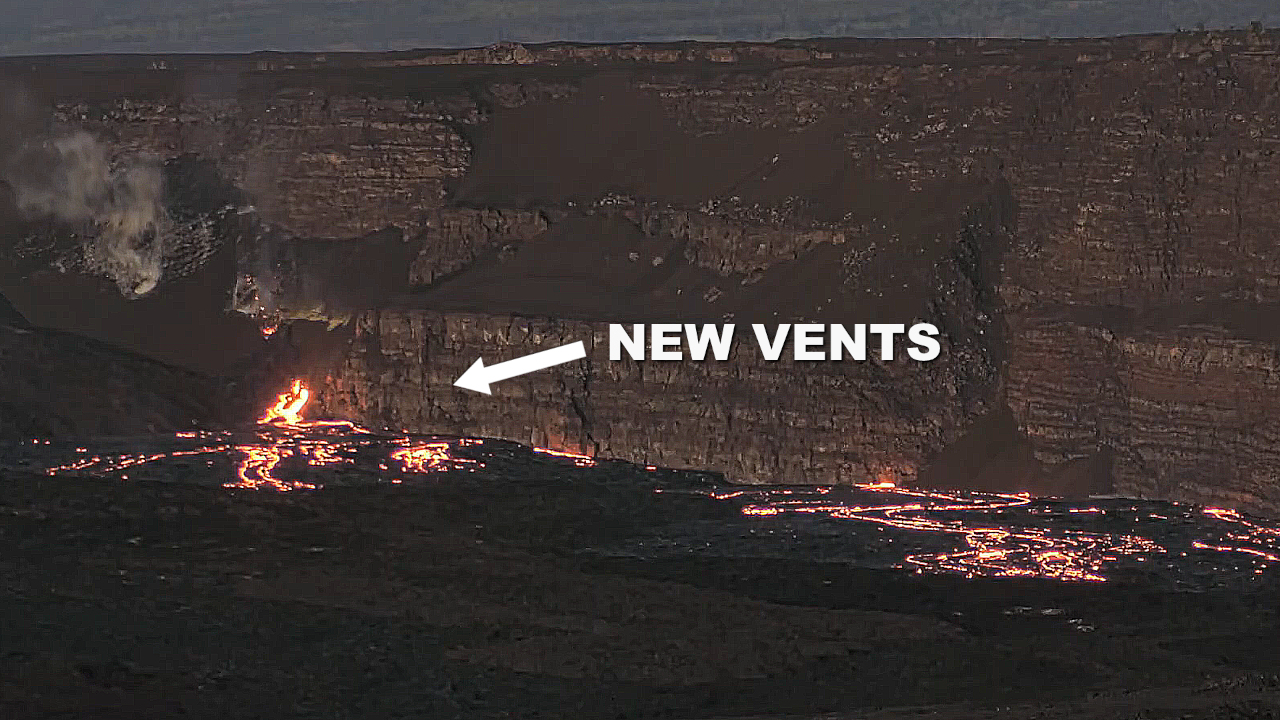

(BIVN) – There have been some changes in the current eruption at Kilauea volcano.
New vents opened Monday night, north of the established vent complex in the summit caldera. The vents opened without significant seismicity, although there was a short-lived swarm of shallow earthquakes in the same region on the night of September 13th.
The new vents are at a lower elevation than the main eruptive vent complex. On Tuesday, the USGS Hawaiian Volcano Observatory reported a total of five new vents have formed, and provided an annotated image showing the exact locations.
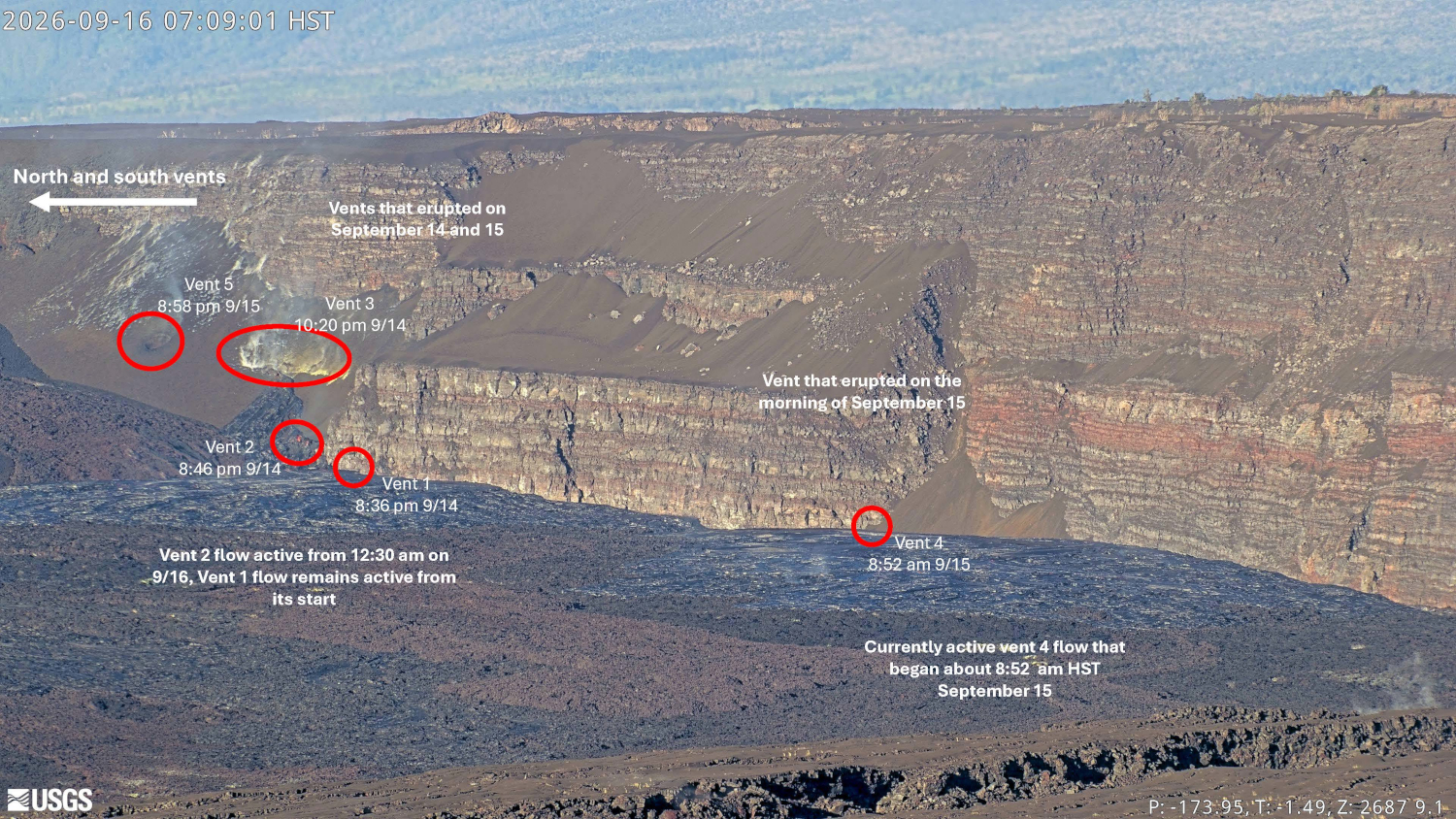
The cracks on and near the base of the northwest crater wall erupted lava Monday night, and were still active this morning. Some spattering could also be seen on the USGS webcam, which was repositioned yesterday to capture the new activity.
The existing vents continue to exhibit low-level, precursory activity. The north vent produced constant spatter overnight.
Still no high lava fountains. This prolonged phase of low-level activity continues.
The USGS Hawaiian Volcano Observatory says their instruments show the summit region is highly pressurized. The opening of new vents appears to be a response to this pressurization. There has also been an increase in seismic activity in the summit area. Tremor has nearly doubled in the past 24 hours, and the number of earthquakes also picked up overnight. Summit inflation is mostly stalled.
It is unknown what these recent changes could mean for the ongoing eruption at Kilauea. In a Tuesday status report, the Observatory listed four possible outcomes.
First, the eruption could become continuous at the new vents. It could be a sign that Kilauea is transitioning to lava erupting more continuously at the summit, rather than episodically.
Alternatively, a fountaining episode from an existing vent could begin at any point during this period of increased pressurization.
Third, it is possible we could see a new vent form in the summit region. We would expect to see tightly clustered earthquakes and changes in ground deformation before this happens.
And lastly, there is always a possibility this pressurization could result in a migration of magma into the upper parts of the East or Southwest Rift Zones, likely within Hawaiʻi Volcanoes National Park. This would also be preceded by increased earthquake rates and deformation patterns. Currently, no unusual activity has been detected in these areas.
On Tuesday, the observatory said the two most likely possibilities are the new vents erupting continuously, or the new vents shutting down and returning all activity to the established vents.
Scientists and emergency officials are keeping a close eye on the Hawaiʻi island volcano, where the alert level remains at WATCH, and the aviation color code is ORANGE.