
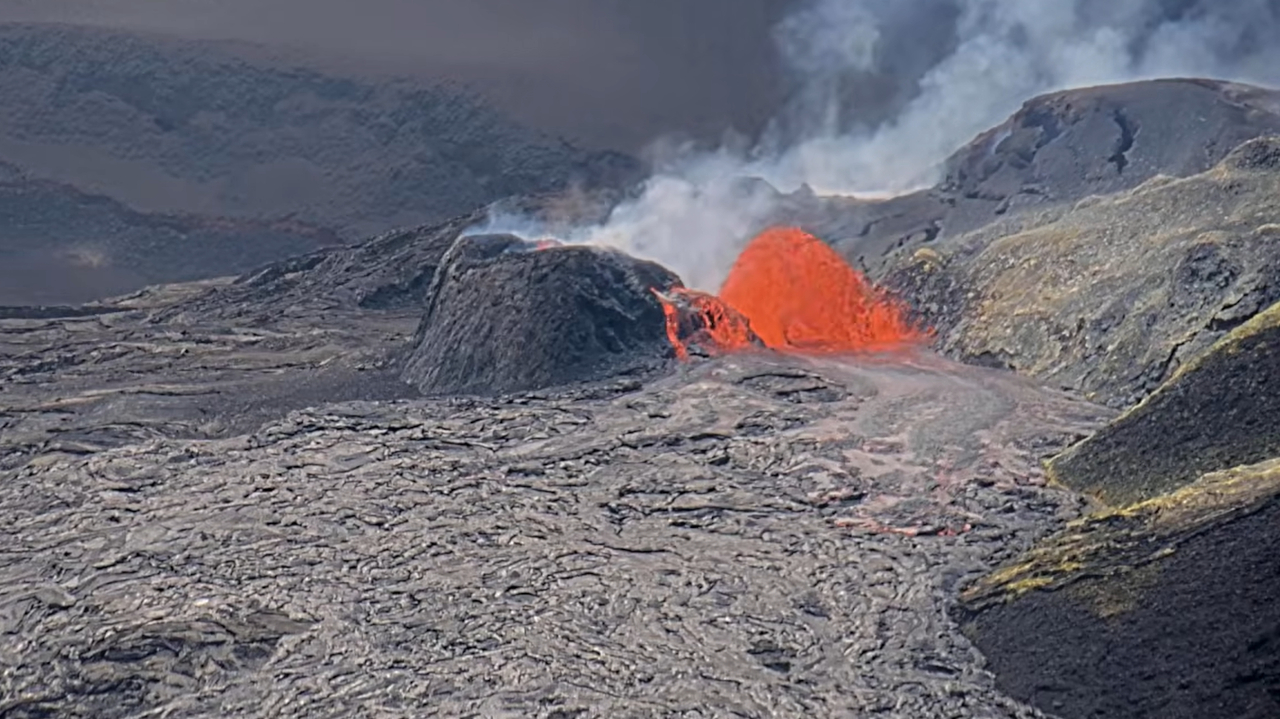

(BIVN) – The summit of Kīlauea remains at a high level of pressurization, with low-level eruptive activity ongoing at the established vents within Halemaʻumaʻu.
Glow and minor spattering were observed overnight from the north vent and the opening near its base, the USGS Hawaiian Volcano Observatory reported on Monday.
After the Observatory posted its morning update, the north vent began overflowing lava at 11:22 am HST. A large dome fountain formed, measuring about 30 feet high, which fed two vigorous overflows away from the vent. The north vent fountain stopped at 12:13 pm HST.
Scientists say a change in eruptive activity or location remains possible within the summit region in the coming days to weeks.
From the USGS HVO on Monday:
Summit Observations:
Overnight, moderate to strong glow was observed overnight from the north vent, the opening near its base, and south vent, while glow from the west vent fluctuated, with visibility potentially affected by fog. Intermittent flames and minor spattering associated with gas jetting occurred at all vents, including a short duration of sustained spattering at the south vent beginning around 3:18 a.m. HST. Spattering from the hole at the base of the north vent occurred intermittently associated with magma rising in the vent during periods of low tremor. Spattering was usually followed by gas jetting with minor spatter at the north, and sometimes south and west vents during drainback events that produced tremor bursts. Visible spattering ended around 6:35 a.m. HST this morning, but seismicity indicates that gas pistoning is continuing deeper within the vents.
Summit tiltmeters showed decreasing tilt beginning yesterday around noon, and the Uēkahuna tiltmeter (UWD) recorded a decrease of two microradians in tilt over the past day. Summit tilt meters are all recording slight increases since midnight.
Concurrent with the tilt decrease were approximately 13 small-magnitude shallow earthquakes in the south caldera region, mostly between noon and 3 p.m. HST. In the past 24 hours, there were 23 shallow earthquakes located across the summit region of Kīlauea. GPS stations on opposite sides of Halemaʻumaʻu (CRIM and UWEV) show a small increase in length since the end of September.
Updated interferometric synthetic aperture radar (InSAR) interferograms following the dike intrusion on September 30-October 1, show the intrusion has been slightly contracting since the evening of October 2. Minor intrusion-related motion was observed along many faults and cracks formed during the 2018 caldera collapse. There are no signs of significant deformation outside the caldera, including the south caldera region.
During inter-episode pauses, the sulfur dioxide (SO2) emission rate from the summit typically varies between 1,000 and 5,000 tonnes per day. Plumes of volcanic gas are visible from the vents in day-time webcam views. Winds are currently forecast from the east then changing to from the east southeast this evening before becoming north northeast after midnight.
Rift Zone Observations:
Rates of seismicity and ground deformation remain low in the East Rift Zone and Southwest Rift Zone. SO2 emissions from the East Rift Zone remain below the detection limit. No significant ground deformation was recorded in either rift zone.
Analysis:
Kīlauea had been erupting episodically between December 23, 2024, and August 25, 2026, from two vents (north and south) in Halema‘uma‘u at the summit. Lava fountaining episodes generally lasted for less than 12 hours and were separated by pauses of two or more weeks. Irregular patterns of ground deformation at Kīlauea summit since the most recent lava fountaining episode, number 54 on August 25, 2026, prevent forecast modeling for when the next fountaining episode can occur. Ground deformation patterns indicate the magma chamber beneath Halemaʻumaʻu is pressurized beyond the level typically seen before recent fountaining events. This pattern was disrupted by the dike intrusion on September 30-October 1 and since then summit tilt has increased slowly with interspersed periods of decreased or flat tilt. The small tube-fed pahoehoe overflow that ended around 1:30 p.m. HST on October 10 is evidence that the top of the magma column in the north vent was right at the surface. The summit wide deflation that began yesterday at noon and ended at midnight was associated with a cluster of small earthquakes in the south caldera region. This pattern indicates that magmatic pressure is continuing to activate weak areas beneath the summit. It is possible that another fountaining episode from the north-south vent complex could occur; however, intrusive activity underneath Kaluapele is also possible, or magma could exploit existing weak crack systems in the summit region to erupt passively (with little or no seismicity or deformation).
HVO continues to closely monitor Kīlauea and is in contact with Hawai‘i Volcanoes National Park and the Hawai‘i County Civil Defense Agency about eruptive hazards. Kīlauea volcano alert level and aviation color code remain at WATCH/ORANGE and conditions could change rapidly.
