

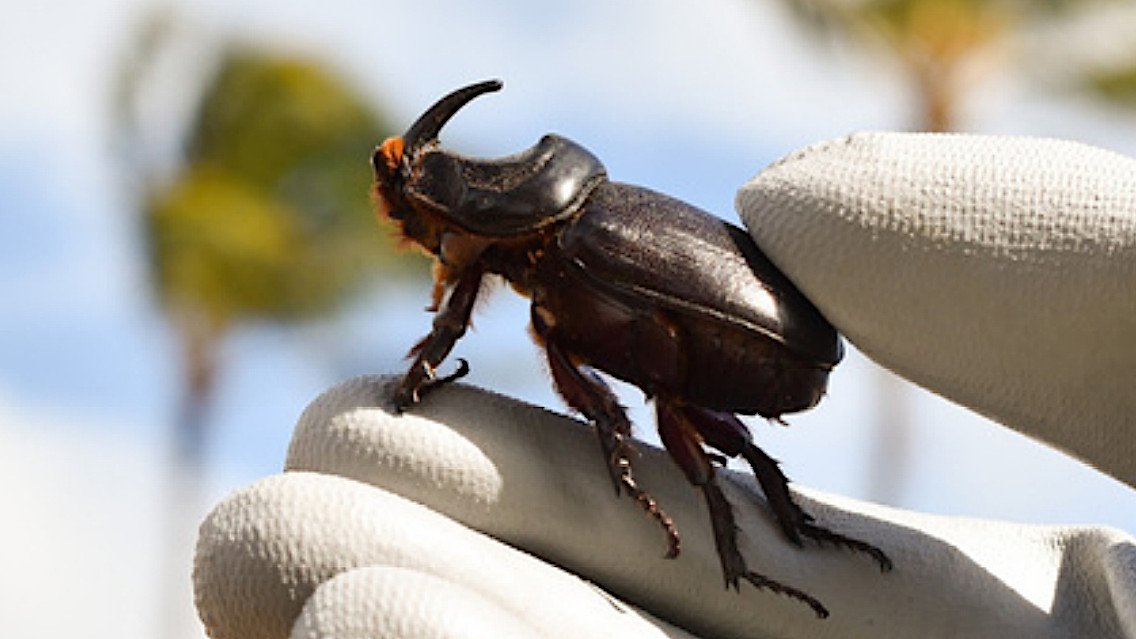
(BIVN) – A Hawaiʻi County Council committee voted in support of a resolution on Wednesday in the hopes it will help fight the spread of the invasive coconut rhinoceros beetle on Hawaiʻi island, just days after a CRB was found in Hilo.
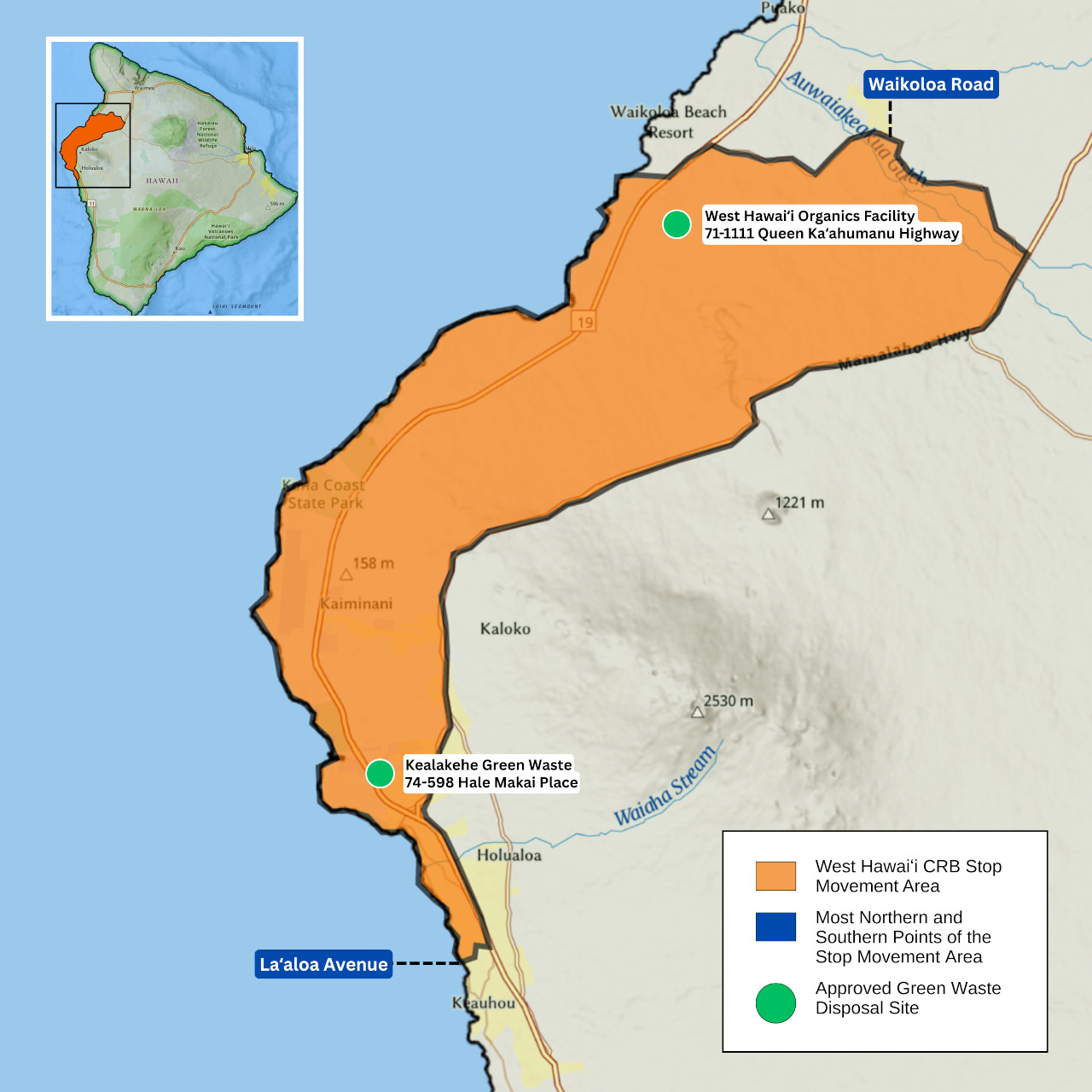
The CRB (Oryctes rhinoceros) is an invasive insect originally native to Southeast Asia. The beetle is known to cause widespread damage to coconut palms and other palms. CRB larvae were first detected in the Waikoloa area in October 2023, and detections expanded to multiple sites in West Hawaiʻi beginning in March 2025.
Most recently, a single female CRB was caught at the Hilo airport. The Big Island Invasive Species Committee says detection traps have been set up in the Hilo area, and multiple dog surveys have been conducted.
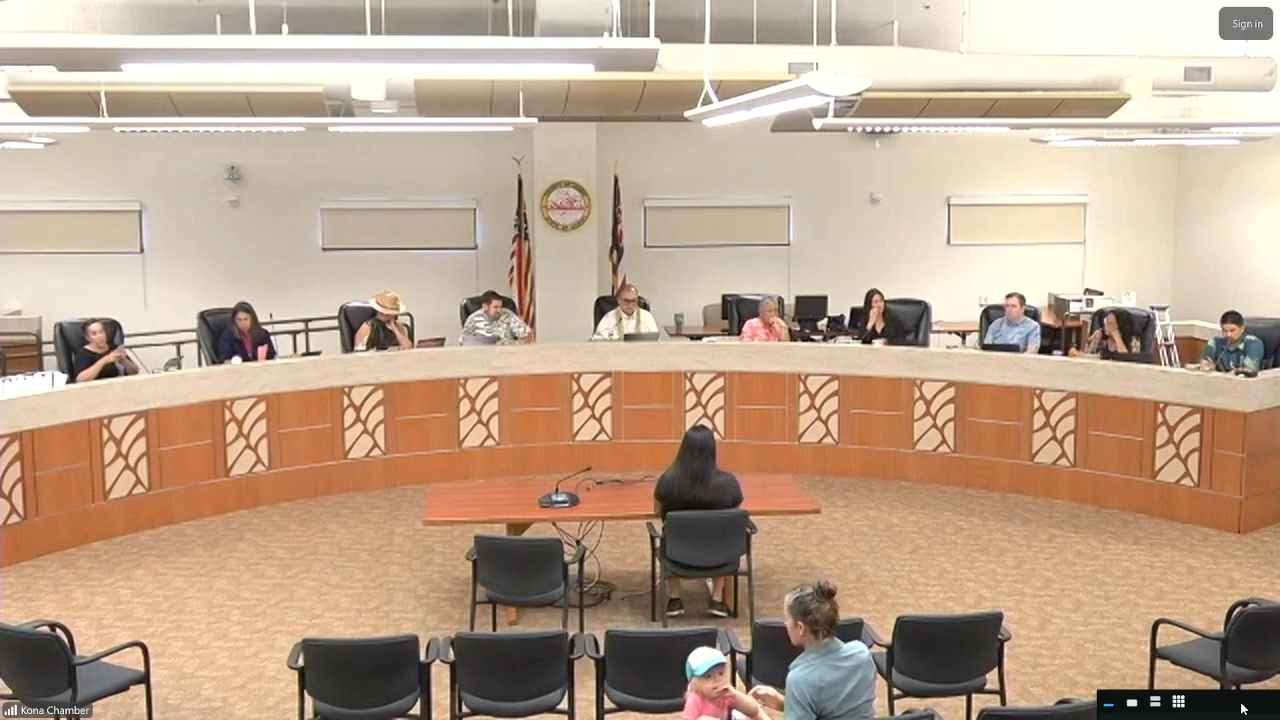
During its meeting in Kona, the Hawaiʻi County Council Committee on Governmental Operations and External Affairs heard Resolution 603, urging the State Department Of Agriculture And Biosecurity to implement and enforce regulations on the transportation of CRB host material on Hawaiʻi island. The measure was introduced by councilmembers James Hustace and Holeka Goro Inaba.
The resolution notes that in July 2025, Hawaʻi County adopted a voluntary compliance order for CRB host materials in the West Hawaiʻi area in order to stop the spread of the pest.
The resolution points out that in January 2026, local organizations – Hawaiʻi Wildlife Fund and Pōhaku Pelemaka – submitted a petition to the State Board of Agriculture and Biosecurity for interim rulemaking to regulate the transportation of CRB host material on Hawaiʻi Island.
The following information is from a portion of Resolution 603:
WHEREAS, in response to the confirmed spread of CRB and the petition for interim rulemaking, DAB extended the voluntary compliance order through April 30, 2026, to allow time for interim rules to be drafted; and
WHEREAS, on March 25, 2026,DAB adopted Plant Quarantine Interim Rule 26-1 pursuant to Section 150A-9.5 of the Hawaiʻi Revised Statutes; and
WHEREAS, Quarantine Interim Rule 26-1 regulates the transportation of CRB host material in a CRB infested area by requiring persons engaging in activities related to CRB host material to enter into compliance agreements with DAB and complete a required training by May 1, 2026; and
WHEREAS, as of May 26,2026, the Big Island Invasive Species Committee has conducted twenty-six training sessions and trained one hundred sixty-four individuals from nineteen entities, which included assisting trainees with completing the compliance agreement forms; and
WHEREAS, DAB’s Plant Quarantine Branch has not designated an employee on Hawaii Island to assist with the implementation of Plant Quarantine Interim Rule 26-1; and
WHEREAS, as of May 26, 2026, DAB’s Plant Quarantine Branch had not approved compliance agreements necessary for businesses and individuals to legally conduct activities involving CRB host materials pursuant to Interim Rule 26-1, creating uncertainty for regulated parties and limiting implementation of the adopted quarantine measures; and
WHEREAS, the Council recognizes the efforts of community organizations, agricultural producers, and residents who have assisted in CRB response efforts and urges continued collaboration between the State, County, and local partners to prevent further spread of CRB;
now, therefore,BE IT RESOLVED BY THE COUNCIL OF THE COUNTY OF HAWAIʻI that, in accordance with Section 150A-9.5 of the Hawaiʻi Revised Statutes, the Hawaiʻi Department of Agriculture and Biosecurity is hereby urged to immediately implement and enforce Plant Quarantine Interim Rule 26-1.
BE IT FURTHER RESOLVED that the Hawaiʻi Department of Agriculture and Biosecurity is hereby urged to provide public awareness of the requirements of Interim Rule 26-1 and expedite the issuance of compliance agreements.
BE IT FURTHER RESOLVED that the Hawaiʻi Department of Agriculture and Biosecurity is hereby urged to designate a Plant Quarantine Branch employee who is located on, or regularly travels to, Hawaiʻi Island as a point of contact to assist businesses, agricultural producers, community organizations, and residents with implementation of Plant Quarantine Interim Rule 26-1.
“This resolution is not asking the state to adopt any new regulations,” said Councilmember James Hustace. “Rather, it urges the department to fully implement the rule it has already adopted, by expanding compliance agreements, increasing public outreach, and designating a dedicated plant quarantine representative here on Hawaiʻi island to serve as a point of contact for businesses, residents, and agricultural producers.”
Jonathan Ho, the DAB Plant Quarantine Branch manager, spoke to the council committee by videoconference from Oʻahu. Ho said the long term approach to CRB is to get into biocontrol. Ho says the University is testing a permitted virus that seems to be effective on the CRB when the insect is in its larval stage. The virus will likely be released if testing shows it does not affect native species.
