
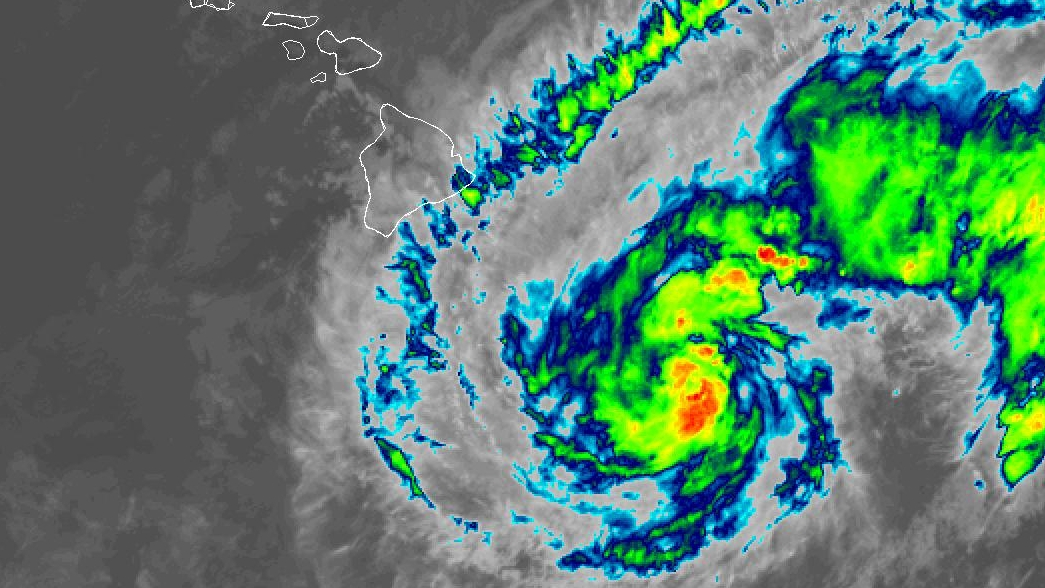

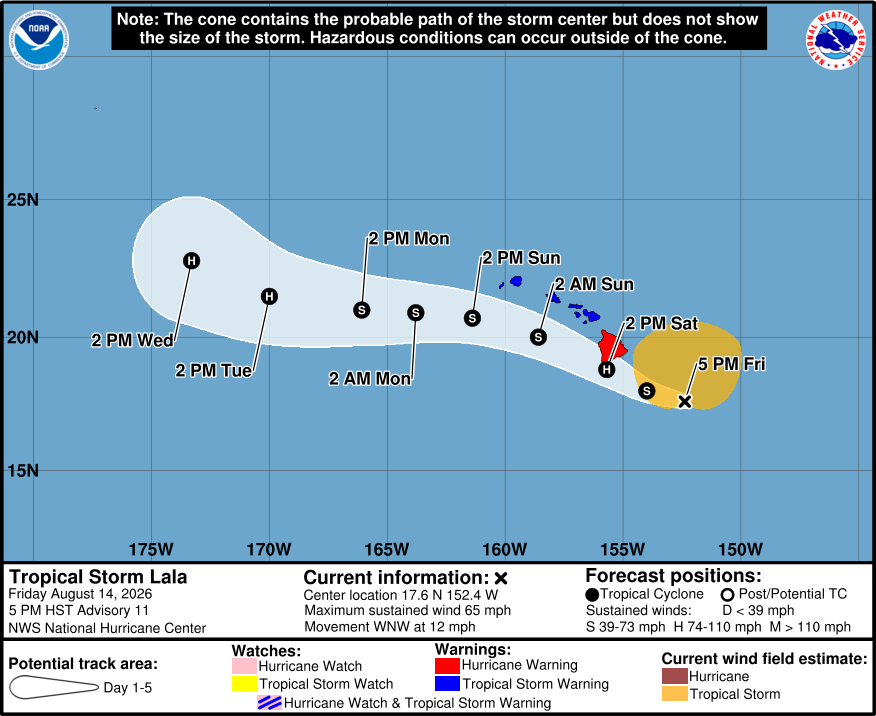
(BIVN) – As of 5 p.m. Friday evening, Lala was 235 miles east southeast of South Point, moving west northwest towards Hawaiʻi island at 12 MPH. Maximum sustained winds are near 65 mph (95 km/h) with higher gusts.
Steady strengthening is forecast, and Lala is expected to become a hurricane when it reaches the Big Island on Saturday.
“Lala has changed little in organization during the past several hours, with most of the deep convection remaining over and north of the center,” stated the Central Pacific Hurricane Center in its latest discussion. “However, data from NOAA and Air Force Reserve Hurricane Hunter aircraft indicate that the cyclone has strengthened some this afternoon.”
“Preparations should be rushed to completion this evening before tropical-storm-force winds begin,” the forecasters stated.
A Hurricane Warning is in effect for Hawaiʻi island, as well as a Flood Watch and high Surf Warning for east-facing shores.
From the Central Pacific Hurricane Center discussion posted at 5 p.m. HST:
Lala has changed little in organization during the past several hours, with most of the deep convection remaining over and north of the center. However, data from NOAA and Air Force Reserve Hurricane Hunter aircraft indicate that the cyclone has strengthened some this afternoon. Pressure observations from nearby NDBC buoy 51004 have also been useful in assessing the cyclone as it passes close to the station. Based on a blend of the aircraft data, buoy observations, and overall satellite presentation, the initial intensity is set at 55 kt.
The initial motion is west-northwestward, or 290/10 kt. A mid-level high pressure system anchored north of the Hawaiian Islands should continue to steer Lala generally west-northwestward during the next several days. Some slowing of the forward motion is possible as the cyclone approaches the Big Island and begins to interact with the island’s terrain on Saturday. Short-term deviations in the track are also possible during this time. After passing near or over the southern portion of the Big Island, Lala could make a subtle turn toward the northwest in the lee of the island before resuming a west-northwestward motion south of the smaller islands through the remainder of the weekend. The latest NHC track forecast is very similar to the previous advisory and remains close to the mult-model consensus (HCCA) and the Google DeepMind ensemble mean.
Some additional strengthening is forecast during the next 12 to 24 h while environmental conditions remain generally favorable. Although mid-level dry air continues to be a limiting factor, the inner circulation could become somewhat more compact and organized as Lala approaches the southern portion of the Big Island. The NHC forecast therefore continues to show Lala reaching hurricane strength near the time it reaches the Big Island on Saturday. Interaction with the island’s terrain should then disrupt the low-level circulation and result in weakening, with increasing vertical wind shear associated with an upper-level low providing an additional negative influence later in the weekend. Some re-strengthening is forecast early next week as vertical wind shear relaxes and Lala remains over warm sea surface temperatures. The latest NHC intensity forecast is similar to the previous advisory and remains near the middle- to upper-end of the guidance envelope.
Key Messages:
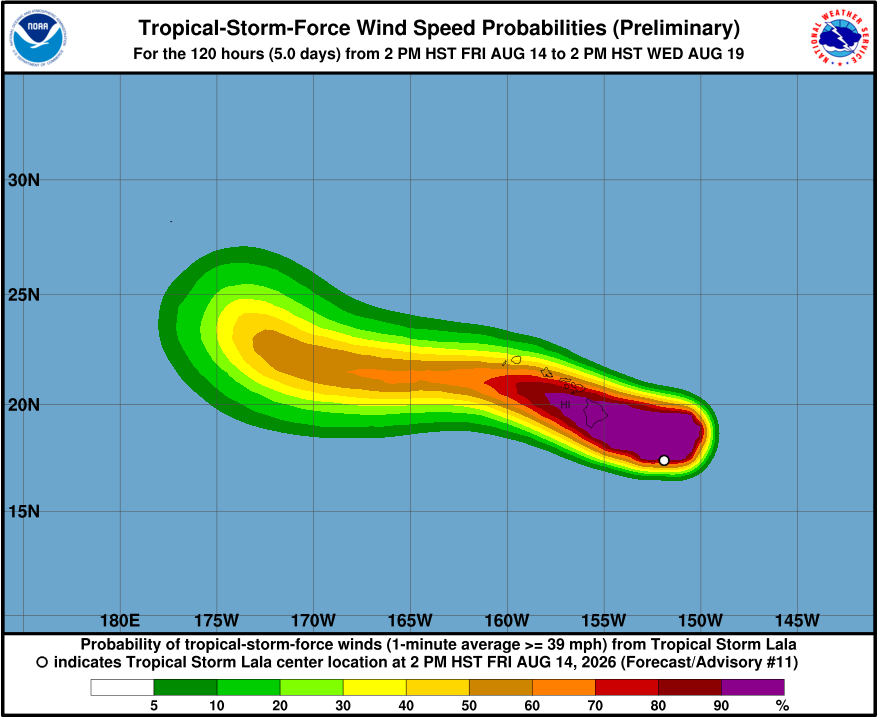
1. Damaging hurricane-force winds are expected on the Big Island of Hawaii Saturday, with the strongest wind gusts expected in areas of higher terrain. Preparations should be rushed to completion this evening before tropical-storm-force winds begin. Tropical-storm-force winds are also expected across portions of the smaller islands this weekend.
2. Heavy rainfall will reach the Big Island this evening and spread westward across the remainder of the island chain this weekend. This rainfall may produce life-threatening flooding and mudslides, especially in areas of steep terrain.
3. Large and dangerous waves are expected across portions of the Hawaiian Islands this weekend. Surf is already building along east-facing shores and will increase along exposed southern shores as Lala passes through the region. This heavy surf may cause localized coastal flooding and significant beach erosion.
