
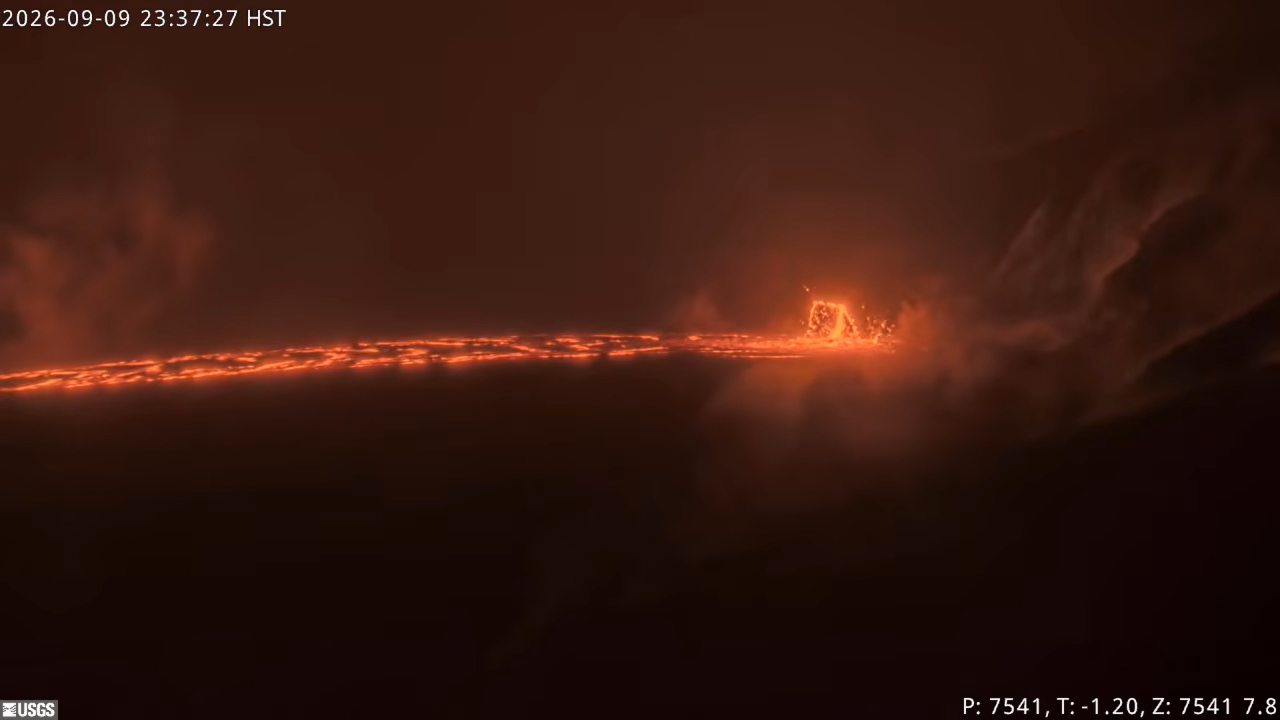

(BIVN) – Intermittent lava activity continues at the summit of Kīlauea Thursday morning, with no change in summit inflation since yesterday.
The USGS Hawaiian Volcano Observatory has adjusted the forecast window for the start of episode 55 lava fountaining to between September 10th and September 11th.
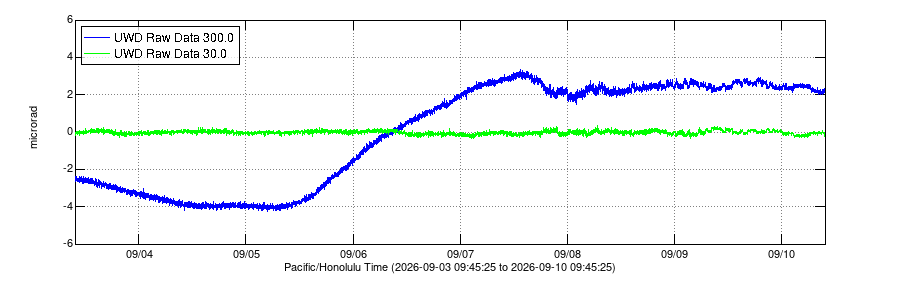
As of 8 a.m. this morning, there have been 50 lava overflows from the north vent in Halemaʻumaʻu since September 7th. The most recent overflow ended at 1:17 a.m. HST. Scientists noted summit reinflation “has been very irregular since lava fountaining episode 54 on August 25 and over the past 24 hours has shown little net change, remaining about 0.5 microradians below the episode 54 starting level.”
The USGS Volcano Alert Level for Kīlauea is at WATCH and the Aviation Color Code is at ORANGE.
From the USGS HVO on Thursday morning:
Summit Observations:
Weak spattering from the north vent was first reported at 6:54 p.m. HST on September 6, with the first sluggish precursory overflow from the north vent starting at around 12:45 p.m. HST on September 7. Overflows from the north vent have continued intermittently since then, with a total of 50 so far, lasting from 15 minutes to about 2 hours long and separated by interludes of about 15 minutes to 8 hours. Overflows have become progressively more vigorous and been fed by a dome fountain that reached 15-30 ft (5-10 m) tall. Two main lava flows have formed during these overflows with one making it about a half mile (1 kilometer) to the southwest of the north vent, and the other making it less than half a mile (1 kilometer) to the northeast of the north vent. The most recent north vent overflow ended at 1:17 a.m. HST this morning, with the break in overflows since then being the second longest since precursory activity began on September 7.
Webcam views at Kīlauea summit over the past day have been intermittently clear. Between overflows, glow was observed intermittently in all three of the eruptive vents in Halemaʻumaʻu. No overflows occurred from the south or west vents, but flames and spatter bursts were observed occasionally from these vents overnight in webcam imagery.
Tremor continues across the summit with regular intervals (about 5 minutes) of gas piston activity. When webcam views have been obscured by weather, changes in tremor signal were used to time the duration of recent overflows from the north vent. Five small earthquakes were recorded beneath the summit region over the past 24 hours.
Summit reinflation has been very unsteady since lava fountaining episode 54 on August 25. On September 7 around 3:00 p.m. HST, inflation at UWD reached a maximum that was higher than when episode 54 began, approximately 13.2 microradians. Following this inflationary high, UWD recorded around 1 microradian of deflation with the onset of precursory lava flows from the north vent. Since then, there has been little change with slow inflation totaling 0.5 microradians. As of this morning, UWD remains at a similar amount of ground tilt it showed yesterday: approximately 12.4 out of the 12.7 microradians lost during episode 54.
During inter-episode pauses, the sulfur dioxide (SO2) emission rate from the summit typically varies between 1,000 and 5,000 tonnes per day. Trade winds are pushing the degassing plume to the southwest of Kīlauea’s summit caldera this morning. Northerly winds forecasted later today could blow volcanic gases as well as fine ash and Peleʻs hair to the south of Kaluapele if episode 55 begins.
Rift Zone Observations:
Rates of seismicity and ground deformation remain low in the East Rift Zone and Southwest Rift Zone. SO2 emissions from the East Rift Zone remain below the detection limit.
Analysis:
The abrupt switch from summit deflation to inflation at the end of lava fountaining episode 54, glow from the vents, overflows, and continued seismic tremor bursts at Kīlauea summit indicate that another lava fountaining episode may occur in the coming days. However, summit inflation has been slow and irregular, having been interrupted by multiple deflations of varying magnitude and duration. Irregular ground deformation affects the forecast window for the start of episode 55 fountaining and prolonged periods of deflation, or no inflation, cause the forecast to be delayed. The start of fountaining episode 55 could be preceded by a return to inflation or intermittent precursory north vent overflows could transition to a lava fountain later today or tomorrow.
Kīlauea has been erupting episodically since December 23, 2024, from two vents (north and south) in Halema‘uma‘u. Lava fountaining episodes, which generally last for less than 12 hours, are separated by pauses of two or more weeks.
HVO continues to closely monitor Kīlauea and is in contact with Hawai‘i Volcanoes National Park and the Hawai‘i County Civil Defense Agency about eruptive hazards.
