
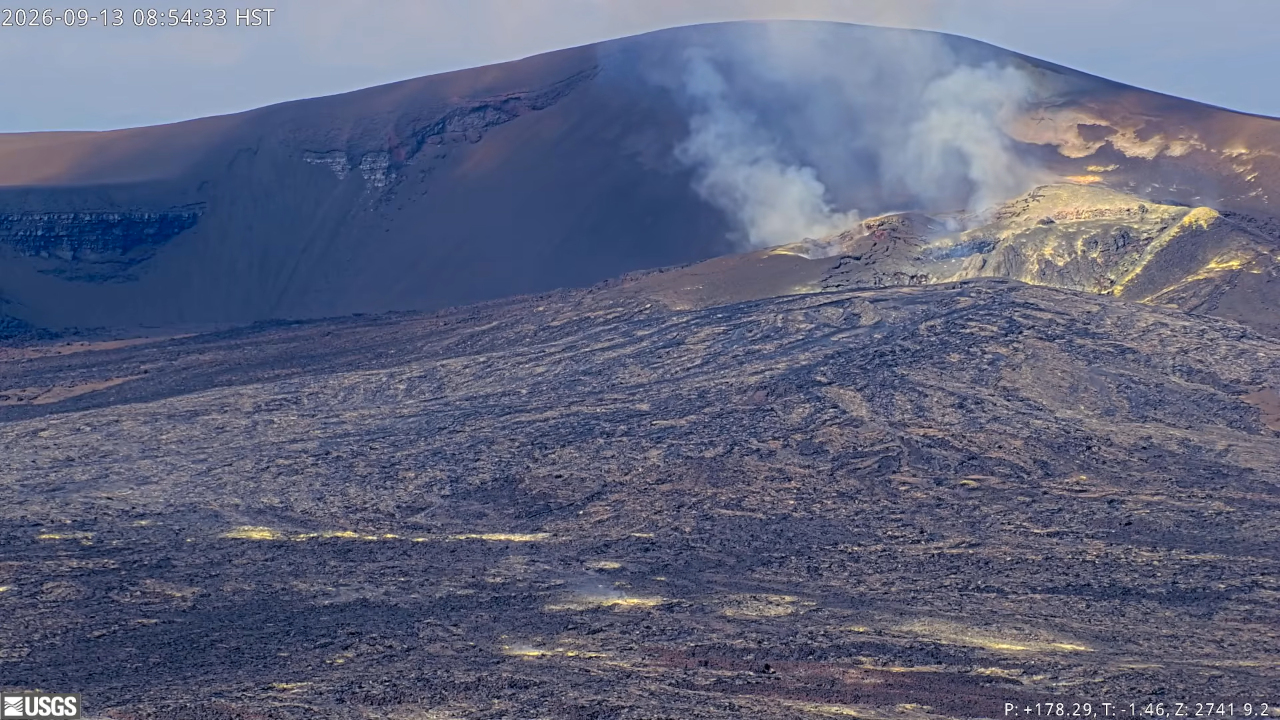

(BIVN) – Kīlauea volcano remains in a precursory phase leading to an eventual episode of lava fountaining, although there has been no lava activity at the surface of Halemaʻumaʻu since noon on Saturday.
The USGS Hawaiian Volcano Observatory said Sunday that the “onset of episode 55 fountaining is likely today or tomorrow, if conditions remain favorable.”
“Slow summit inflation has continued over the past hours and is currently well above the episode 54 starting level,” the Observatory noted. “Inflation-based forecasting models are no longer valid and it is difficult to say how long this precursory activity may last.”
There have been 104 short, precursory lava flows recorded at the Kīlauea summit since September 7th.
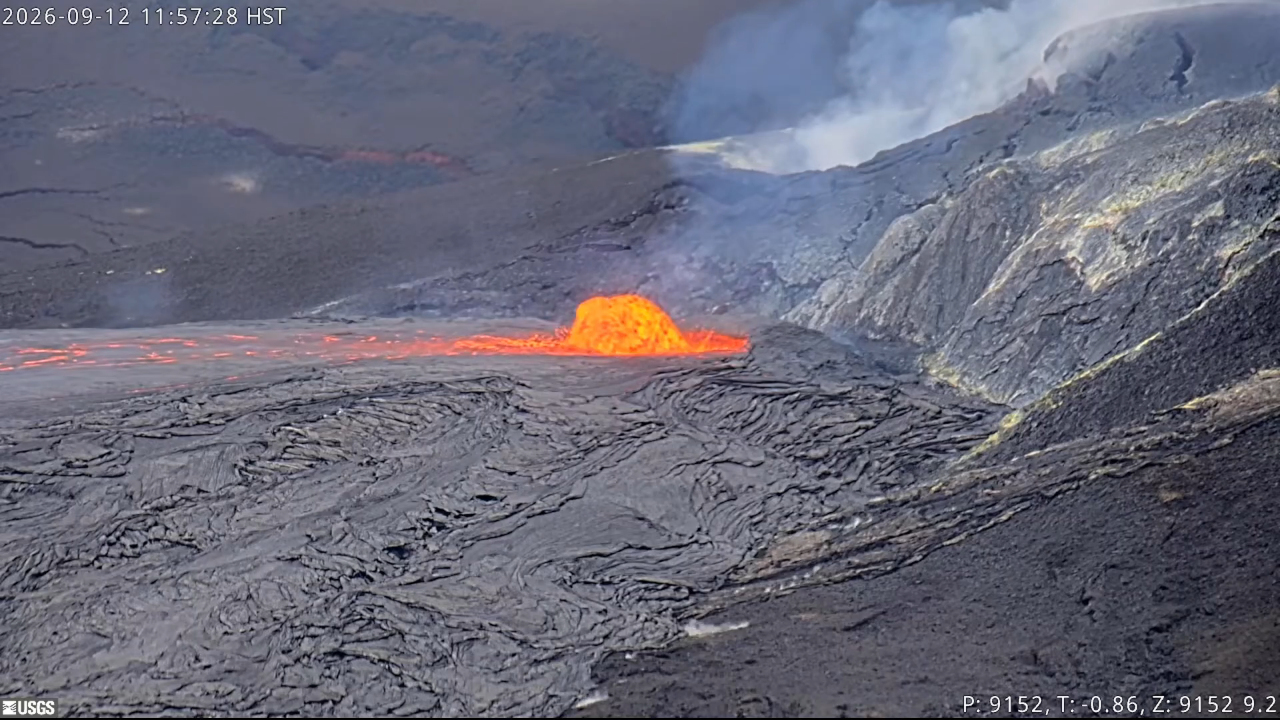
From the USGS HVO on Sunday morning:
Glow was observed from all three vents at times overnight, with flames and spatter occasionally visible in the north vent. There were only 4 overflows from the north vent in the past 24 hours, and none have occurred since noon yesterday, September 12. Overflows yesterday morning hours averaged about 20 minutes in length and were accompanied by dome fountains about 35-50 feet (10-15 m) in height. Overflows since September 7 have built a small shield around the north vent nested within the spatter cone. This is the third longest precursory period (5.8 days) since high fountains began after episode 4. The longest period of precursory activity was 6.2 days before episode 44 and the most overflows record was 179 from the north and south vents combined prior to episode 36.
The onset of precursory overflows was preceded by weak spattering from the north vent, first reported at 6:54 p.m. HST on September 6. Initial sluggish precursory overflows from the north vent started at around 12:45 p.m. HST on September 7 with no dome fountains or spattering. Overflows from the north vent have continued intermittently since then, with a total of 104 so far lasting from a few minutes to about 2 hours long and separated by interludes of about 15 minutes to 8 hours. Overflows between September 7-9 became progressively more vigorous and were fed by a dome fountain that reached 15-30 ft (5-10 m) tall. Two main lava flows formed during these overflows with one making it about a half mile (1 kilometer) to the southwest of the north vent, and the other making it less than half a mile (1 kilometer) to the northeast of the north vent. On September 10, overflows were generally sluggish, less frequent, shorter in duration (less than ten minutes), not fed by a dome fountain, and did not travel as far from the north vent. Overflows on September 11-12 showed more vigor and lasted longer than ten minutes, with dome fountains that grew from 15-30 ft (5-10 m) to 35-50 feet (10-15 m) tall and generated lava flows that traveled farther from the north vent than on September 10.
Tremor amplitude and tremor spikes associated with gas pistoning both gradually decreased over the past 24 hours. Tremor recorded at Kīlauea’s summit has become relatively uniform and continuous, possibly reflecting the stable position of magma close to the surface within all 3 vents. Over the past 24 hours, 19 small earthquakes were recorded beneath the summit region mostly south of Halemaʻumaʻu. While most episodes only have a handful of earthquakes during the runup to fountaining, the recent earthquakes have not been closely clustered in space or time and are probably related to the general increase in pressure in the shallow Halemaʻumaʻu magma chamber.
Summit reinflation has been very unsteady since lava fountaining episode 54 on August 25. On September 7 around 3:00 p.m. HST, inflation at UWD reached a maximum that was higher than when episode 54 began, approximately 13.2 microradians. Following this inflationary high, UWD recorded around 1 microradian of deflation with the onset of precursory lava flows from the north vent. From then on, there was little net change until around 9 p.m. HST on September 10, when slow inflation returned. As of this morning, summit inflation seems to have slowed but UWD is showing a total gain of 15 microradians since the end of episode 54, several microradians above the 12.7 microradians lost during episode 54.
During inter-episode pauses, the sulfur dioxide (SO2) emission rate from the summit typically varies between 1,000 and 5,000 tonnes per day. Ligh trade winds (less than 10 mph (5 meters per second) are pushing the degassing plume to the southwest of Kīlauea’s summit caldera this morning are expected to continue. Models indicate that gases as well as fine ash and Pele’s hair would be transported to the south of Kaluapele if episode 55 fountaining were to begin today.
