
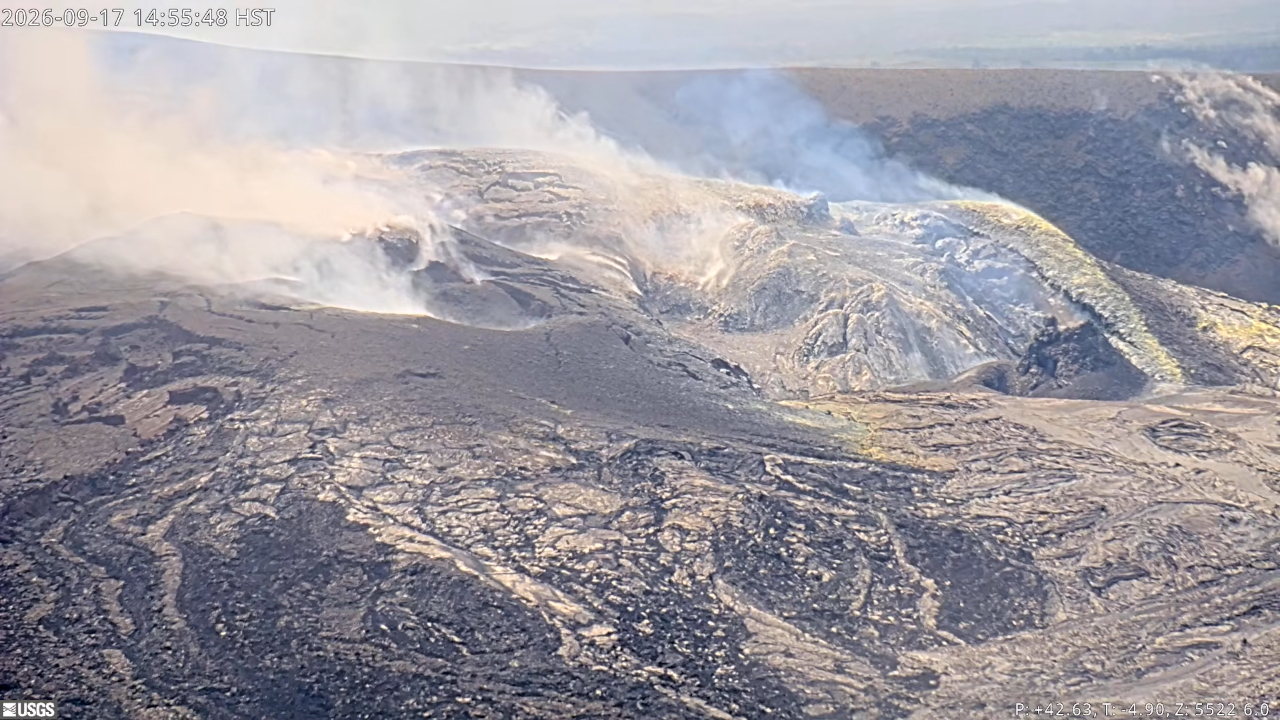

(BIVN) – The eruption at the summit of Kīlauea remains stalled between episodes as of Thursday.
This morning, the USGS Hawaiian Volcano Observatory reported the six new vents within Halemaʻumaʻu stagnated last night. As of 10 a.m. this morning, there is no active lava on the ground.
“There is no anomalous activity outside of the summit,” the Observatory noted, adding that minor summit deflation began at about 5 pm Wednesday last night. The rate of deflation slowed Thursday morning.
“No anomalous seismic activity or deformation has occurred outside of the summit region,” the Observatory reported. “However, tiltmeters on the East Rift Zone did show typical rainfall excursions early this morning. These changes are not related to magma movement.”
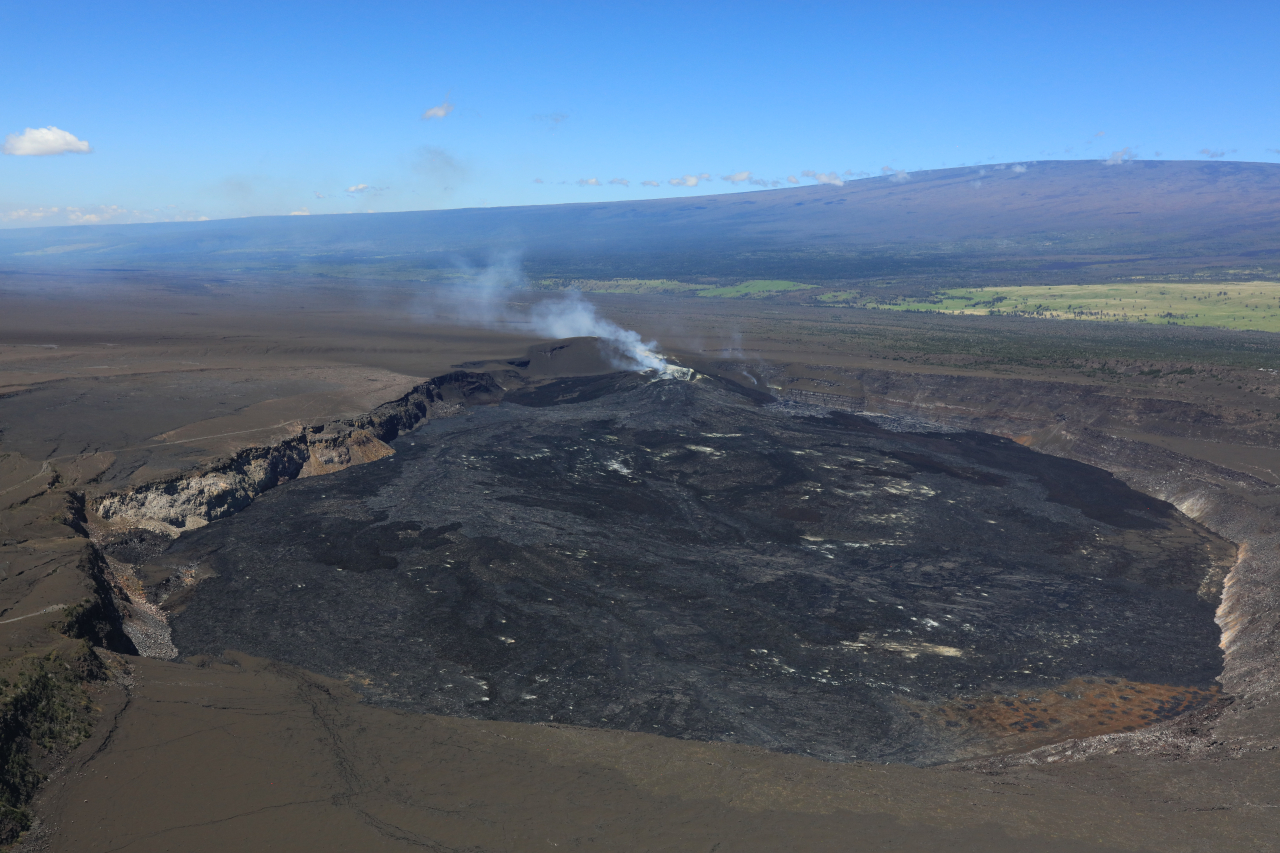
From the USGS HVO on Thursday morning:
Summit Observations:
Summit tilt and tremor began dropping around 5 p.m. HST yesterday just as vent 6 opened up north of the other vents. Shortly after, eruptive activity began to diminish on the new vents and was completely stagnated at all six vents by 8:30 p.m. HST. There were short-lived, small flows from several of the vents during the night as the vents depressurized.
Glow continued all night from the north-south-west vent complex along with flames at times. The vents were obscured by heavy rain and clouds in the early morning hours but no obvious changes in the intensity of glow from the vents could be detected. Spattering stopped at the north vent around 7 p.m. HST and about two hours later at the south and west vents.
Tremor began decreasing around 5 p.m. and by 9 p.m. HST was transitioning from continuous tremor to intermittent tremor bursts. Tremor bursts became dominant after 10 p.m. HST and strengthened until about 1:30 a.m. HST. Strong bursts continue this morning and are the dominant seismic signal across the summit. There were twelve earthquakes located across the summit region. Ten of these occurred within the last 8 hours, but do not form clusters in time or location.
The summit underwent a small deflation last night of about 2 microradians measured on the UWD tiltmeter. Slow deflation continues this morning but appears to be leveling off. The amount of deflation is similar to the deflationary “steps” recorded earlier in this repose period and in the periods leading up to episodes 51-54. The total inflation since the end of episode 54 is currently 14 microradians, over a microradian more than was lost during episode 54 fountaining.
During inter-episode pauses, the sulfur dioxide (SO2) emission rate from the summit typically varies between 1,000 and 5,000 tonnes per day. Moderate to strong trade winds (10 miles per hour, 5 meters per second or more) are pushing the degassing plume to the southwest of Kīlauea’s summit caldera this morning and are expected to continue. Models indicate that gases as well as fine ash and Pele’s hair would be transported to the south of Kaluapele if fountaining starts today with an episode 55.
Rift Zone Observations:
Rates of seismicity and ground deformation remain low in the East Rift Zone and Southwest Rift Zone. SO2 emissions from the East Rift Zone remain below the detection limit. No significant ground deformation was recorded in either rift zone, however, tiltmeters on the East Rift Zone did show typical, minor rainfall excursions early this morning. These changes are not related to magma movement.
Analysis:
The main north, south, and west vents continued to glow last night, indicating magma remains close to the surface in these vents. Current deflation is similar to the deflationary steps seen previously during the current repose period after the episode 54 fountaining. Even with the small deflation last night, pressure remains high within the system. Forecast windows for this episode can no longer be modeled due to the irregular changes in inflation and deflation. Current conditions remain favorable for either another fountaining episode or change in eruptive activity if inflation returns. Possibilities are outlined in the September 15 Status Report.
Kīlauea has been erupting episodically since December 23, 2024, from two vents (north and south) in Halema‘uma‘u. Lava fountaining episodes, which generally last for less than 12 hours, are separated by pauses of two or more weeks.
HVO continues to closely monitor Kīlauea and is in contact with Hawai‘i Volcanoes National Park and the Hawai‘i County Civil Defense Agency about eruptive hazards.
