
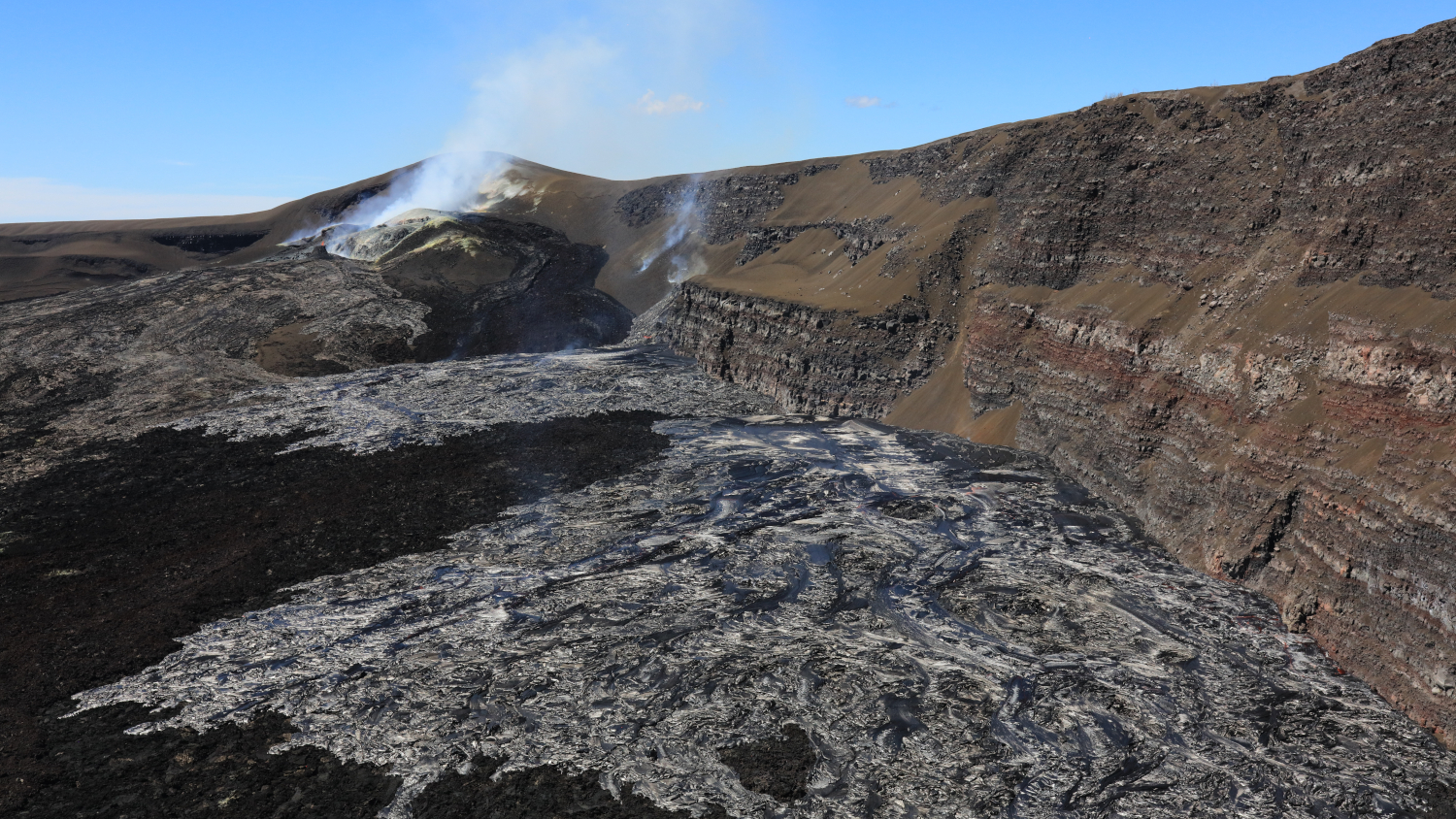

(BIVN) – As of Thursday evening, there were no active lava flows at the summit of Kīlauea. The established vent complex is glowing and spattering.
“Kīlauea summit deflation slowed and stopped by 9:00 a.m. HST,” the USGS Hawaiian Volcano Observatory reported, while the UWD tiltmeter was flat.
Scientists noted that no surface deformation has been detected outside of the summit. The Observatory said heavy rain was “producing a false inflationary peak on the Pu‘u‘ō‘ō (POC) tiltmeter,” as a Flood Advisory was in effect, at times, for Hawaiʻi Volcanoes National Park.
The latest Volcano Watch article, written by HVO geophysicist Ingrid Johanson, examines the current situation at Kīlauea:
Beginning with episode 5 in January, 2025, the USGS Hawaiian Volcano Observatory has been issuing forecast windows for when the next lava fountain will occur in Halemaʻumaʻu at the summit of Kīlauea. What do recent changes at the eruption site mean for the future of fountain forecasting?
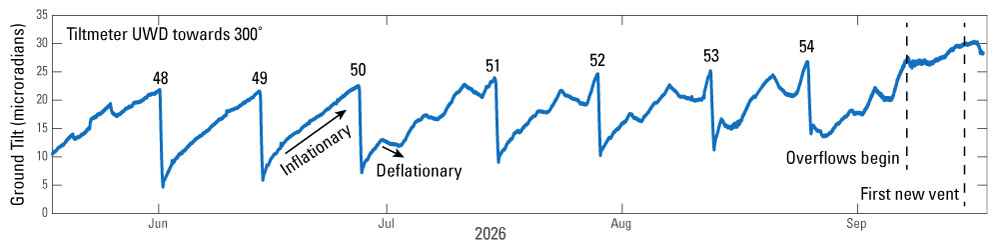
Forecasts have been based on observing the reinflation of the summit magma chamber using tiltmeter data. As detailed in past “Volcano Watch” articles, episodes typically begin when the ground tilt record has recovered as much tilt as was lost during the previous fountaining episode. The regularity of this process is what allowed the forecasts to be made. Recently, reinflation has become more unsteady and now, following the opening of new vents in Halemaʻumaʻu on September 14-16, it appears the behavior of the volcano may have changed.
During recent pauses between fountaining episodes, tiltmeters would sometimes indicate that the magma chamber was going through a period of deflation, which would alter the forecast. The deflation periods usually lasted 1-2 days and had a variety of amplitudes, meaning the amount of deflation in each period is not consistent. Once inflation started again, sometimes it came back with the same rate as before the deflation (which would mean the fountaining was delayed), and sometimes inflation would come back at a faster rate, such that there wasn’t much noticeable delay at all.
Episode 53 was an example of this second pattern. Summit tiltmeters were showing deflationary tilt as the forecast window got closer. Once the deflation period was over, summit inflation came roaring back at a faster rate of inflation and the episode started in just over a day. This variability was also on display during recent activity.
Tilt variations during the pauses have become more common with time. Prior to episode 42, deflation periods were rarer and usually associated with overflows from the vents during the precursory period. More recently, pauses have been accompanied by several of these deflations. With hindsight, the increasing variability of reinflation seems like a possible sign of the changes to come.
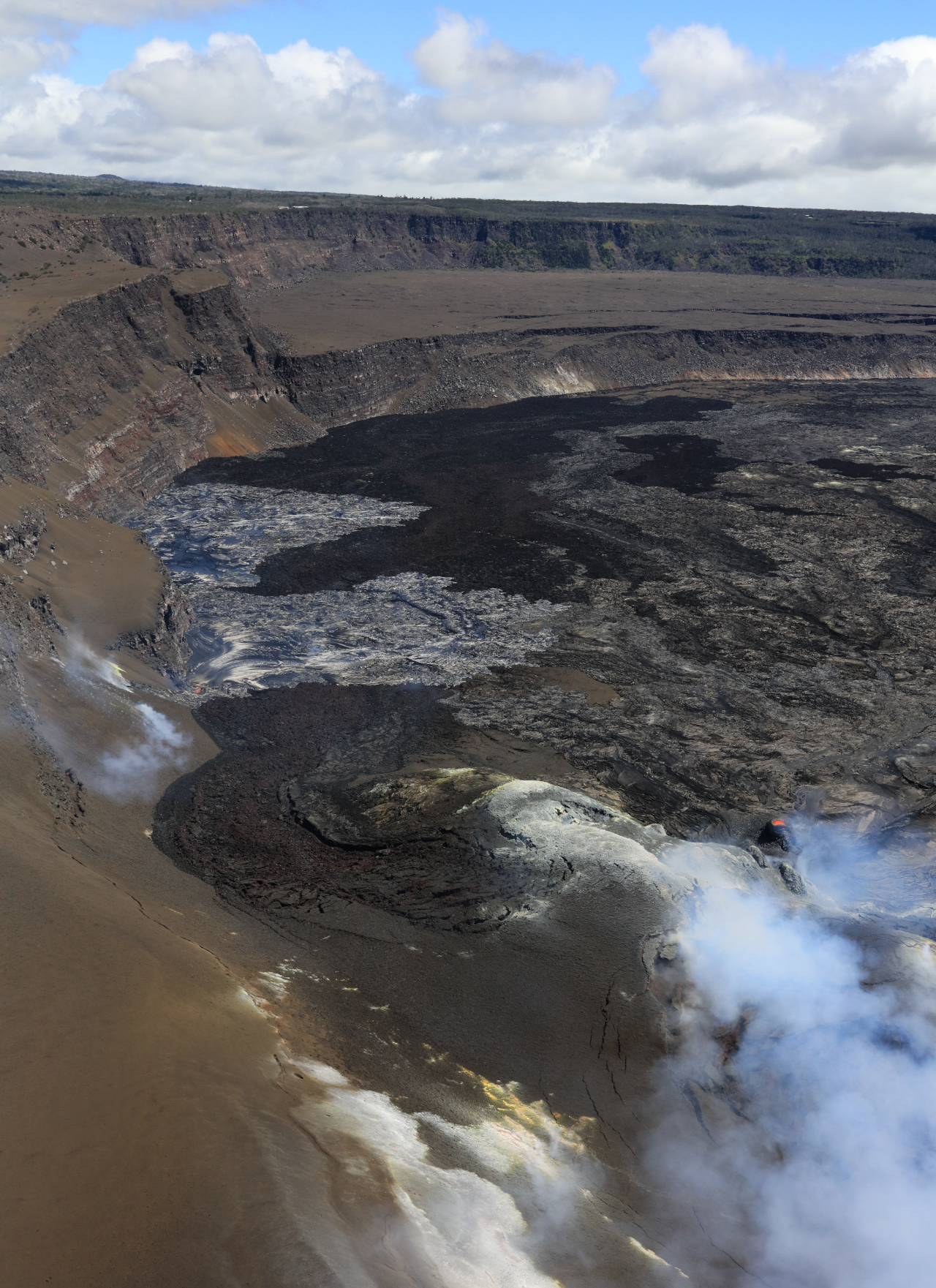
Following episode 54, reinflation of the magma chamber was quickly interrupted by a period of deflation. Two more deflation periods were observed, until overflows from the north vent began on September 7, after which summit tiltmeters recorded little change in tilt. However, on September 10, inflationary tilt began again and continued through the most significant change to the eruption site so far. On September 14, 2026, three new vents opened north of the existing vent complex, followed by another two nearby on September 15, and a sixth on September 16.
The reason for the deflation periods is not known. Tiltmeters show that the deflationary tilt is in line with inflationary tilt, meaning that the same source (Halemaʻumaʻu magma chamber) is likely responsible for both signals. They are reminiscent of a phenomenon called Deflation-Inflation events (DI-events) that have been commonly observed at Kīlauea. DI-events have a unique shape that is not as evident in more recent tilt data, making it unclear whether these newer periods should be classified as DI-events. Still, a shared underlying mechanism cannot be ruled out.
The origin of DI-events is also somewhat mysterious. However, while the active vent was at Puʻuʻōʻō on the East Rift Zone of Kīlauea before 2018, it was noted that Puʻuʻōʻō would also experience a DI-event after a short delay following a summit DI-event. This means that deflation during a DI-event wasn’t because more magma was leaving the magma chamber (which would have caused rift zone inflation), but because less magma was entering it. This means there is reason to think that the variability in reinflation during recent pauses is due to variability in the supply of magma into the magma chamber.
It is too soon to know for sure whether fountaining has ended at the summit, and too soon to know if the new vents that have opened will persist. Earthquake activity has risen slightly around Kīlauea’s summit, but we currently see no anomalous deformation or seismic activity in the East Rift Zone or Southwest Rift Zone that would indicate activity is moving out of Kīlauea’s summit. Scientists are keeping a close eye on Kīlauea, tracking monitoring data to see if recent changes develop further at the summit.
