

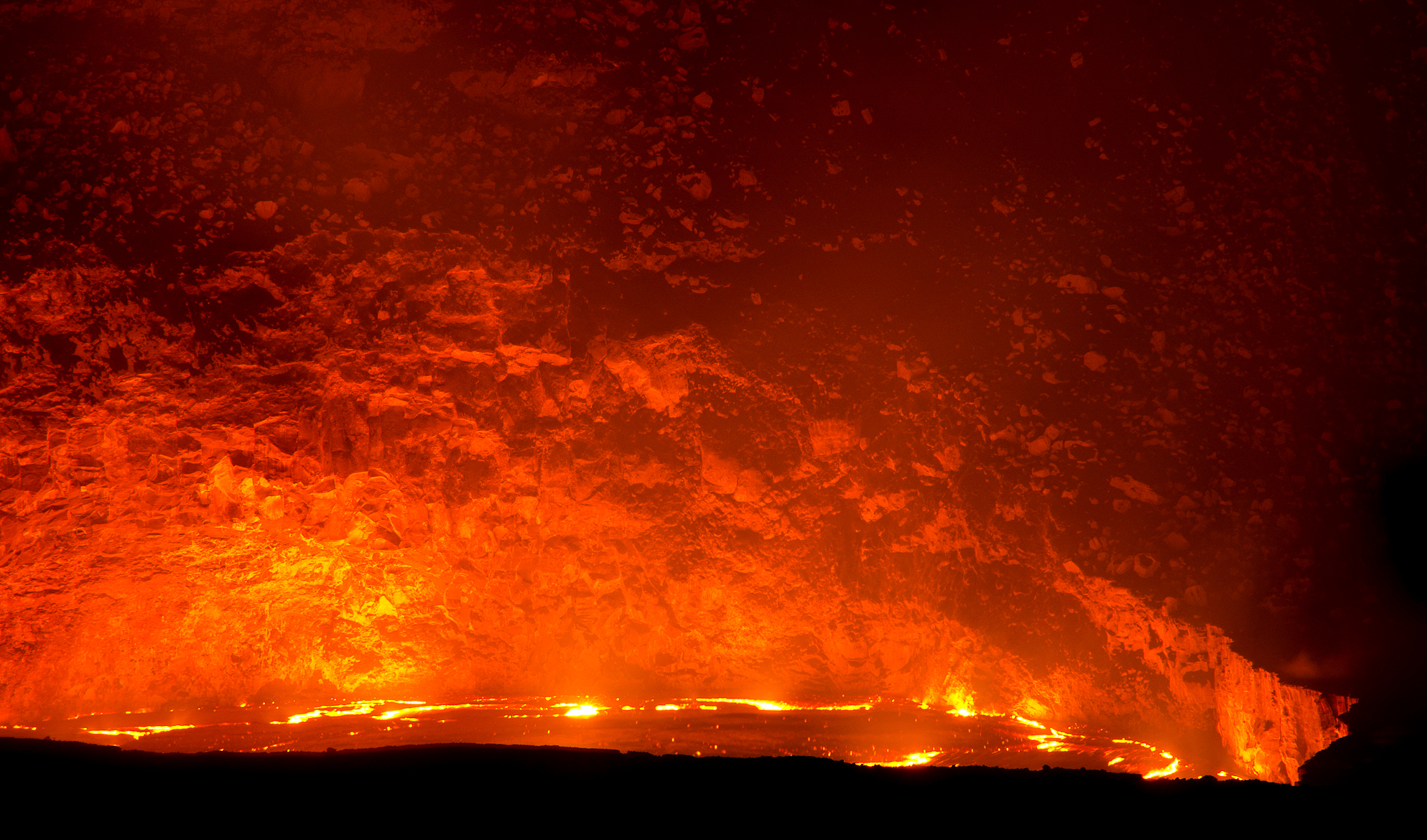
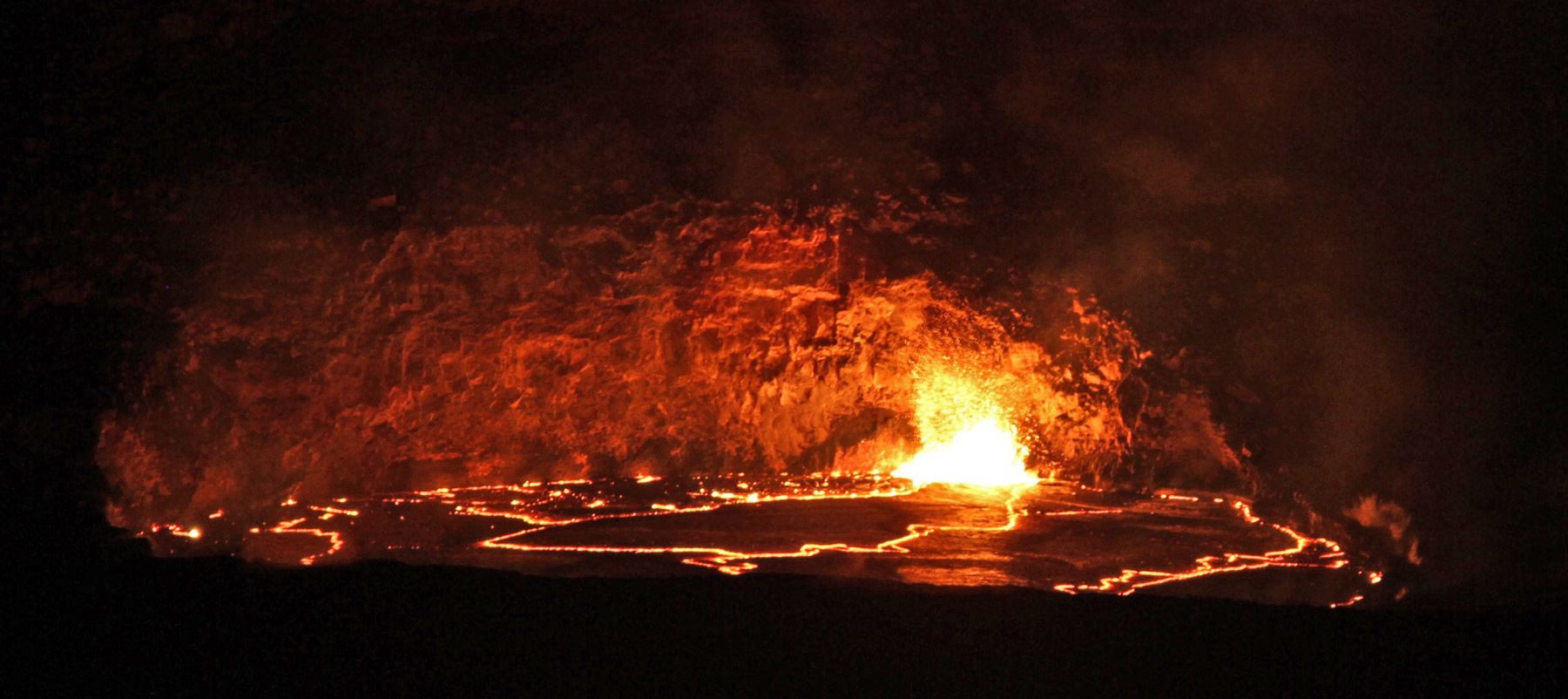
HAWAII VOLCANOES NATIONAL PARK – The lava lake at the summit of Kilauea volcano reached the rim of the Overlook crater vent this morning, “during a period when all spattering stopped, but did not get quite high enough to overflow onto the Halemaʻumaʻu Crater floor,” scientists report.
The USGS Hawaiian Volcano Observatory says there was no significant change in tilt recorded at Kīlauea’s summit over the past day. This week’s rise in the level of the lava lake to record heights has correlated with inflation recorded at the summit; about 7.5 microradians since inflation started on Tuesday, April 21. The radial tilt leveled off into slight deflation on Monday but as of this posting Tuesday morning it has returned to steady inflation. The lava lake remained at a steady 10-13 feet below the rim on Monday.
The USGS Hawaiian Volcano Observatory says seismicity is elevated beneath Kilauea’s summit and upper East and Southwest Rift Zones. Sulfur dioxide emission rates averaged 3000-5200 tonnes/day for the week ending April 21.
HVO has installed a new webcam at the Halemaʻumaʻu Overlook. The new angle compliments the four views already trained on the volcano vent at the summit.
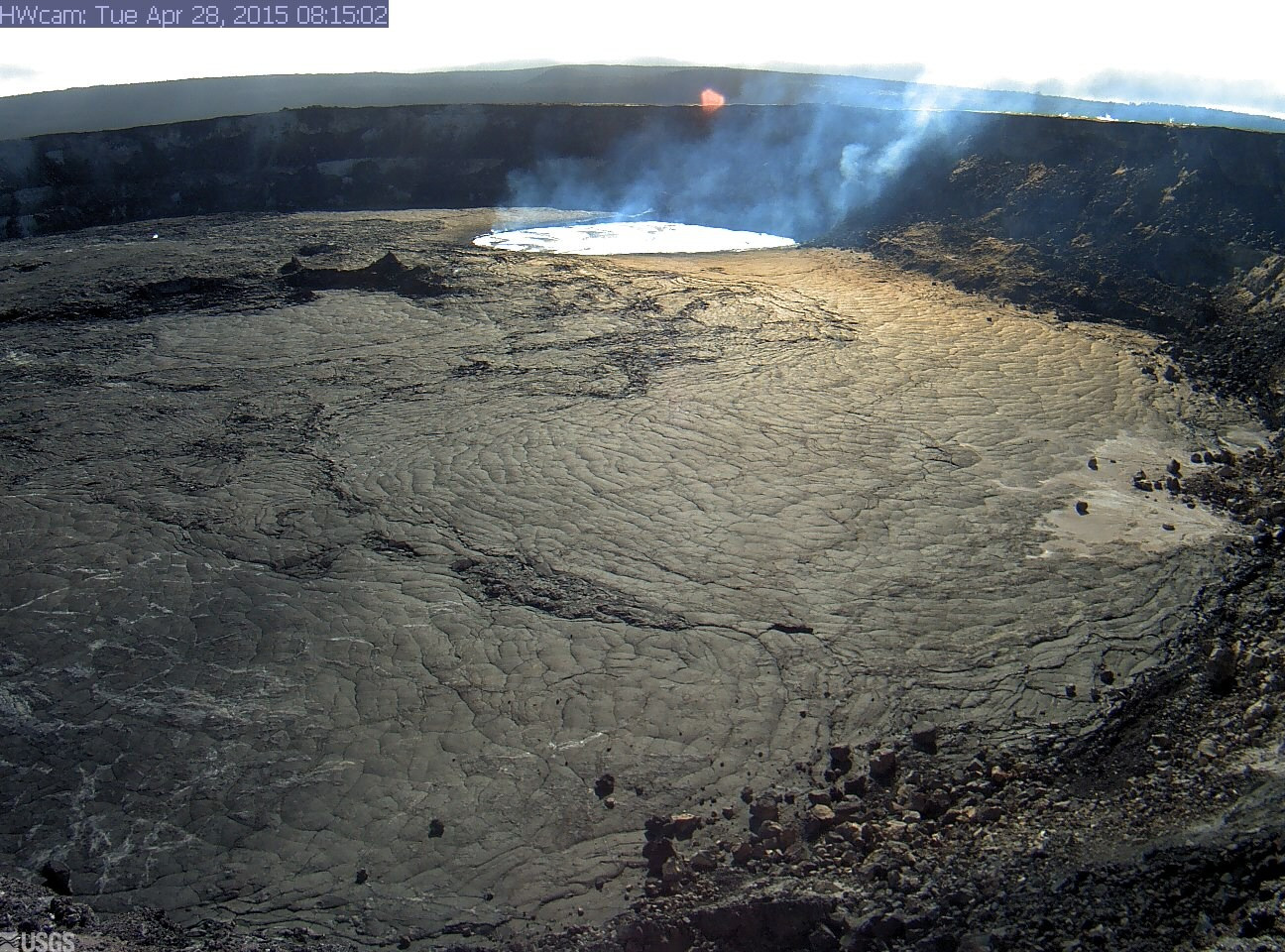
As the lava level rises, some residents have expressed concern. To alleviate fears, Hawaii County Civil Defense issued an eruption information update Tuesday morning:
The recent rise of the lava lake within the Halema‘uma‘u Crater vent at the summit of Kīlauea has not resulted in any significant change or increased activity at Pu‘u ‘Ō‘ō. All active flows from Pu‘u ‘Ō‘ō remain within about 5 miles of the Pu‘u ‘Ō‘ō vent, and about 8 miles from the area of Highway 130 near Pāhoa. The team at the USGS Hawaiian Volcano Observatory is maintaining close observations of all volcanic activity and the community will be kept informed of any changes in the level of volcanic threat. Presently, the Kilauea Volcano alert level remains at the WATCH or orange threat level and there is no immediate threat to any down slope communities.Hawaii County Civil Defense on April 28 at 8:03 a.m.
Now that the laval lake is visible to the public, the activity has drawn thousands of additional visitors to Hawai‘i Volcanoes National Park. Over the last several days, hopeful onlookers waited up to 30 minutes or longer to park. Rangers are having to redirect vehicles during peak visitation hours to park at the Kīlauea Military Camp ball field. From there, park officials say visitors can hike one mile to the Jaggar Museum observation deck, the closest and best vantage point to view the spectacular lava lake.
Visitors should come prepared to ensure a safe and enjoyable park experience. We encourage people to avoid peak hours, and arrive after 10 p.m. and before 4 a.m. if possible, or they will likely wait in line for parking. The park remains open 24 hours a day.” Superintendent Cindy Orlando
The National Park Service also offered these tips for an optimal viewing experience:
- Be prepared to hike one mile each way between Kīlauea Military Camp ball field and the Jaggar Museum observation deck on Crater Rim Trail. Wear sturdy closed-toe shoes, bring rain gear, water, binoculars, a flashlight, and extra batteries.
- Carpool if possible to reduce the number of vehicles in the parking areas.
- As a courtesy to other visitors, no “tailgating” in the Jaggar Museum or Kīlauea Overlook parking lots. Choose another picnic location so others have a chance to view the eruption.
- To observe viewing and weather conditions, monitor the USGS Hawaiian Volcano Observatory webcams. The KI camera provides a panoramic view of Halema‘uma‘u Crater from HVO.
- High levels of dangerous sulfur dioxide (SO2) gas and volcanic ash can be blown over Jaggar Museum by southerly winds. These gases are a danger to everyone, particularly to people with heart or respiratory problems, young children and pregnant women. Kīlauea Visitor Center offers updates on air quality 24 hours a day, and visitors can monitor the Hawaii SO2 network website.
The public is also reminded that park entrance fees apply and that the use of unmanned aircraft (drones) is prohibited in all national parks. An incident at the park made headlines Monday: rangers tased a park visitor who was operating a drone at the overlook.

Residents “expressed concern”about what, exactly? How would the lava overflowing onto the crater floor be any kind of danger to anyone anywhere meriting an announcement from the county civil defense? Preposterous.
And as for the rangers tasing some guy flying his drone… way to go smoky… I’ll feel a lot safer next time I’m up there knowing that if someone refuses to show you their identification (which is not against the law) that you’ll tase them, or worse, and I’ll be safe knowing that you have kept me safe by not allowing some guy to go back to his car and go home with his family. Going to his car is “acting erratically”? That’s cop talk for “he didn’t obey our illegal command”.
PunaPerson – I think that any INCREASE in lava anywhere makes someone in Pahoa (which must be a very stressful place to live these days!) worry that LAVA is increasing in the flows throughout the WHOLE Volcano. It’s an entire system of Pu’u’s, right? I think this was a very important announcement. Why wouldn’t they alleviate worry for that community that already has lost buildings and businesses due to the flow in their backyard?
A little geology lesson might help you understand this a bit better. Visit their website and learn how this all works and I think your compassion level will rise as this lava level rises.
Thanks for the suggestion, but I believe I have an adequate basic understanding of vulcanism on Hawaii island. All anyone has to do is look at the maps on the USGS website to see that the current outbreaks are 8 (eight) MILES from Pahoa. The location and intensity of magma movements and lava flows is always active and always changing, but activity at Halemaumau has no causal connection with lava flows immediately threatening Pahoa, or anywhere else.
One house was destroyed by the lava flow near Pahoa. What “businesses” were lost to the lava flow? All the businesses in the Pahoa Marketplace have re-opened over a month ago.
See today’s (Thursday, April 30, 2015) BIVN article on the Halemaumau activity and how it has very little to no relation to the downslope potential threat to Pahoa here: https://www.bigislandvideonews.com/2015/04/30/volcano-scientists-issue-special-statement-on-lava-lake-overflow/
Perhaps you will educate yourself with “a little geology lesson” about how things work.
Why no comment on revealing all the “businesses” that have been lost to the lava flow? I’m still waiting.