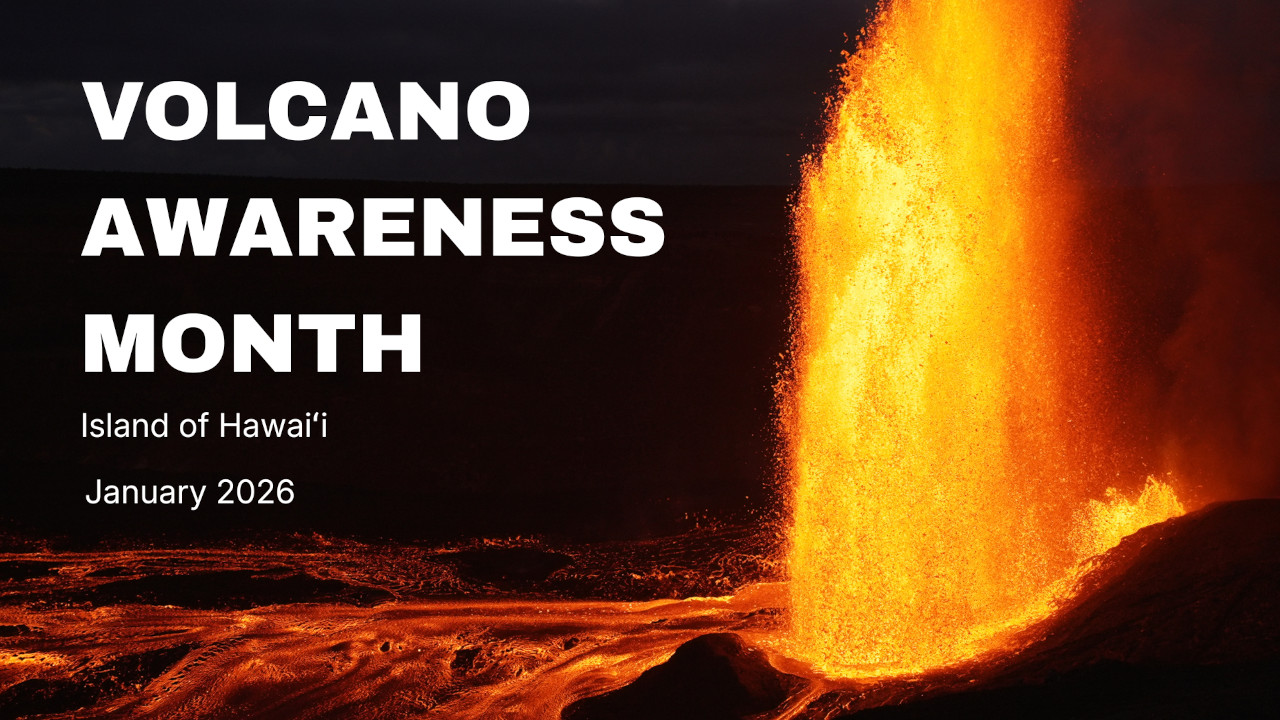
(BIVN) – This week’s Volcano Watch article about the upcoming Island of Hawaiʻi Volcano Awareness Month was written by USGS Hawaiian Volcano Observatory geologist Katie Mulliken:
As the year 2025 comes to a close, we reflect on the historic past year of volcanic activity on the Island of Hawaiʻi. Thirty-eight episodes of lava fountaining at the summit of Kīlauea remind us that we live on a volcanic landscape and should be aware of the volcanic processes and hazards that can affect us.
In January 2026, join USGS-Hawaiian Volcano Observatory (HVO) staff, and our partners at Hawaiʻi Volcanoes National Park, the University of Hawaiʻi at Hilo (UHH), and the County of Hawaiʻi Civil Defense Agency, in a series of programs being hosted around the Island of Hawaiʻi. We’ll be doing talks, guided walks, or available to talk story about eruptions and earthquakes in Hawaii, how we monitor them, and hazards associated with these events.
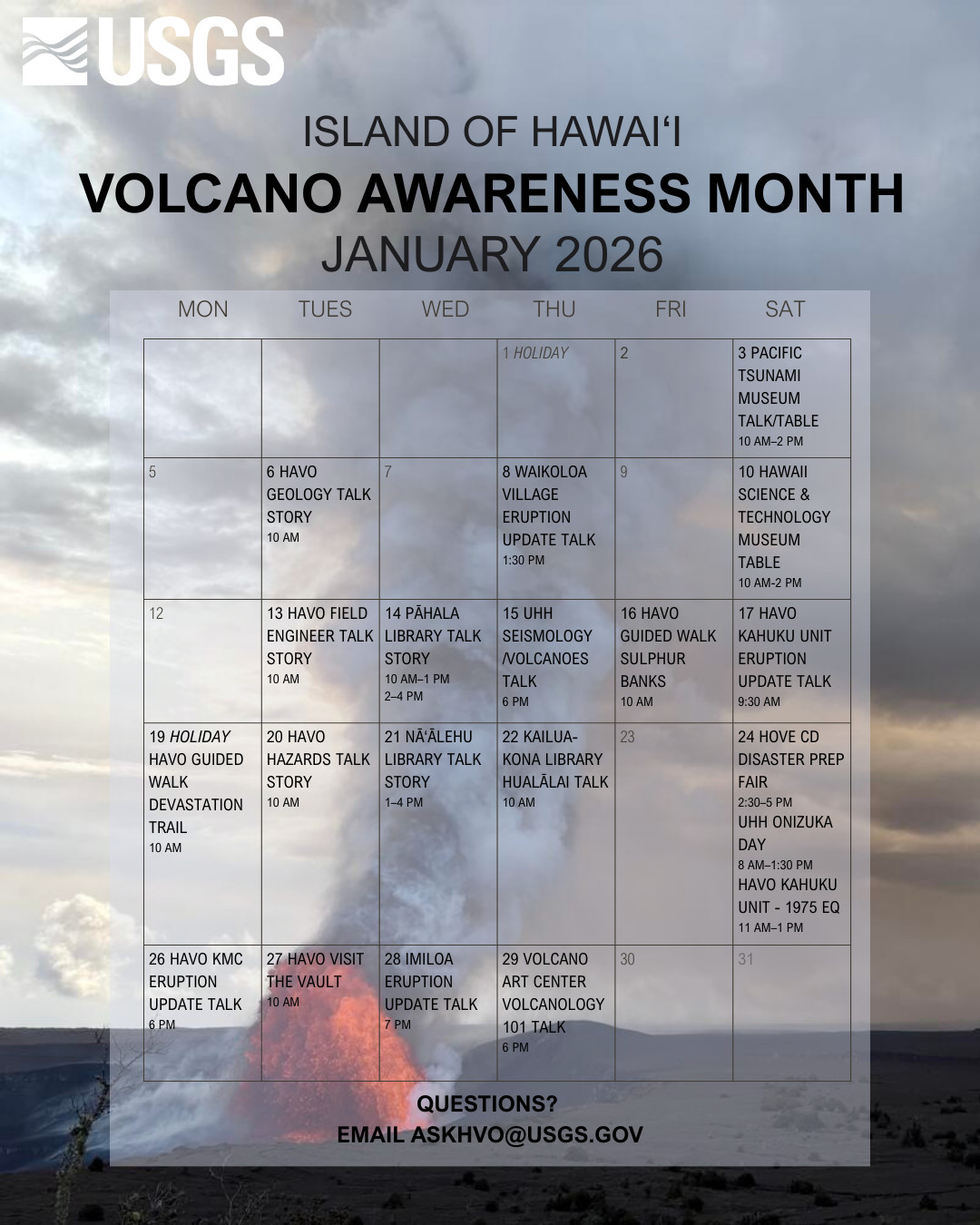
Island of Hawaiʻi Volcano Awareness Month January 2026 calendar of events. (USGS HVO)
Kīlauea lava fountaining episodes over the past year have occurred within Hawaiʻi Volcanoes National Park, and have been visible from overlooks around Kaluapele (Kīlauea summit caldera). While the eruption has been fascinating for scientists and viewers alike, it also demonstrates that eruptions can have far-reaching effects.
Lava flows have been contained within the caldera, and larger particles that fall out from the lava fountains (called tephra which include Pele’s hair) have blanketed the areas immediately downwind of the eruptive vents. These areas are extremely hazardous and remain closed to the public. Smaller particles from the fountains, including ash and Pele’s hair, as well as volcanic gas emissions, are transported downwind and have affected communities in the district of Kaʻū and farther.
Each Tuesday in January, HVO staff will be in Hawaiʻi Volcanoes National Park. Learn from HVO geologists, field engineers, and hazards specialists during informal talk story sessions, during which you can hear about their work and ask questions. Or, venture into the Whitney Vault near Volcano House, where you’ll learn about the original volcano monitoring devices that were housed there and how our technology has changed over time. Additional guided walks in Hawai‘i Volcanoes National Park will be offered at Haʻakulamanu on January 16 and Devastation trail on January 19.
In the District of Kaʻū, where vog and volcanic ash from Kīlauea’s recent eruptive episodes have affected communities, HVO will host talk story sessions at the Pāhala and Nāʻālehu Public Libraries on January 14 and 21, respectively. Come to the Kahuku Unit of Hawaiʻi Volcanoes National Park on January 17 to hear a Kīlauea eruption update. On January 24, learn about the impacts of the November 29, 1975, magnitude-7.7 earthquake and tsunami at the Kahuku Unit of Hawaiʻi Volcanoes National Park in the morning, and then attend the County of Hawaii Civil Defense Agency’s disaster preparation fair at Ocean View in the afternoon.
In Volcano area, hear a Kīlauea summit eruption update at the Kīlauea Military Camp the evening of January 26, and learn all about volcanology and how we monitor volcanoes during an evening presentation on January 29 at the Volcano Art Center in Volcano Village.
Several Volcano Awareness Month events are being hosted in Hilo, at various locations throughout January. Join HVO staff at the Pacific Tsunami Museum (January 3), Hawaii Science & Technology Museum (January 10), or at UHH for Onizuka Day on January 24. At these locations, you can come see the youngest rocks on Earth— pieces of the lava fountains that fell to the ground, or slabs of pāhoehoe collected from the floor of Halemaʻumaʻu crater. You’ll also have an opportunity to learn about how volcanoes and earthquakes are related in Hawaii during an evening talk at UHH on January 15, or hear an update on the summit eruption of Kīlauea at the Imiloa Astronomy Center on January 28.
An update of the Kīlauea summit eruption will also be offered in Waikoloa Village on January 8. And residents in Kailua-Kona, who live on Hualālai volcano, can hear a presentation on the history of Hualālai activity, as well as vog from other erupting volcanoes, on January 22.
Whether you live in Volcano Village, and can hear the roaring of Kīlauea’s episodic lava fountains, or in Kona, where you may be affected by the vog (volcanic air pollution), we hope to see you at one of the Volcano Awareness Month events this coming January. If you have any questions, please let us know at askHVO@usgs.gov.

by Big Island Video News
on at
STORY SUMMARY
ISLAND OF HAWAIʻI - Island of Hawaiʻi Volcano Awareness Month events will include presentations, guided walks, and eruption updates.