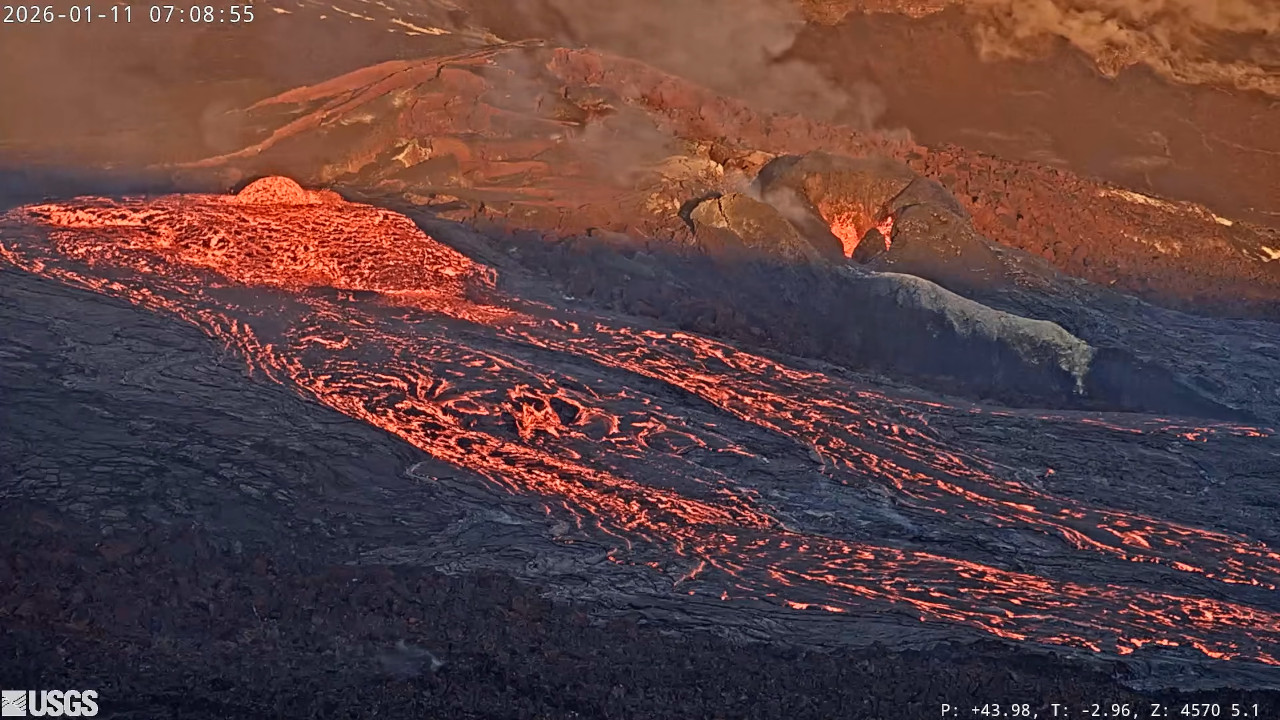
(BIVN) – Kīlauea continues to build to another anticipated episode of high lava fountaining at the summit, although the Hawaiʻi island volcano has maintained a steady precursory phase of intermittent, low-level activity for over a day.
UPDATE – (9:30 a.m.) – “Activity has decreased this morning to about one overflow per hour from the south vent and only spattering from the (north) vent,” the USGS Hawaiian Volcano Observatory reported on Sunday morning. “Kīlauea summit region showed deflation on tiltmeter UWD since about 4 p.m. yesterday. The prolonged precursory activity has extended the forecast window for the onset of episode 40 high fountaining from now to January 17.”
The USGS Volcano Alert Level remains at WATCH, with all activity confined to Halemaʻumaʻu crater within Hawaiʻi Volcanoes National Park.
Throughout the day on Saturday, the north and south vents produced vigorous spatter, dome fountains, and lava overflows.
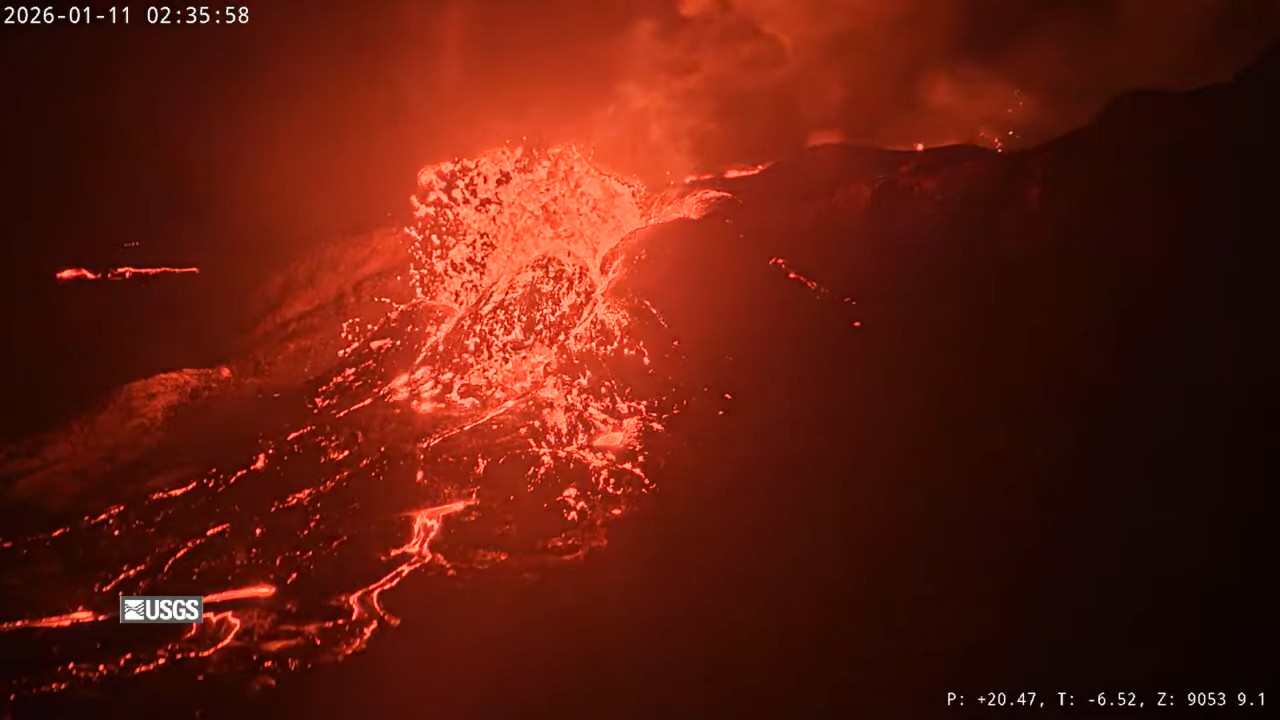
USGS webcam shows lava activity at the summit before sunrise
The USGS Hawaiian Volcano Observatory has not yet issued a Volcanic Activity Notice for episode 40. Scientists noted on Saturday that high lava fountains could begin at any time.
UPDATE – (9:30 a.m.) – From the USGS HVO on Sunday morning:
Nearly continuous overflows continued from the north vent most of yesterday and throughout most of last night. Intermittent dome fountains continued to form within the south vent over the past day and last night, feeding pulses of lava overflowing from the south vent several times an hour. Activity at the north vent decreased after 3 a.m. this morning, with lava only intermittently overflowing the vent. As of this morning, only spattering is visible within the north vent and large overflows from the south vent have slowed to about one per hour with the last overflow ending just before 9:10 a.m. HST. Overflows from the south vent continue to feed an active lava flow that extends over 1500 feet (500 meters) across the floor of Halemaʻumaʻu crater.
Since the end of episode 39, the Uēkahuna tiltmeter (UWD) has recorded 23 microradians of re-inflation beneath Kīlauea summit; however, UWD showed nearly a microradian of deflation to 22 microradians since about 4 p.m. yesterday associated with the overflows from the north and south vents last night. The SMC tiltmeter mirrors the UWD tiltmeter, but SDH shows continued slight inflation, possibly influenced by the deeper south caldera magma chamber.
Volcanic gas emission rates have dropped significantly since the end of episode 39 but probably remain in the range of 1,000 to 5,000 tonnes of sulfur dioxide (SO2) per day, as typically observed during previous eruptive pauses. Winds are light out of the north (less than 10 mph or 2 m/sec) and are forecast to become more southerly in the afternoon. The plume is moving to the south-southwest of Halema’uma’u.

by Big Island Video News
on at
STORY SUMMARY
HAWAIʻI VOLCANOES NATIONAL PARK - The summit has maintained low-level lava activity for an entire day, but episode 40 has not yet entered its high fountain phase.