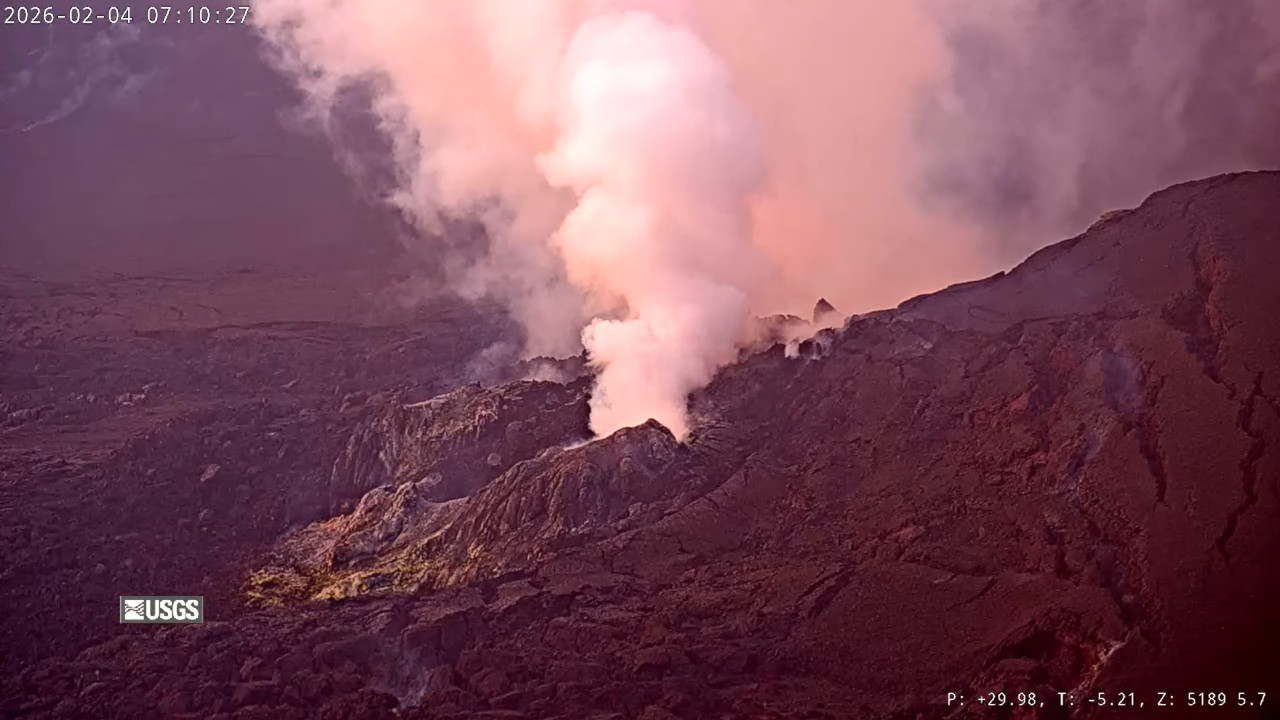
(BIVN) – The ongoing eruption at the summit of Kīlauea is paused, as the Hawaiʻi island volcano builds to its next episode of high lava fountaining.
The USGS Hawaiian Volcano Observatory reports seismic tremor has continued over the past few days. On Tuesday, scientists said “pulses of increased tremor beneath the summit correlated with periods of increased brightness at the south vent, suggesting that gas pistoning is probably occurring within that conduit.”
“Areas near Kīlauea summit including Hawaiʻi Volcanoes National Park and nearby communities have been experiencing higher than usual levels of vog (volcanic air pollution) due to ongoing light and variable winds,” the scientists noted on Tuesday.
Summit inflation continues, and the most recent forecast for the onset of episode 42 lava fountaining is between February 11 and 16. The Observatory says the forecast window will be refined as more data become available.
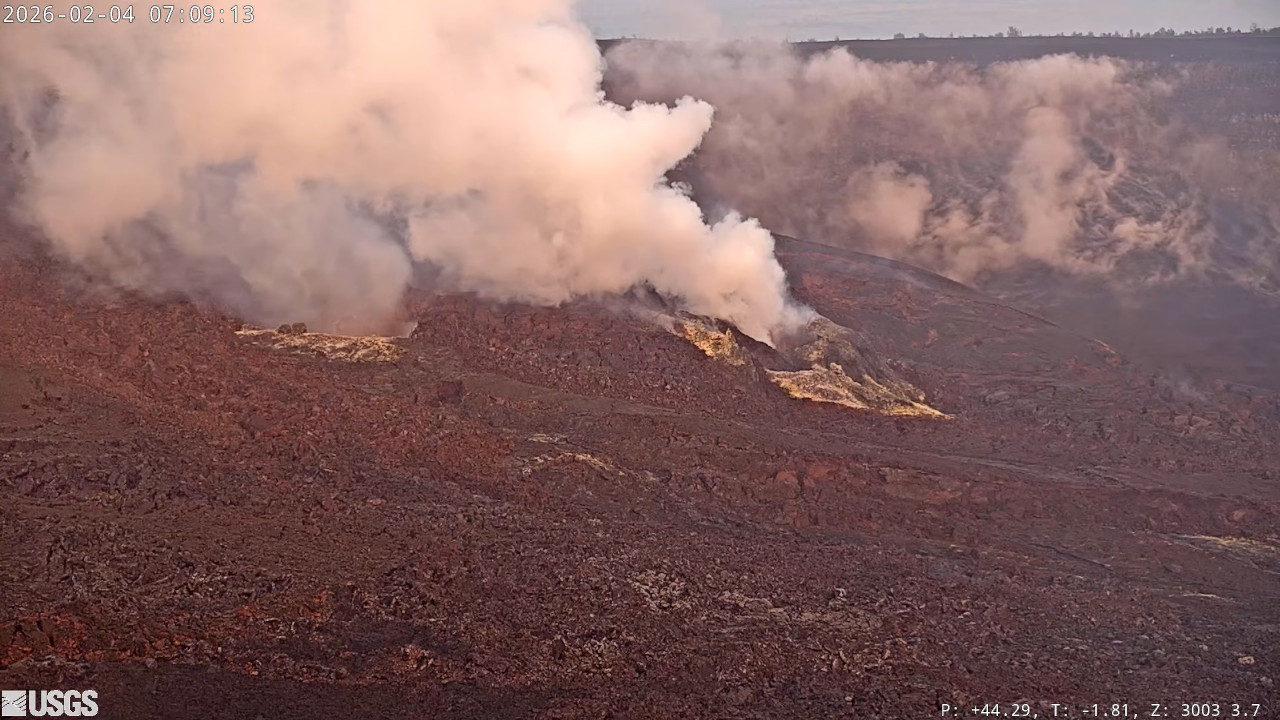
USGS webcam view of the Kīlauea summit vents on Wednesday morning.
From the most recent update by the USGS HVO:
Summit Observations:
Intermittent moderate to bright glow from the south vent was visible on webcams overnight, similar to recent nights. Very little glow was visible from the north vent and appeared to be associated with small flames, also similar to recent nights.
Seismic tremor continued over the past 24 hours. Recurring pulses of increased tremor beneath the summit occurred several times per hour. These pulses correlate with periods of increased brightness at the south vent, suggesting that gas pistoning is probably occuring within that conduit. Two earthquakes less than magnitude 1 were located beneath Kīlaueaʻs summit over the past 24 hours.
The Uēkahuna tiltmeter (UWD) has recorded 18.6 microradians of inflationary tilt since the end of episode 41, including less than one microradian of inflationary tilt in the past 24 hours. The overall rate of inflation was lower than rates observed in recent days due to small variations in observed tilt.
The sulfur dioxide (SO2) emission rate from the summit was last measured on February 2 at 5,172 tonnes per day, which is slightly higher than the typical range of 1,000 to 5,000 tonnes of SO2 per day observed during previous eruptive pauses. This is considerably lower than rates observed during lava fountaining episodes. Areas near Kīlauea summit including Hawai’i Volcanoes National Park and nearby communities have been experiencing higher than usual levels of vog (volcanic air pollution) due to ongoing light and variable winds. The National Weather Service forecast indicates calm wind becoming east southeast 5 to 8 mph today, with light and variable wind tonight.
Rift Zone Observations:
Rates of seismicity and ground deformation remain very low in the East Rift Zone and Southwest Rift Zone. SO2 emissions from the East Rift Zone remain below the detection limit.
Analysis:
The rapid rebound of inflationary tilt, glow from the vents, and presence of low-level volcanic tremor after episode 41 indicate that another lava fountaining episode is likely. Models are suggesting that episode 42 is likely to start sometime around Valentine’s Day with a current forecast window of February 11 to 16.
Kīlauea has been erupting episodically since December 23, 2024, primarily from two vents (north and south) in Halema‘uma‘u. Eruptive episodes, which generally last for less than 12 hours, are separated by pauses that can be as long as over two weeks.
HVO continues to closely monitor Kīlauea and is in contact with Hawai‘i Volcanoes National Park and the Hawai‘i County Civil Defense Agency about eruptive hazards.

by Big Island Video News
on at
STORY SUMMARY
HAWAIʻI VOLCANOES NATIONAL PARK - The most recent forecast for the onset of episode 42 lava fountaining is between February 11 and 16, scientists say.