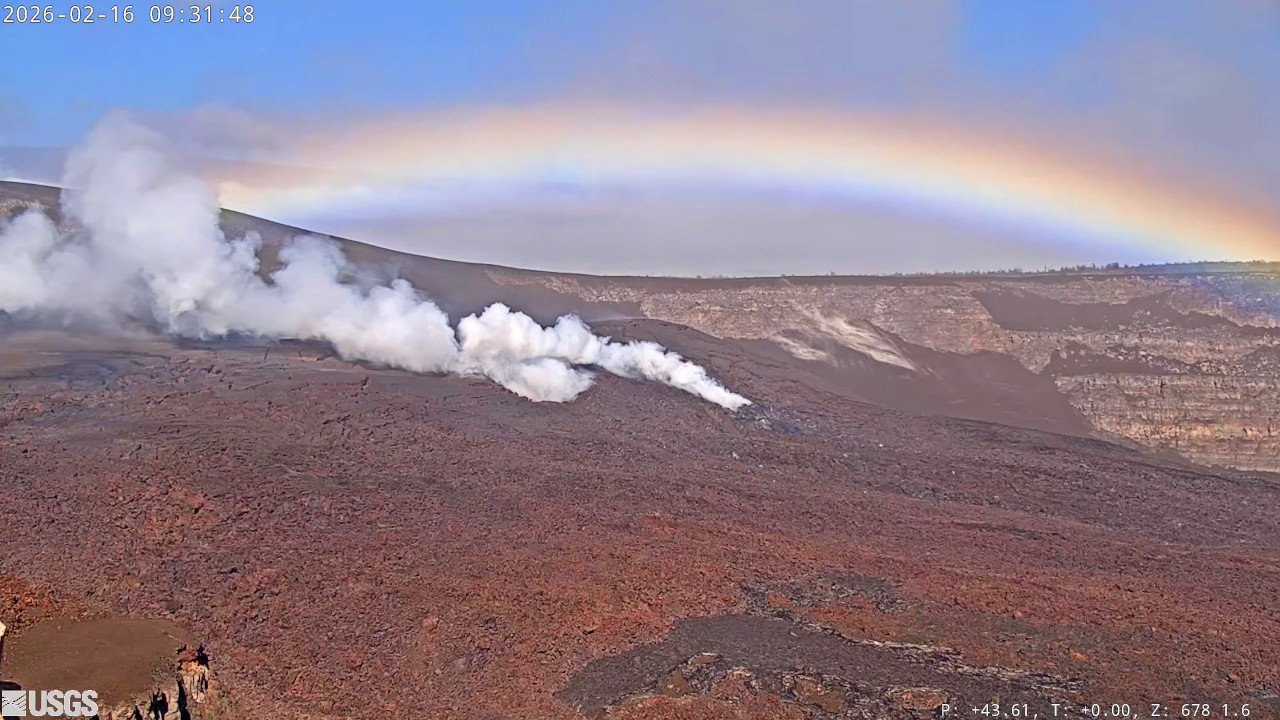
(BIVN) – The ongoing eruption at the summit of Kīlauea volcano on Hawaiʻi island is once again paused following nearly 10-hours of high lava fountaining on Sunday.
Episode 42 came to an end at 11:38 p.m. HST on Sunday night. The final moments were punctuated by a final high jet of lava, followed by high flames burning at both vents. Bright glow continued from both vents through the night. On Monday, both vents were quiet and “emitting robust degassing plumes”, geologists noted.
33.7 microradians of deflation were recorded at the summit during the high lava fountaining. The Uēkahuna tiltmeter began recording inflation once episode 42 ended. “There is not enough data to issue forecast for the onset of episode 43 lava fountains,” the USGS Hawaiian Volcano Observatory reported on Monday, “but it is likely 2-3 weeks away.”
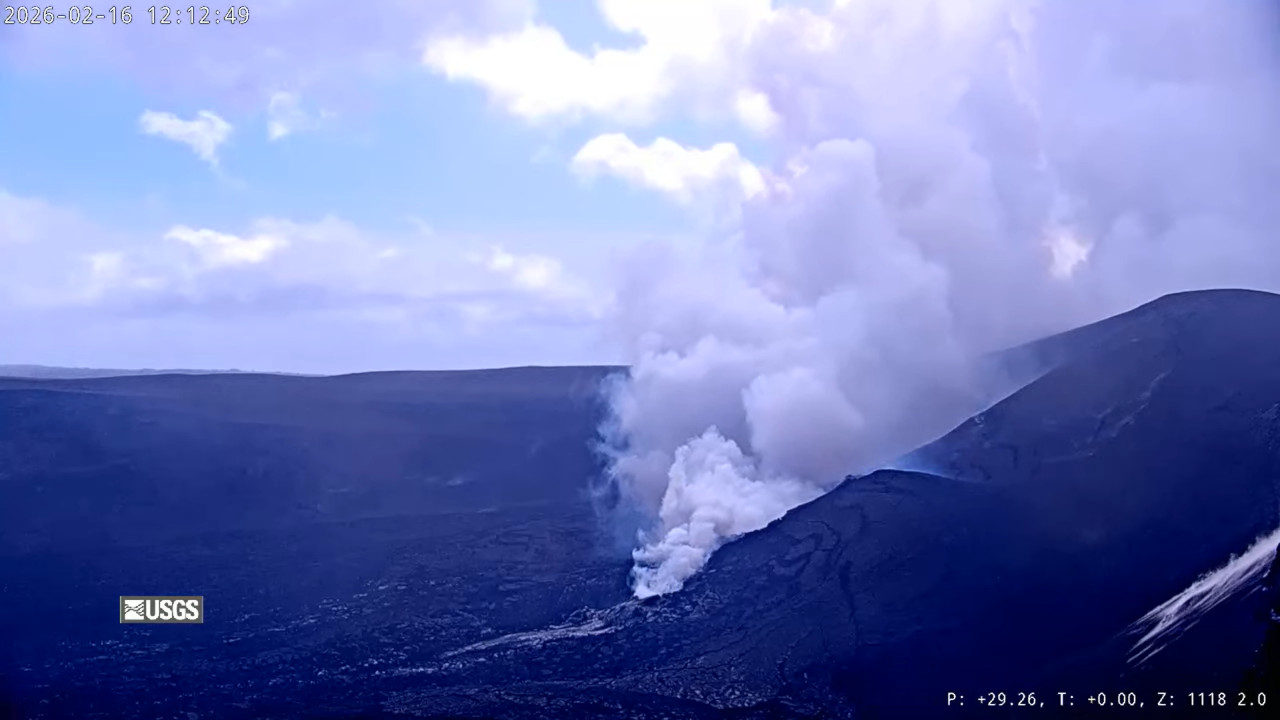
USGS webcam shows the inactive Kīlauea summit vents emitting robust degassing plumes on Monday.
Tephra fall outside of the closed area of Hawaiʻi Volcanoes National Park was reported to be relatively light during episode 42. “Fine ash and Peleʻs hair was reported falling in Pahala, Punaluʻu, and Nāʻāehu to the southwest of Halemaʻumaʻu crater in Hawaiʻi Volcanoes National Park,” the Observatory stated.
The USGS HVO provided this “Episode 42 Chronology” following the event:
Episode 42 lava fountaining from the north and south vents stopped at approximately 11:38 p.m. HST on February 15. The south vent dropped rapidly, then jetted back up for about 30 seconds between 11:34 and 11:36 p.m. HST. During the last 2 minutes, activity from the south vent was mostly narrow jets. The north fountain began to slowly drop in height but jetted back up about a minute before the episode ended. Episode 42 ended after 9 hours and 48 minutes with both the north and south vents active for most of the eruption. The highest peak or instantaneous effusion rate of 1000 cubic yards (780 cubic meters) per second occurred around 3:00 p.m. HST on February 15. Episode 42 ended with an average effusion rate of 430 cubic yards per second (330 cubic meters per second). An estimated 15 million cubic yards (11.4 million cubic meters) of lava erupted and covered about 50% of Halemaʻumaʻu crater floor. The Uēkahuna tiltmeter (UWD) recorded about 33.7 microradians of deflationary tilt during episode 42.
The onset of episode 42 fountaining of the ongoing Halemaʻumaʻu eruption occurred at 1:50 p.m. HST on February 15, 2026, marked by a sharp increase in tremor and deflationary tilt at recorded at the Uēkahuna tiltmeter (UWD). North and south vent fountain heights peaked between 2:00 and 3:00 p.m. HST, with maximum fountain heights during the episode estimated at around 400 m (1300 feet) from the south vent. The north vent fountain reached about 300 meters (1000 feet). Light tephra fall consisting mostly of fine ash and Peleʻs hair was reported falling in Pahala, Punaluʻu, and Nāʻāehu to the southwest of Halemaʻumaʻu crater in Hawaiʻi Volcanoes National Park
Initial precursory activity began on February 14 at 1:05 p.m. HST with a very short, small overflow from the north vent. This was followed by two more north vent overflows at 4:41 p.m. and 5:56 p.m. lasting 9 and 6 minutes respectively. Intermittent spattering continued throughout the night and up until episode 42 fountains began. Overflows resumed from the south vent on the morning of February 15 at 3:51 a.m. and again at 4:06 a.m. HST, both lasting only a few minutes. There were three or four tiny overflows from both vents prior to noon, which is when the north vent vigorously overflowed from 12:13 to 12:22 p.m. That north vent flow was followed by the overflows from the south vent at 12:20 p.m. HST. There were about a dozen precursory flows prior to the onset of continuous eruptive activity. There were only a few short breaks before overflows became continuous from the south vent at 1:08 p.m. HST. The north vent began overflowing continuously just after 1:20 p.m. HST with fountain heights growing gradually to over 20 meters (60-70 feet) high prior to the onset of episode 42.
All images and video are courtesy the U.S. Geological Survey. A synthesized text-to-video voiceover was used in the narration for this story.
Tremor began to rapidly increase and tilt started to drop rapidly when episode 42 fountains began at approximately 1:50 p.m. HST. At first, the north vent grew rapidly, exceeding 100 meters (330 feet) in height by 2:10 p.m. and 200 meters (660 feet) by 2:25 p.m. HST. The south vent remained relatively small until just before 2:30 p.m. and by 2:30 p.m. it equaled the north vent fountain in size. By 2:40 p.m. the south vent fountain exceeded the height of the north vent fountain and remained that way for the rest of the eruption. Peak heights were reached around 3:00 p.m. HST and fountains remained there for the next 1-2 hours with a peak effusion rate just under 800 cubic meters per second (1050 cubic yards per second). The dual fountains produced significant heat and ash, which, by around 3:00 p.m. HST, created a large plume that reached 10,600 meters (35,000 feet) in altitude according to the National Weather Service. Rainy and cloudy weather during this period made it difficult to accurately measure the fountain heights, but the south vent was somewhere between 330 to 400 meters (1100 and 1300 feet) high, while the north vents was about 250-300 meters (800-1000) feet high. Both fountain heights very gradually decreased until about 4:45 p.m., when the south vent began to oscillate between 250 meters and 400 meters (800 feet and 1300 feet) in short bursts. This behavior lasted until about 6:00 p.m. HST. Following that, both the south and north fountains slowly declined to about 180 meters (600 feet) and 150 meters (500 feet), respectively, by 11:00 p.m. HST.
Only light tephra fall was reported in communities to the southwest during episode 42 as compared to the widespread, heavy tephra fall associated with episode 41. Reported tephra fall was fine-grained ash and Pele’s hair during episode 42. Episode 42 was similar to, but slightly smaller than episode 41 in size, eruptive style, fountain height, and volume of eruptive lava. The principal difference impacting tephra distribution appears to have been the presence of light Kona winds from the southwest during episode 41 and strong trade winds from the northeast during episode 42. Tephra can pose a health hazard and may contaminate catchment water supplies.

by Big Island Video News
on at
STORY SUMMARY
HAWAIʻI VOLCANOES NATIONAL PARK - Episode 42 ended at 11:38 p.m. Sunday night, after nearly 10 hours of high lava fountaining from both vents.