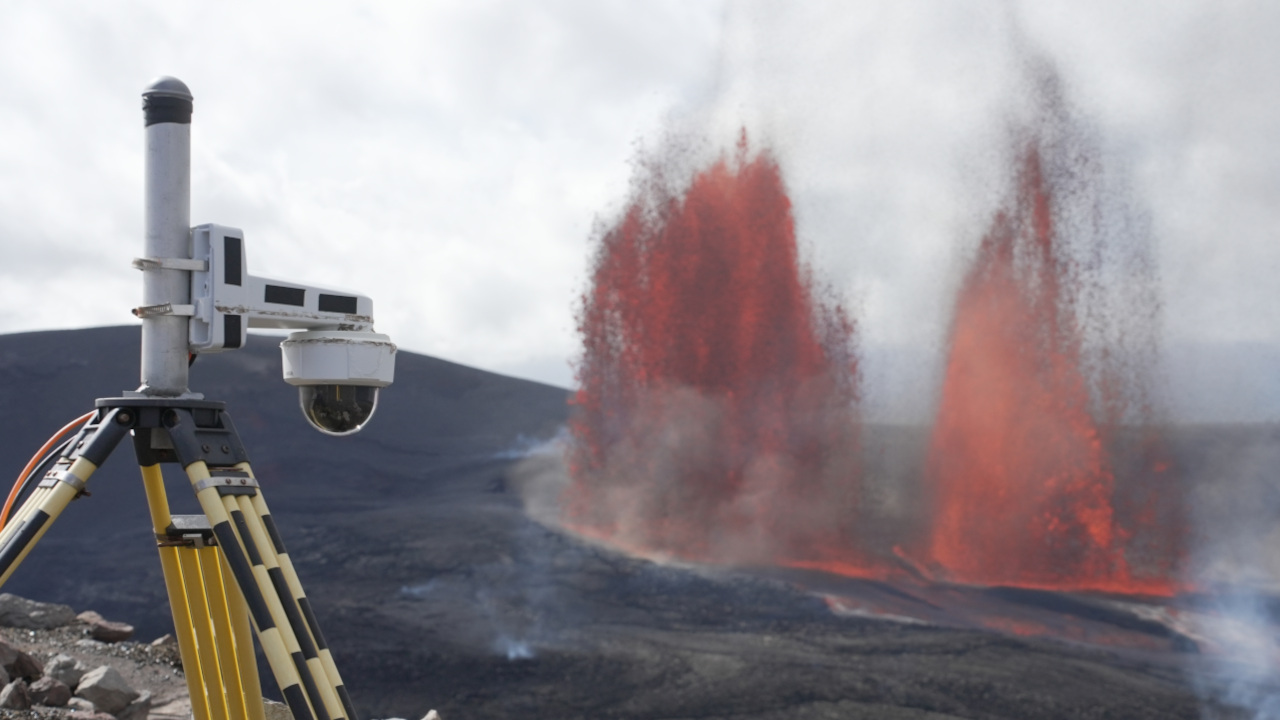
(BIVN) – The ongoing eruption at the summit of Kīlauea volcano remains paused, and the forecast window for the next episode of high lava fountaining is between April 5th and 15th, based upon modeling of the slow re-inflation measured at the summit.
In the latest USGS Hawaiian Volcano Observatory Volcano Watch article, HVO geologist Kendra Lynn writes about the rising temperature of the shallow magma system under the summit, and what it might mean for the eruption:
Geochemical analysis of erupted tephra samples over the past decade help scientists understand the temperature of Kīlauea’s shallow magma system under the summit—and things have been “heating up!”
Do you know how hot erupting basaltic lava is at our Hawaiian volcanoes? This value is usually around 1150–1200°C (2100–2190°F) and it can be measured in a few different ways. Calibrated thermal cameras/images can provide temperature estimates of active lava flows, and field geologists can manually measure the temperature using a device called a thermocouple—basically a thermometer that is inserted into the active lava flow.
Using field-based observations, past generations of volcano scientists have calibrated a laboratory-based thermometer to calculate eruptive temperatures based on magnesium oxide (MgO) in lavas and tephra. Over the past decade, USGS Hawaiian Volcano Observatory (HVO) scientists have used MgO values in near-real-time as a geochemical monitoring tool, conducted as part of a cooperative agreement with the Geology Department at the University of Hawai‘i at Hilo.
By examining changes in MgO—and thus, changes in eruptive temperatures—for tephra from summit eruptions from 2008–present, we can determine whether the magmatic system is cooling down or heating up. More simply—this is how HVO scientists take Kīlauea’s temperature!
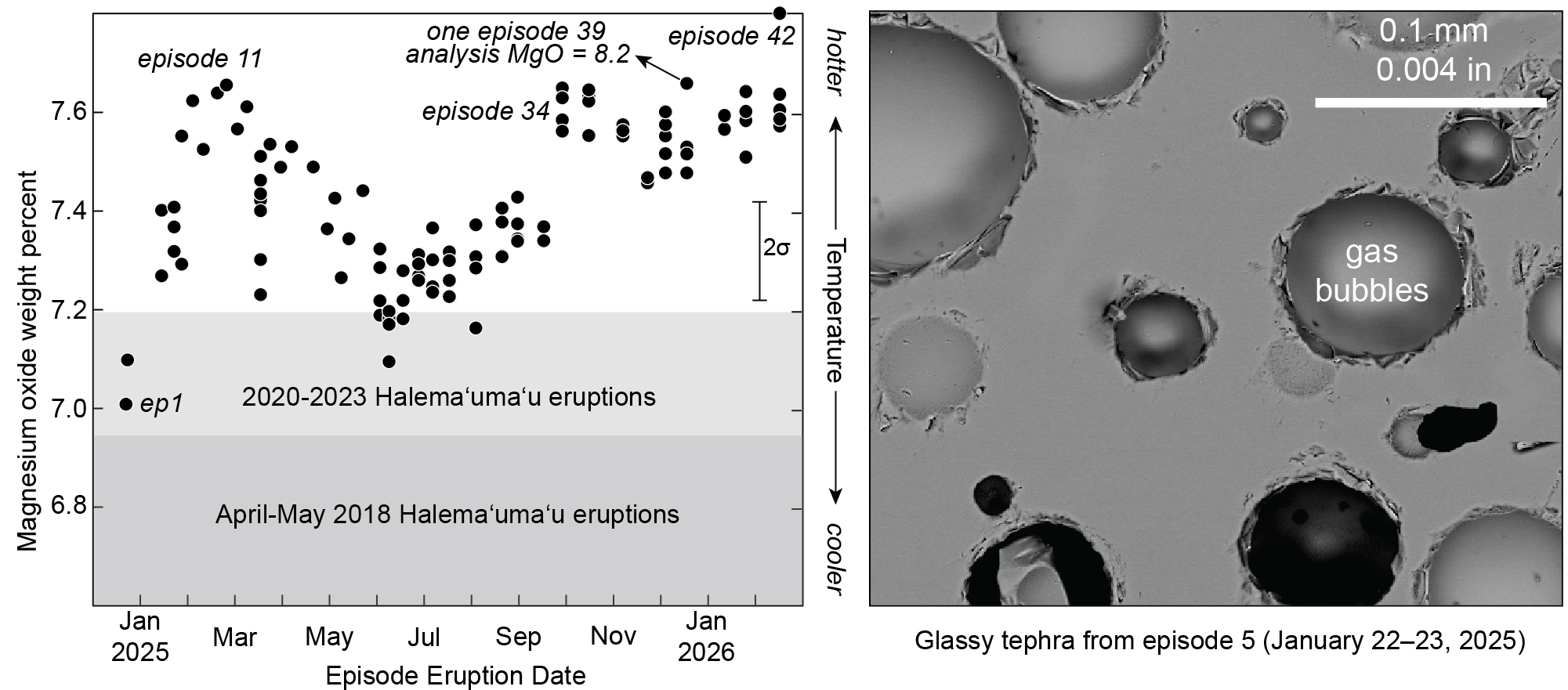
Left: Kīlauea tephra glass magnesium oxide for the ongoing summit fountaining eruption (black circles) compared to the ranges of glass magnesium oxide for the 2020-2023 and April–May 2018 Halema‘uma‘u eruptions. Right: Electron microscope image of glassy tephra with round gas bubbles from episode 5 that erupted from January 22–23, 2025. USGS images and data.
This is done using several analytical techniques and instruments, but we summarize results from measuring MgO in tephra glasses using an electron microprobe. This glassy material rapidly cooled after it erupts and is the best representation of the magma.
In April and May 2018—prior to summit collapse—the lava lake in Halemaʻumaʻu had glass 6.7–7.0 weight percent MgO, reflecting temperatures of 1159–1165°C (2118–2129°F). After summit collapse, the 2020–2023 Halemaʻumaʻu eruptions had a larger MgO range of 6.0 to 7.2 weight percent, reflecting a wider temperature range of 1144–1170°C (2091–2138°F) but with a similar maximum.
Over the first 42 episodes of the ongoing lava fountaining eruption in Halemaʻumaʻu, which began on December 23, 2024, the magmatic system has been hotter, with glass MgO higher at 7.0–8.2 weight percent, meaning temperatures are at least 50°F higher (range of 1165–1191°C or 2129–2176°F). Thus, lava erupting now is hotter than eruptions from 2018–2023.
These measurements reflect the temperature of the lava at the Earth’s surface—in our ambient atmosphere, which on a delightful day at Kaluapele might be around 75°F (24°C). Once magma reaches the surface to erupt as lava, rapid and dramatic cooling occurs over second to minutes.
How do we measure pre-eruptive temperature of Kīlauea’s magmas, before they erupt at the surface? HVO scientists use a few laboratory methods to determine the pre-eruptive temperature of Kīlauea’s magmas and thus can characterize the thermal state of the shallow magmatic system.
Erupted lavas and tephra contain olivine crystals—the common green mineral found in Hawaiian basaltic rocks—and their chemistry is sensitive to the magma temperatures. When HVO scientists looked at olivine chemistry from the 2008–2018 lava lake, the 2020–2023 summit eruptions, and the ongoing lava fountain episodes in Halema‘uma‘u, they found that olivine tracks an increase in temperature of about 15–20°C (60–70°F).
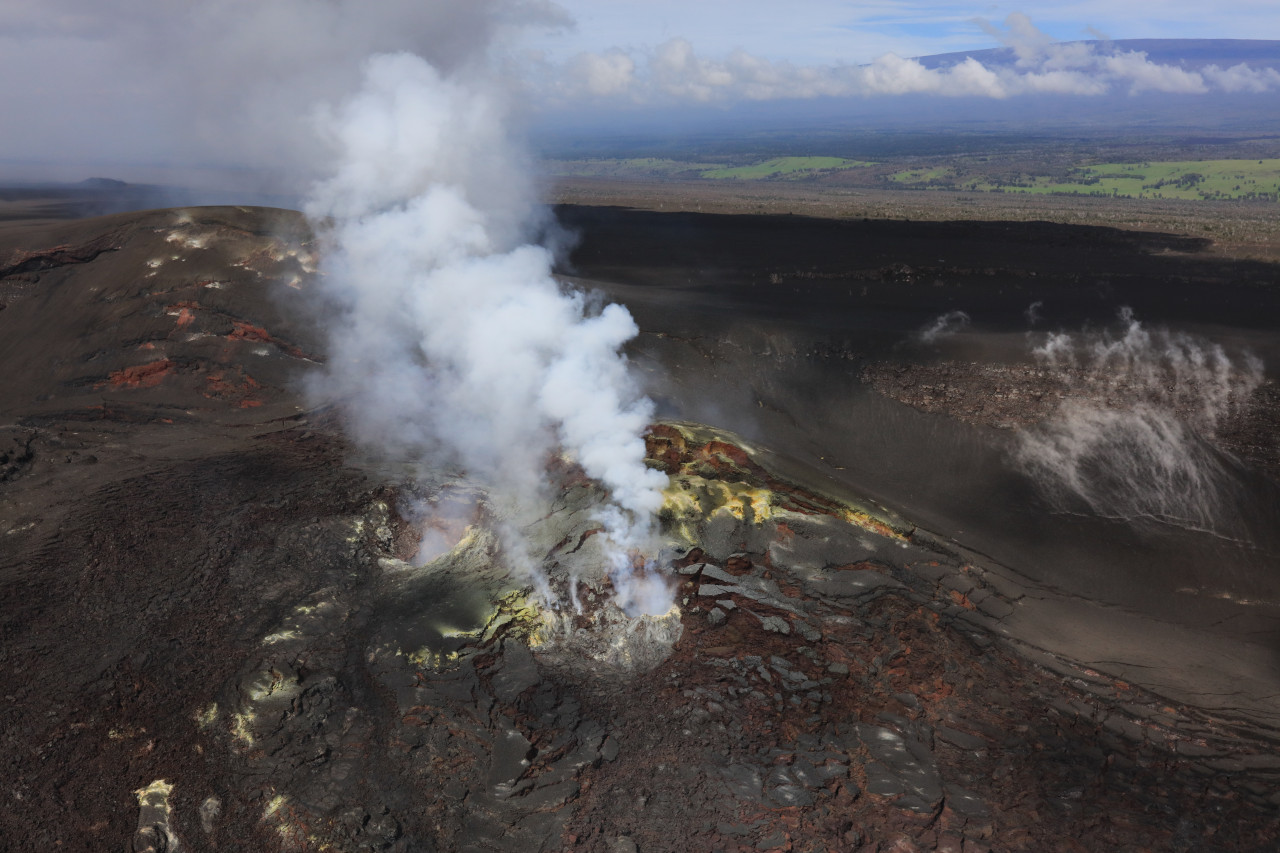
USGS: “On March 25, 2026, U.S. Geological Survey Hawaiian Volcano Observatory staff conducted a routine helicopter overflight to collect samples from the crater floor and thermal and visual images around Halemaʻumaʻu after episode 43 that occurred on March 10, 2026. The north and south vents have a robust gas plume emanating from them and spatter could be seen far down in the south vent (not visible in photo). Yellow sulfur crystals are visible over much of the edifice of the north and south vents.” (USGS photo by D. Downs)
The increase in temperature of both glass (liquid component) and olivine show us that Kīlauea’s shallow magma reservoirs have been heating up over the past decade and continue to show these signals through episode 42.
What does this mean for the long-term behavior of Kīlauea? It’s possible that the increasing temperatures observed for the current eruption might have to do with its prolonged episodic nature—hotter, fresher magmas entering the system are driving repeated eruptive episodes. With temperatures still elevated, it could mean the episodic activity will continue for some time. It may also reflect somewhat high rates of magma supply to the shallow reservoir beneath Kīlauea’s summit, which could lead to continued episodes or an eruption elsewhere on the volcano.
HVO’s team of interdisciplinary scientists are carefully monitoring Kīlauea to detect any changes to the pattern of episodic eruptions, and the laboratory-based work and near-real-time geochemical monitoring is an important perspective that will help detect changes to the thermal state of the system.

by Big Island Video News
on at
STORY SUMMARY
HAWAIʻI VOLCANOES NATIONAL PARK - Scientists are taking Kīlauea's temperature at the summit, and things are heating up.