
All images and video are courtesy the U.S. Geological Survey. A synthesized text-to-video voiceover was used in the narration for this story.
(BIVN) – Episode 47 of the ongoing Kīlauea summit eruption ended abruptly just after midnight, after 9 hours of continuous lava fountaining from the north vent. The eruption is once again paused, and the USGS Volcano Alert Level has returned to ADVISORY.
There was some tephra fall reported with the event. Sparse reticulite up to 3 inches in size fell at both the Uēkahuna and Keanakākoʻi overlooks inside Hawaiʻi Volcanoes National Park. The USGS Hawaiian Volcano Observatory says fine ash and Peleʻs hair fell in communities to the northeast, including Mauna Loa Estates, ʻŌhiʻa Estates, Volcano village, and Royal Hawaiian Estates.
From the USGS Hawaiian Volcano Observatory Episode 47 Chronology:
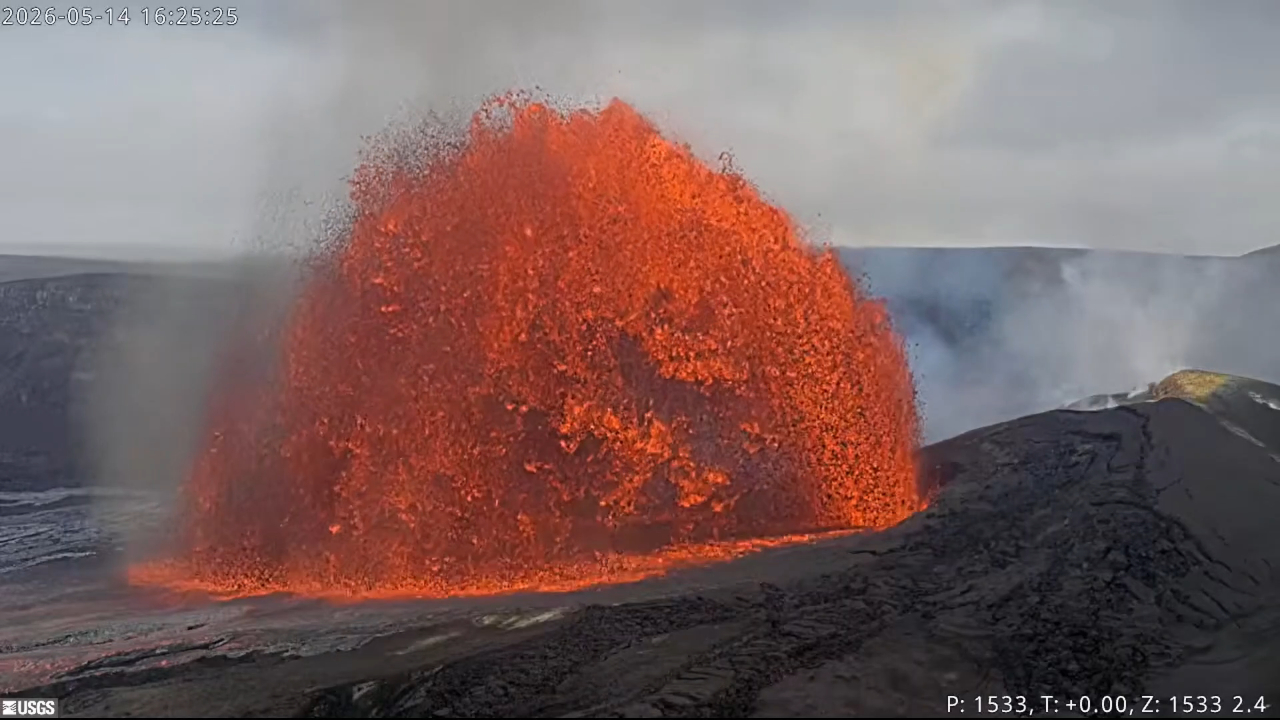
Lava fountaining episode 47 in Halemaʻumaʻu at the summit of Kīlauea began at 3:27 p.m. HST on May 14 and stopped abruptly at 12:27 a.m. HST on May 15, after 9 hours of continuous fountaining from the north vent. The last minute was marked by strong gas jetting and large flames from both eruptive vents that continued after the eruption ended. The south vent never fountained during this episode, but it periodically spattered in the early hours of north vent activity. The instantaneous effusion rate peaked somewhere between 360 and 390 cubic yards (275 and 300 cubic meters) per second around 5:00 p.m. HST, with an average effusion rate of 270 cubic yards (220 cubic meters) per second for the entire fountaining episode. An estimated 6.8 million cubic yards (5.2 million cubic meters) of lava erupted and covered about 30-40% of the Halemaʻumaʻu crater floor. The Uēkahuna tiltmeter (UWD) recorded about 15.6 microradians of deflationary tilt during episode 47.
Episode 47 lava fountaining began approximately 12 hours after the onset of precursory lava overflows at 2:57 a.m. HST in the early morning of May 14. There were around 75 precursory overflows exclusively from the south vent, though spattering was intermittently visible at the north vent throughout this time. Low-level dome fountaining from the north vent began at 2:58 p.m. HST this afternoon, then it steadily escalated in vigor and height until it transitioned to episode 47 fountaining at 3:27 p.m. HST. After the north vent became active, the south vent continued overflowing cyclically, but over the next couple hours its activity diminished to only spattering. The south vent’s last spattering was observed around 5:15 p.m. HST; thereafter, it still exhibited periodic gas jetting while being progressively buried by north vent tephra. Meanwhile, the north vent lava fountain grew steadily until reaching a maximum height of around 650 feet (200 meters) by 5:00 p.m. HST. Over the next several hours the fountain height gradually declined, and it was estimated around 200 feet (60 meters) high just before the episode ended at 12:27 a.m. HST on May 15.
The north vent lava fountain produced significant heat and ash, feeding a plume that reached a maximum height of about 20,000 feet (6,000 meters) above sea level based on radar data reported by the National Weather Service and Washington Volcanic Ash Advisory Center. At first, trade winds from the northeast pushed most tephra from the lava fountaining to the southwest of Halemaʻumaʻu. However, around the time the maximum fountain height was reached, low-altitude winds weakened and the ash plume rose vertically from the fountain. This allowed tephra to spread out and fall at a number of locations around the rim of Kaluapele (Kīlauea caldera). Vertical convection also allowed the plume to reach higher altitudes above 15,000 feet (4,500 meters) where winds were blowing southwest to northeast. At 5:01 p.m. HST, the National Weather Service issued an ashfall advisory for Hawaiʻi Volcanoes National Park and areas to the northeast. Sparse reticulite up to 3 inches (5 centimeters) in size fell at both the Uēkahuna and Keanakākoʻi overlooks, while fine ash and Peleʻs hair were deposited outside Hawaiʻi Volcanoes National Park in communities to the northeast, including Mauna Loa Estates, ʻŌhiʻa Estates, Volcano village, and Royal Hawaiian Estates.
Earthquake activity during episode 46 was minor. Levels of seismic tremor rose and fell with the lava fountaining and they are now at typical levels for an eruptive pause.