
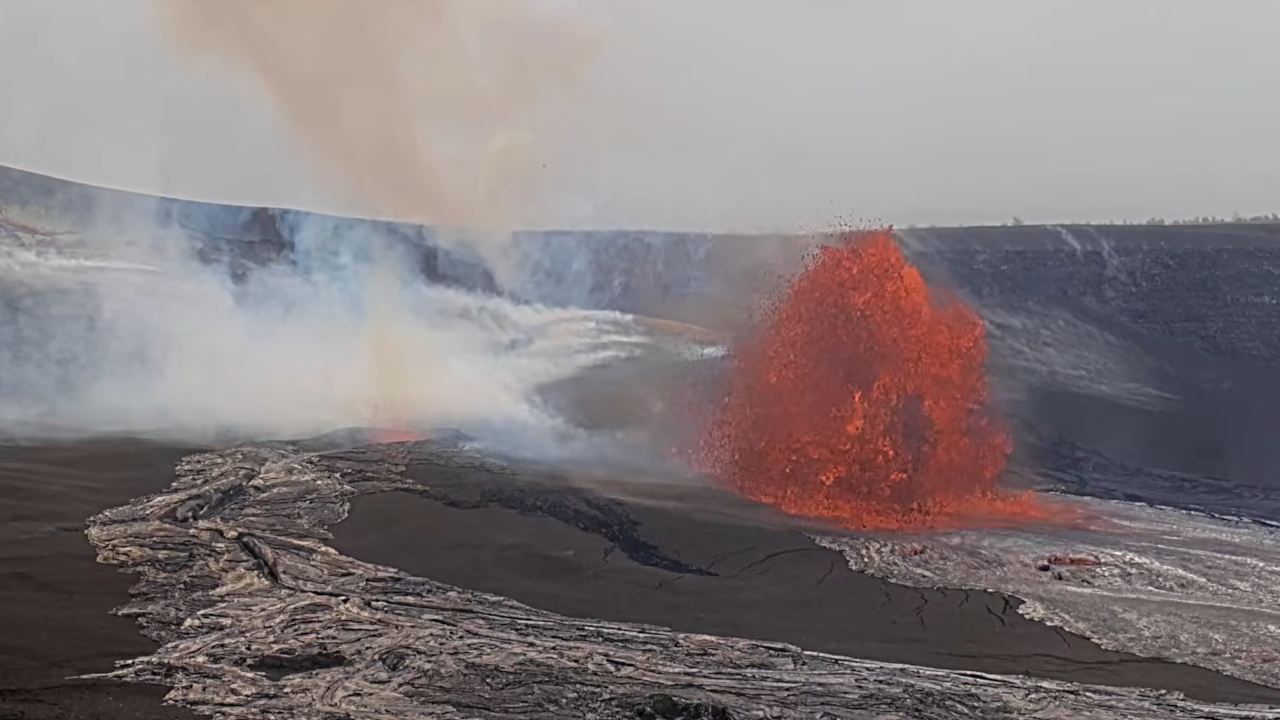

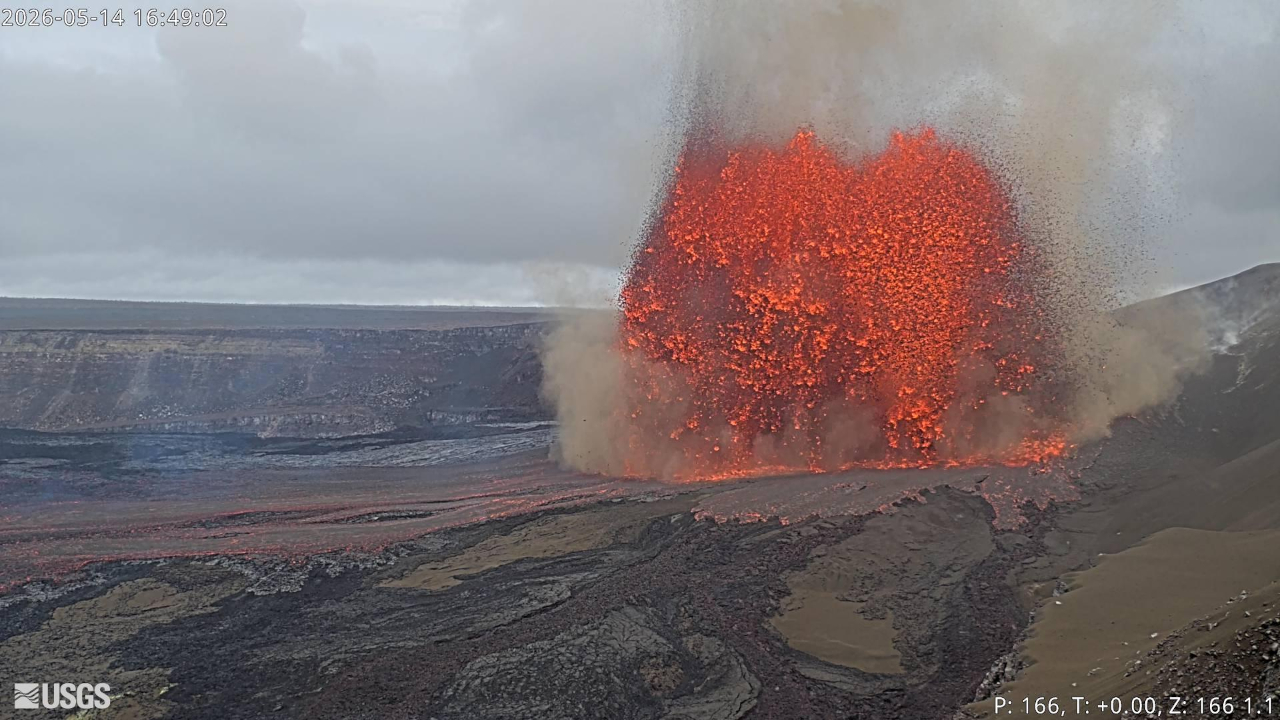
(BIVN) – Episode 47 in the ongoing eruption at the summit of Kīlauea began Thursday at 3:27 p.m. HST.
The high lava fountaining phase of the episode began after a day of precursory activity involving lava overflows from the south vent.
As of 4 p.m. HST, lava fountaining activity was focused at the north vent, though the south vent continued to cyclically overflow.
“Ground-level sensors near the eruptive vents indicate that winds are blowing from the northeast direction, which suggests that volcanic gas emissions and volcanic material may be distributed to the southwest direction from Halemaʻumaʻu,” the USGS Hawaiian Volcano Observatory stated in a Volcanic Activity Notice issued after the fountains began.
The Hawaiʻi County Civil Defense in a radio message said areas and communities in Kaʻū downwind of Kilauea “may experience fine ash and Pele’s hair along with elevated gas levels.”
“Take necessary precautions and reduce exposure,” the emergency officials recommended.
At 4:18 p.m. HST, the Observatory reported the approximate effusion rate was 120-240 cubic yards per second. “The top of the convective plume cloud is at 13,000 feet and is visible from Mauna Loa,” the geologists said.
By 4:42 p.m. HST, north vent fountains were reported to be about 500 feet (150 meters) and leaning toward the north. Small fountains (under 50 feet or 15 meters)were also erupting from the south vent.
In a Special Weather Statement, the National Weather Service said:
Lava fountaining episode 47 of the ongoing Halemaʻumaʻu Crater eruption began this afternoon at 3:27 pm HST. Web cams, satellite imagery, and radar data indicate that occasional small bursts of volcanic ash are emanating from Halemaʻumaʻu Crater up to about 15,000 feet as of 4:30 pm HST. Low level trade winds will likely push ash toward the southwest or west, and any ash fallout will likely occur over the Kaʻū and South Kona Districts. Of note, should a higher plume develop during this episode, southwesterly winds aloft could result in an easterly or northeasterly dispersion of ashfall instead.
Avoid excessive exposure to ash which is an eye and respiratory irritant. Those with respiratory sensitivities should take extra precaution to minimize exposure.
