
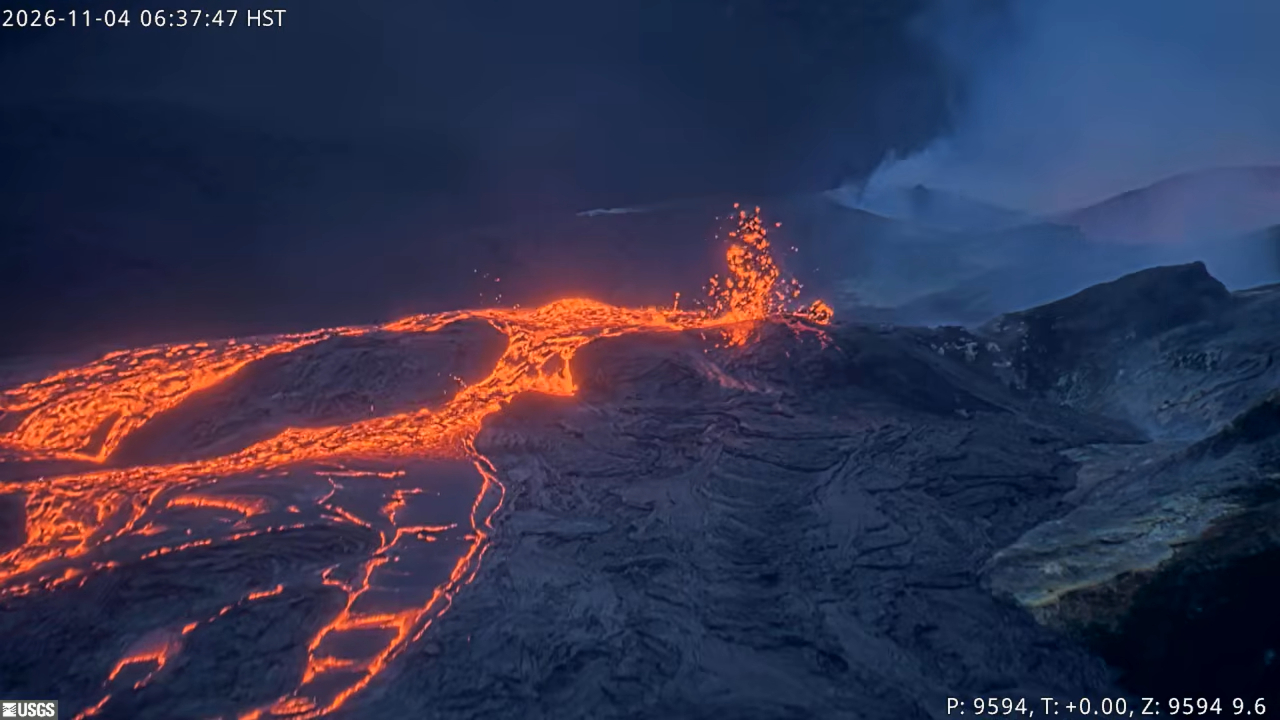

(BIVN) – The eruption at the summit of Kīlauea remains in a precursory, intermittent lava flow phase, as it builds to the next episode of high lava fountaining.
The USGS Hawaiian Volcano Observatory says the episode 56 remains a possibility today or anytime within the next few days.
The USGS Volcano Alert Level remains at WATCH and the Aviation Color Code is ORANGE.
From the USGS HVO on Wednesday:
Lava flows have occurred intermittently over the past day from the north vent. Summit inflation that continued through most of yesterday shifted to deflation around 3 a.m. this morning. Seismic tremor at the summit is elevated with fluctuations in tremor associated with the beginning and end of lava overflows. SO2 emission rates are elevated. Episode 56 high fountaining remains a possibility today or anytime through November 8 based upon prior behavior once precursory flows have begun.
Summit Observations:
Intermittent overflows continued from the north vent over the past day. Overflows were typically around 15-20 minutes in duration, and this morning 2-3 per hour were occurring. Strong glow could be seen from the southwest vent overnight, along with occasional spatter and flames.
Background seismic tremor began increasing around 6 a.m. and remains elevated as of this morning. Periodic strong tremor bursts associated with the vigorous drain back of lava marking the end of each overflow picked up this morning. Six small earthquakes were located at the summit in the past day, with most beneath the south caldera region.
This morning the Uēkahuna tiltmeter (UWD) had recovered a total of 17.6 microradians of tilt since the end of episode 55. Inflationary tilt that continued through yesterday and early this morning switched to deflationary tilt around 3 a.m., with deflationary tilt continuing this morning.
Sulfur dioxide (SO2) emission rates averaged 4000 tonnes per day (t/d) after overflows began on November 2. Strong trade winds this morning are carrying volcanic gases southwest toward Kaʻū.
Rift Zone Observations:
Rates of seismicity and ground deformation remain low in the East Rift Zone and Southwest Rift Zone. SO2 emissions from the East Rift Zone remain below the detection limit.
Analysis:
Following episode 55 on October 17, 2026, summit tiltmeters initially recorded a typical post-fountaining recovery, with a steady upward trend that gradually slowed and was interrupted by several small fluctuations. This inflationary trend was interrupted by deflation on November 2, with fluctuating tilt since that time. Inflation based models are probably not reliable unless steady inflationary tilt returns to the summit. The onset of precursory overflows typically indicates that a new episode of fountaining is within 1-6 days. It is reasonable to estimate that the onset of episode 56 fountaining will occur between now and November 8, provided conditions remain stable at the summit.
Kīlauea has been erupting episodically since December 23, 2024, from two primary vents (north and south) within Halemaʻumaʻu at the summit. Lava fountaining episodes generally last less than 12 hours and are separated by pauses of two or more weeks.
HVO continues to closely monitor Kīlauea and remains in contact with Hawaiʻi Volcanoes National Park and the Hawaiʻi County Civil Defense Agency regarding eruptive hazards.
