

HILO – Amidst Sunday’s chorus of voices opposed to the Thirty Meter Telescope being placed on Mauna Kea, there were a few who bravely voiced their support for the planned observatory to the University of Hawaii Board of Regents in Hilo.
Thayne Currie, a research associate at the Subaru Telescope and a contributor to the science case of the TMT, testified in favor of the $1.4 billion TMT, which promises to be one of the most powerful observatories on the planet once it goes into operation.
Currie was recently filmed having an animated dialogue with the Mauna Kea Ohana on the mountain, where he continued to advocate for the project despite being surrounded by those who have been blocking construction crews from accessing the site of the project. The conversation remained peaceful and respectful. The video was taken by Occupy Hilo.
“The first step” to reaching compromise, Currie told the regents on Sunday, “is just to start talking with one another and being unafraid to do so.”
“If we cannot talk to our neighbors, there is something seriously wrong with us,” Currie said.

Facts instead of emotion. What a novel idea.
He states that the protests “hurt me” and “it was heartbreaking.” That sounds pretty emotional.
I salute those brave enough to be outspoken in their support of TMT, even while facing opposition from the ignorant so called ‘protectors’ of Mauna Kea and their supporters. They are truly inspiring.
PS: This site can help clear up any misconceptions you may have about TMT, especially if you are an opponent to the TMT.
http://www.maunakeaandtmt.org/
To see it in those terms is single minded. The issue is much bigger. It is about the legality and right to obligate the land in the first place. The beneficiaries oppose the land use. Enough said. This objection is not “new” but in fact, continuous for over 120 yrs.
“The beneficiaries” entitlement mind set.
Aloha Disambugation.
That is a matter of personal choice. Personally I salute the protectors. The link you provided does not I.M.H.O. clear misconceptions as no lands were ever lawfully ceded, additionally the pro-T.M.T. website you linked does not answer the question it poses on how the Hawaiian community feels about the T.M.T.? For those in favor of the T.M.T. project I would have recommended this official T.M.T. website which is more adept at outlining the engineering dimension:
http://www.tmt.org/
Bottom line as aforementioned the debate is a matter of personal choice, and one has to follow one’s conscience……the ultimate arbitrator. Mahalo.
Mr. Currie, if the CSO is removed and other telescopes as you state, how long does the TMT have to be up? Do you think there is a possibility to have all telescopes removed in the near future? If so, when? You stated that “it’s a place that has answered key philosophical questions.” Is it possible that the studies can be performed elsewhere in the world? Mount Everest? Did you and your team try?
The TMT would be up as long as it is relevant. If technology changes rapidly, that could be less than the 30 years they are projecting. It really depends on technology advances and what they are learning about space. Have you watched the news about the earthquake in Nepal? Mt. Everest is difficult to access by foot, let alone build structures on. It is also twice as high as Mauna Kea and breathing without supplemental oxygen would be next to impossible.
Exactly diverdave, There is no negotiating with that mindset. They can’t see the forest through the trees.
http://www.angelfire.com/big09a/TreatyOfAnnexationHawaiiUS.html
I am aware of the earthquake. I understand that Mt. Everest is not as solid or strong as Mauna Kea, but it is sacred land and it should not be utilized for telescopes. Is there another mountain that your team may do studies on? With modern day technology, why can’t the telescopes be operated from the ground? Or perhaps on the moon? Is it possible to have one built that has that capability? Hawaii is a beautiful place, is it possible that you brought your work to Hawaii to enjoy the beautification of the island? How long have you lived in Hilo? Since your first project here?
Hi Inaleam:
These are good questions.
1. To give you some sense of the astronomy community’s perspective for the lifetime of the TMT and the current telescopes, see this link on the new UH Master Lease Renewal here: http://www.malamamaunakea.org/management/uh-master-lease-renewal-eis (see the Dec. 2014 link, 6.9 MB, PDF form)
The section you are interested in is Sect. 3.2.1, page 29. While there are a range of opinions within our community, I think these are fairly representative. Basic summary:
– TMT, being the flagship observatory of the mountain, would be up through the end of new lease.
– CSO is going down soon: this was decided 6 years ago, in fact, and the decision will not be reversed. I think their plan is to cease operations in 2016 and have the telescope completely off the mountain sometime in 2018.
– There’s stated support for either SMA or JCMT but not both past 2033.
– UKIRT faces an uncertain future and could decommission within 20 years; IRTF also faces an uncertain future past 2033.
– There is no expectation that VLBA will continue beyond 2033.
– There is some interest in modifying CFHT to have a larger mirror, but this is not set.
– The leading observatories now — Keck, Subaru, Gemini — are definitely interested in continuing beyond the current lease term (2033) for some time. The lease estimates an operation lifetime 30-40 years into the new sublease.
So in total, by the time the TMT is built and operational the total number of telescopes on the mauna will not change. By the new sublease term, it’s very likely that the number will shrink. My guess (just a guess) is that a couple of decades later there will be at most 5 observatories operating and then eventually just the TMT until the end of the new lease.
2. Yes, there was a lot of work put in to identifying a range of sites for the TMT. The candidates included Maunakea, Mexico, and Chile. I think also they considered Arizona and the Canary Islands. While it is possible to build telescopes in the other places, Maunakea is by far the best site.
For instance, the best mainland sites are in Arizona and even these (Mt.
Hopkins and Mt. Graham; the sites of MMT and LBT, respectively) have
consistently far poorer seeing than Maunakea (a very rough estimate of the ability to
do key aspects of astronomy, in particular achieve high spatial
resolution imaging, which is one of the bread-and-butter niches for a large aperture telescope like the TMT). I should know: I did my PhD thesis
work largely from Mt Hopkins. Additionally, the Arizona sites are
practically unusable for an entire 6-8 weeks each year due to the
monsoon season: we used to dread getting time in July because of this and
in August the observatories are usually shut down.
Chile is more competitive, but even here the situation still favors
Maunakea. My understanding is that the typical wind speed (which affects
AO which in turn affects our ability to get sharp images) is worse on
the E-ELT/Cerro Azores site. Additionally, the median seeing looks like
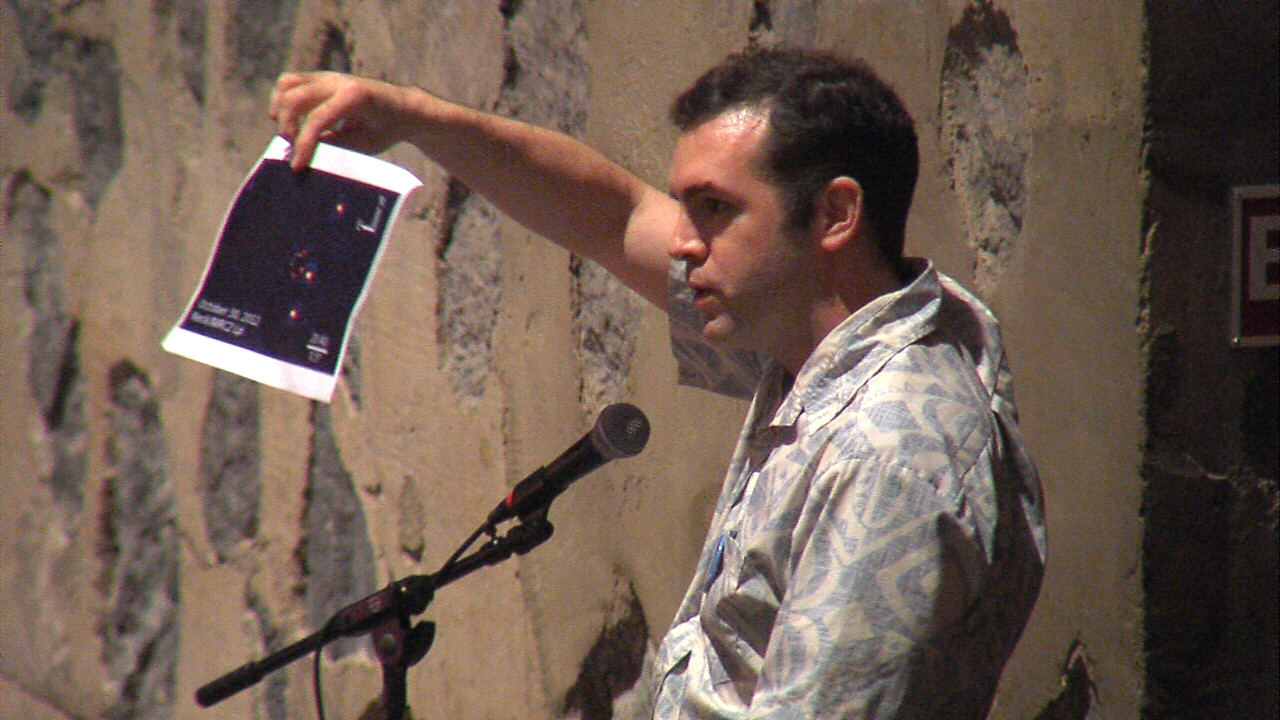
it is worse on Cerro Azores than has been measured on Maunakea. The seeing on established sites like Cerro Paranal (where the VLT is located) is consistently worse than Maunakea. The image I showed during my testimony required 0.25″ seeing. That happens periodically on Maunakea: it happens only in the dreams of most people on Paranal. Everest wouldn’t work because of accessibility and also because the air is too turbulent. For the same reasons, some place in the Rockies wouldn’t work (as the CFHT director recently noted, anyone flying into Denver Intl. is keenly aware of how bumpy the air is!).
There are other considerations. For example, a slightly northern latitude telescope (e.g. on Maunakea) will be able to see different stars and study different things than one in the south (like Chile). Most existing partners either already have ties to the Hawaiian community
(e.g. U. Hawaii, Japan, mainland US institutions, and China I think as
well). Logistically it’s far more straightforward to
have an observatory in Hawaii than in Chile when the partners are
almost all North American or Pacific Rim. Additionally, in Hawaii we
would be able to connect with a strong local astronomy program (U.
Hawaii). Chile’s astronomy community is growing and shows promise, but is not in the same league as U. Hawaii’s (which stands shoulder-to-shoulder with the programs of institutions like Princeton, MIT, Cornell, etc.).
Best wishes,
Thayne
I appreciate your quick responses. As far as the U. Hawaii… How beneficial has it been so far? What was gained from the observations so far and why is that information important to the community? I couldn’t understand the information you gathered from the studies on Mauna Kea in the video (when you raised the paper in your hand), can you please tell me what you said? Also you stated in a previous response that “if technology advances” is it at all possible to build a telescope that has better technology now? Maybe enhance the TMT to observe more in depth? I’m no scientist, but with China and Japan involved as you stated, can’t they come up with a better tool for your observations to conduct studies at different levels? Perhaps a smaller tool that you may carry around? They are the number one countries who produce the BEST technology.
I appreciate your quick responses. As far as the U. Hawaii… How beneficial or educational has it been so far? What was gained from the observations and why is that information important to the community? I couldn’t hear the information you gathered from the studies on Mauna Kea in the video (when you raised the paper in your hand) can you please tell me what you said? Also you stated in a previous response that “if technology advances..” is it at all possible to build a telescope that has better technology now? Maybe enhance the scope to observe more in depth or “zoom-in” capabilities and features than a TMT? I’m no scientist or inventor, but with China and Japan involved as you stated, can’t they come up with a better tool for your observations to conduct studies at different levels? Perhaps a smaller portable tool that you may carry around or haul? Or one that is lightweight to be mobile? China and Japan are the countries who produce the BEST technology. When was the last time technology enhancement, upgrade and/or improvements was discussed with China and Japan?
Hi again:
1. As far as the U. Hawaii… How beneficial or educational has it been so far?
R:
So I take your question to be how has Maunakea been beneficial to the
University of Hawaii campuses and their educational goals. The ability
to conduct astronomy from Maunakea has turned U. Hawaii from just having
an astronomy program into one of the world leaders in astronomy,
especially for observational astronomy, within a few decades, at least
on par with (and often better than) numerous Ivy League schools and
others around the world, like Oxford and Cambridge. IfA is rather large
for an astronomy program: there are 50+ faculty, ~30 graduate students,
and overall about 300 people employed. Tenure-track position in
astronomy are fiercely competitive, but UH graduates do quite well
here. Astronomy grads also tend to do well in finding jobs in related
fields in optical engineering, IT/systems administration. I know some
who work at Boeing or at Lockheed-Martin; some even end up working in
finance.
2. What was gained from the observations and why is that information important to the community?
R:
I’ll answer this in general and for UH in particular. In my testimony I
described how astronomy helps us answer key philosophically-loaded
questions, really fundamental *human* questions.
– For example,
“what is the universe made out of?” Apparently, the answer is that
“dark energy” comprises most of the ‘stuff’ of the universe. The
smoking gun for dark energy was found only about 17 years ago, and this
discovery won three people the Nobel Prize in Physics. Observatories on
Maunakea were key in achieving these results. If you would like, you
can read two of the papers here: http://arxiv.org/abs/astro-ph/9805201 and http://arxiv.org/abs/astro-ph/9812133
(note
the papers call this the “cosmological constant”, which is actually the
term Einstein first used to describe a sort of negative
pressure/anti-gravity that would prevent an otherwise static universe
from collapsing. It appears to be real but instead something that
causes the rate-change of the universe’s expansion to increase with
time.)
– Another one. We’ve spent thousands of years
looking up at the sky and seeing stars
and the planets like Jupiter that orbit the Sun, but it was only 7 1/2
years ago that we first saw a planet around another star. And that was
done from telescopes on Maunakea, specifically the Keck and Gemini
telescopes. Here is the discovery paper for that system:
http://arxiv.org/abs/0811.2606
Since then, we have imaged a fourth planet around that star (http://arxiv.org/abs/1011.4918). Subaru has probably yielded the first image of a planet around a Sun-like star: http://arxiv.org/abs/1307.2886 A combination of telescopes have yielded more discoveries, like these: http://arxiv.org/abs/1110.3808 and http://arxiv.org/abs/1310.4825 .
These
discoveries are exciting because they are first key steps towards
imaging an Earth twin around a nearby star. TMT will certainly allow us
to image and study many planets, perhaps some that might be habitable
like the Earth.
– Here’s a more recent example of an
extremely important result in exoplanets, a rocky Earth-sized planet
whose presence we infer indirectly, that a) used Maunakea observatories
and b) was lead by an astronomer at U. Hawaii: http://arxiv.org/abs/1310.7988 .
3. Also you stated in a previous response that “if technology advances..”
is it at all possible to build a telescope that has better technology
now? Maybe enhance the scope to observe more in depth or “zoom-in”
capabilities and features than a TMT? [W]ith China and Japan … can’t they come up with a
better tool for your observations to conduct studies at different
levels? Perhaps a smaller portable tool that you may carry around or
haul? Or one that is lightweight to be mobile? China and Japan are the
countries who produce the BEST technology. When was the last time
technology enhancement, upgrade and/or improvements was discussed with
China and Japan?
R: I think that was someone else who made that statement. But here are a couple of responses:
In
terms of “depth” (raw sensitivity) or “zoom-in” (angular resolution)
capabilities, the primary/secondary mirrors set theoretical limits. In
terms of theoretical limits, you could do better if you simply had a
larger mirror, which is going to be rather expensive. Given a certain
glass size (primary/secondary diameters) you could do better if you are
able to align each of the mirror segments more and more precisely.
What
you might be alluding to, and what is a serious focus, is the suite of
instruments (which can be transported to and from the telescope) that
would be used in combination with the TMT to produce scientific data.
This could include adaptive optics systems which correct for the
blurring of starlight by the atmosphere and instrument components like
coronagraphs, which help you to block light from a star so you can see
faint objects located just off axis (like planets). These types of
systems are constantly evolving/being updated:. For example, at Subaru
we started out with a 36-element adaptive optics system then a few years
later upgraded a 188-element AO system, which corrects for blurring
even better. Now we have a *second* AO system to correct for the
residual blurriness of the primary AO system, which allows us to get
incredibly sharp images (and thus will allow us to see even fainter
objects located very close to a star. The instrument suite for TMT will
probably completely change multiple times during its existence on
Maunakea
The TMT will have a suite of what’s called
“first-light instruments” that will be very versatile and well-suited to
a few specific focuses (e.g. a first-light instrument called IRIS will
be awesome at getting spectra of galaxies and of bright, massive planets
like scaled-up versions of Jupiter). For an instrument that will
allow us to image really faint, lower mass planets (more like that of
the Earth), we will need a new instrument besides these first-light
instruments. A lot of what we are doing now with 8 meter-class
telescopes on Maunakea and in Chile really serve as technology
development or early “prototypes” of such a system that will someday go
on the TMT.
As for the leading countries, at least
in my field the United States, Canada, and Japan do extremely well. We
will be drawing on the expertise of individuals from institutions in
these countries, many of whom are involved in these sort of “prototype”
projects (e.g. Japan has SCExAO; the California universities and Canada
are involved in the Gemini Planet Imager). China and India are just starting but will have great contributors as well.
http://www.hawaiireporter.com/conklins-points-on-hawaii-sovereignty-not-valid
I learned a lot from this and these are questions directly from me with no guidance. It’s nice to know that 300 people are employed with the project. Are they on the Big Island or are they stationed elsewhere? is there a parking lot on the summit?
I applaud the accomplishments and it is great that students find careers in IT, Engineering, Boeing, and with a large corporation like Lockheed Martin. Are there any public reports of this data? Statistical information?
From my understanding, you mentioned that the mirrors must be large for resolution purposes and they are expensive, but is it possible to build a larger scope than the TMT that can be mounted at ground level? One that is suitable to observe farther to accommodate the difference in height?
Is it simple enough to add more mirrors for resolution enhancement capabilities?
The skies are clear in Hawai’i on the most part. Can clouds be a huge interference?
Are the other telescopes that are located around the world capable of seeing the same observation? I know you stated that the “planet around a star” was found through a telescope at Mauna Kea, but can the other telescopes that are located elsewhere see it from where they are?
Also, is this open to the public or is it for students and employees only? What is the cost?
I learned a lot from this and these are questions directly from me with no guidance. It’s nice to know that 300 people are employed with the project. Are they on the Big Island or are they stationed elsewhere? is there a parking lot on the summit?
I applaud the accomplishments and it is great that students find careers in IT, Engineering, Boeing, and with a large corporation like Lockheed Martin. Are there any public reports of this data? Statistical information?
From my understanding, you mentioned that the mirrors must be large for resolution purposes and they are expensive and you mentioned many other parts needed for the instrument, but is it possible to build a larger scope than the TMT that can be mounted at ground level? One that is suitable to observe farther to accommodate the difference in height (being at the ground level)?
What about having just one? One HUGE telescope and just upgrade as technology advances. One that can be adjusted for different observations internally that can be mounted at ground level.
Is it simple enough to add more mirrors for resolution enhancement capabilities?
The skies are clear in Hawai’i on the most part. Can clouds be a huge interference?
Are the other telescopes that are located around the world capable of seeing the same observation? I know you stated that the “planet around a star” was found through a telescope at Mauna Kea and then a “fourth planet” but can the other telescopes that are located elsewhere see it from where they are?
Also, is this open to the public or is it for students and employees only? What is the cost?
I’m not sure if I missed it, but do you have a picture that you can share with the planets around the star?