

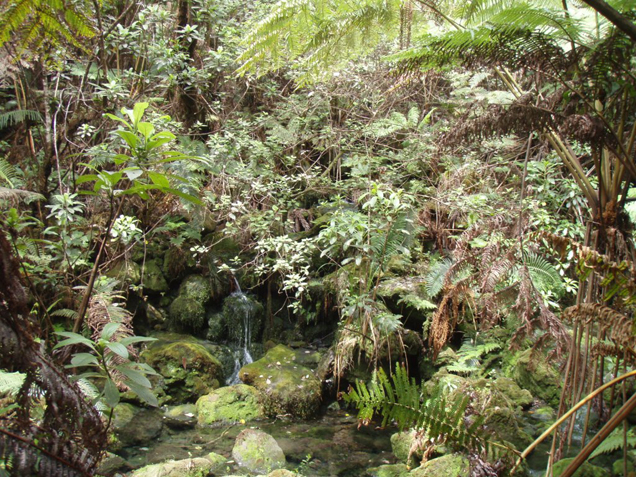
KA‘U, Hawaii: A Draft Environmental Assessment that lays out a management plan for the 61,641-acre Ka‘ū Forest Reserve has been published and now awaits public comment.
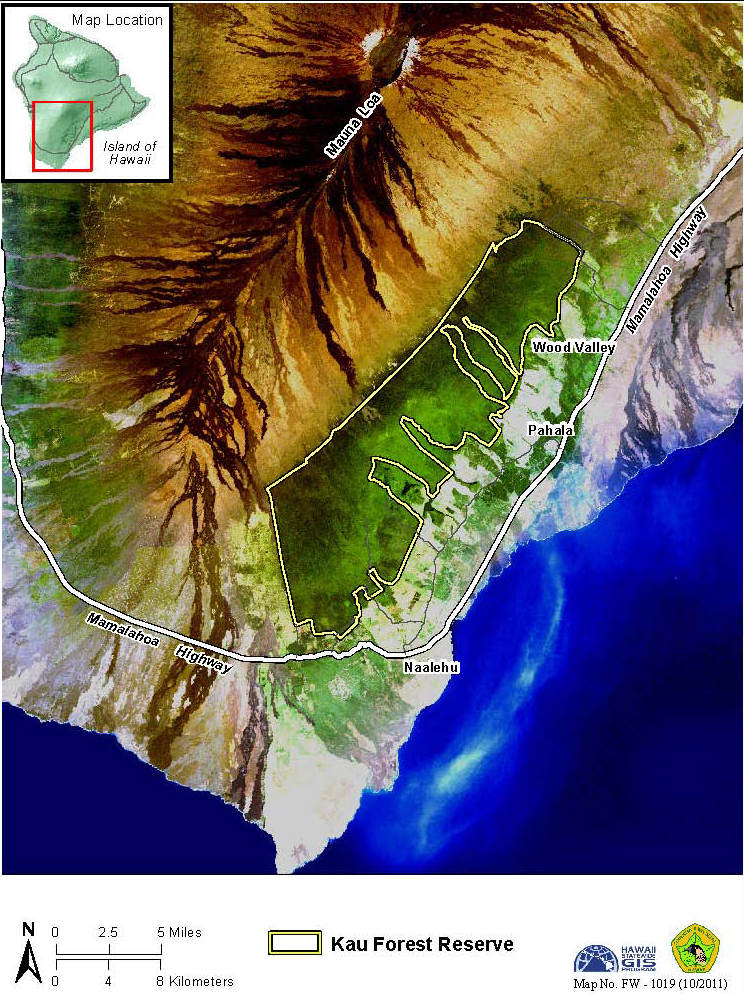
The plan is being prepared by The Department of Land and Natural Resources, Division of Forestry and Wildlife. According to the draft document’s summary:
The Plan responds to a need to maintain and restore key watershed, preserve a unique ecosystem with critically endangered plants and animals, perpetuate natural resources vital to Hawaiian culture and practices, find a suitable site to reintroduce ‘Alalā or Hawaiian Crow into the wild, and provide for continued and expanded public use. Common to all three alternatives under consideration is construction of 12,000 acres of new fenced management units in the upper elevation central portions of the Reserve in which ungulates will be removed and the native forest protected. Field surveys would be conducted to identify locations for the planned fence alignments, and final fence alignments would be sited to avoid any impacts to botanical, faunal, and archaeological resources. Fences would include walkovers and gates to ensure public access into management units. Other actions include weed monitoring and control, trail and access improvements for hunters and hikers, outplanting of rare plant species, cooperation with water source users, and actions to foster reintroduction and survival of the ‘Alalā. Impacts to pig hunting, which is considered by many to be a cultural practice, would occur but be less than significant because of the proposed locations of management areas. DOFAW seeks to balance providing public hunting opportunities in the Reserve with the protection of native ecosystems and watersheds, and the Plan includes actions to substantially facilitate public hunting in the Reserve.
On Tuesday, the Department of Land and Natural resources issued a media release announcing the availability of the draft EA for review and comment until June 22. It can be found online together with the management plan and cultural impact assessment at: http://hawaii.gov/dlnr/dofaw. From the DLNR release:
“This management plan is part of the DLNR’s goal to increase protection of Hawai‘i’s forested watersheds, as well as to fulfill our mandate to restore native Hawaiian species such as the ‘Alalā (Hawaiian crow) and provide access and recreational opportunities to the people of Hawai‘i,” said William J. Aila, Jr., DLNR Chairperson.
DOFAW is working with adjacent landowners to provide additional access, particularly across State-leased and private land below the Reserve, to ensure continued public access. Gates and step-overs will be installed at trails and access points along fences to facilitate access for hikers, hunters, gatherers, and others who use this area.
Nohea Ka‘awa, DOFAW outreach and education specialist, has been meeting with community members for the past eight months to share information about the Forest Reserve, its status, threats, value to people, and proposed actions to protect it from further damage by invasive, non-native plants and animals.
Ka‘awa said: “A lot of cultural knowledge about the Reserve that has been documented and is still practiced today is the knowledge passed down from our Ka‘ū kūpuna. We started gathering community input by talking with our kūpuna, and from there, everything else fell into place.
“We consulted and interviewed over 80 community members and actually had site visits with them up into the remote parts of the Ka‘ū Forest Reserve where we are planning some of our projects. There is a lot of support for this project from the community. The Ka‘ū hunters we met with were very interested in the project and some even volunteered themselves to help with the fencing and management work.”
Shanell Leilani Dedman, a Ka‘ū resident, Cultural Resource Specialist, and Makua member of Kūpuna Council for Hawai‘i Volcanoes National Park, is supportive of continued and expanded public use. She noted that “Access to the Ka‘u Forest Reserve for residents, especially to the Ka‘ū district, should be a priority. Protection of the forest for cultural, recreational and personal gathering rights among others is a positive step towards promoting stewardship. The Ka‘ū Forest Reserve are wahi kapu (sacred areas).”
Ka‘awa added that “DOFAW’s goal is to work with the Ka‘ū community throughout the implementation of the plan and to continue to provide programs that will educate future generations about the environment and how we are all connected.”
The DLNR says the Ka‘ū Forest Reserve was established in 1906 to protect these forests on the lower slopes of Mauna Loa to ensure a good water supply for the agricultural lands of Ka‘u. Tunnels and springs in the Ka‘ū Forest Reserve are still used today for domestic use as well as agriculture. “Much of the agriculture in Ka‘ū, including coffee, macadamia nuts, and ranching, depends on a supply of fresh, clean water from the springs and tunnels in the Reserve,” wrote DLNR, “and maintaining this water supply is vital for the future viability of agriculture and the Ka‘ū community. The Reserve’s native forests replenish springs and other groundwater, reduce flooding and erosion, provide habitat for unique species of plants and animals and are also a cultural, recreational and scenic resource for the community.”
One issue that is certain to come up during the public comment process: the proposal to fence 12,000 acres and eradicate the ungulates within. The EA goes into detail about this proposal, here:
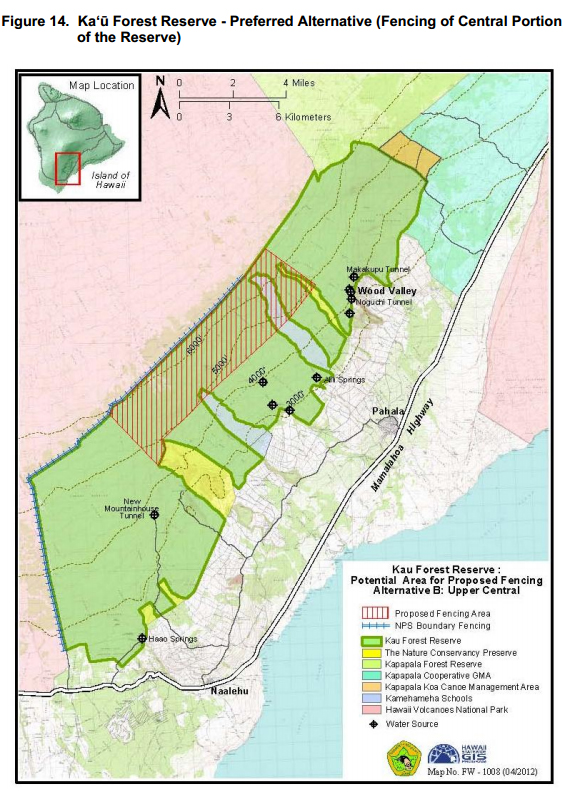
To protect the water resources of the Reserve and limit damage to native Hawaiian ecosystems, a combination of fencing and feral ungulate removal from fenced units is needed. Without fencing, ungulate control is not effective, due to reproduction of existing populations and continued ingress from adjacent areas. The construction of fenced management units is proposed for approximately 12,000 ac (4,856 ha) in the upper elevation (4,000 – 5,000 ft (1,219 – 1,524 m)) portions of the Reserve. We have prioritized this area because the proposed fencing and feral ungulate removal would protect a large portion of the Ka‘ū Forest Reserve landscape, including important watershed and existing native species habitat, particularly habitat for the three endangered forest bird species. This area is also a priority for restoration for release of the ‘Alalā. Monitoring data from forest bird transects shows this area is the portion of the Reserve that has the most feral ungulate damage. Although there is currently an intact canopy of tall native trees, in many areas much of the ground and understory layers of ferns, small plants and young tree seedlings have been damaged by feral ungulates, leaving the ground bare and exposed. Without management, the native forest will continue to decline because young trees will not be able to grow and become established to replace the older canopy trees as they die. Fencing and feral ungulate removal will benefit native ecosystems by limiting the browsing and trampling of native plants. Other benefits include reduction of soil erosion/exposed soil and subsequent invasion of non-native plants.
Three possible alternatives of about 12,000 ac (4,856 ha) are being considered for fencing, which differ in the location of fencing. These draft alternatives will be presented to agencies, organizations and the general public in the draft EA. DOFAW’s preferred alternative for fencing in the draft EA is shown in Figure 14.
We are still determining the location, size design and number of the fenced units that would be constructed within the proposed area for fencing. The area would be subdivided into separate fenced subunits of 2,000 – 4,000 ac (809 – 1,619 ha) in size that would be fenced over time, as funding becomes available. The final configuration and number of fenced unit(s) will consider factors such as water resources, quality of native ecosystems and habitat for native species, level of damage from ungulates, public use of area, cooperation with adjacent landowners, terrain, logistics, accessibility, and feasibility for effective feral ungulate removal. Field surveys will be conducted to identify locations for the planned fence alignments, and final fence alignments will be sited to avoid any impacts to botanical, faunal, and archaeological resources. Fences are not meant to restrict public access into management units, and walkovers and gates will be installed in order for people to access fenced areas. Fencing costs are estimated at approximately $150,000 per mile (labor, materials and helicopter), and will be completed based upon the availability of funding for labor and materials. DOFAW staff and/or contractors will need to implement construction of fenced units in phases.
As fence construction is completed, DOFAW staff will use various approved methods to remove ungulates from within the fenced units (State of Hawai‘i 2007). Public hunting will be encouraged during the first phase of ungulate removal where safe, feasible and effective, but additional control methods including drives, trapping, staff control with dogs, and snaring, may be needed to remove all the ungulates.
Regular fence inspection and maintenance will be needed once fence construction is complete. Fences will also need to be replaced as they deteriorate and costs for fence replacement will need to be taken into account in future management plans.
Earlier in the document, authors wrote:
An alternative that was suggested by several parties during early consultation was fencing and removing ungulates from all of the Ka‘ū Forest Reserve. It is recognized that there are rare plants, birds and important native ecosystems that require preservation throughout the Reserve. Maintaining and/or restoring areas of low elevation may be vital to preserving the long-term health of forest bird populations, which visit different parts of the Reserve at different times to follow flowering or other resources. Furthermore, protecting only high elevations may not fully protect the vital watersheds that provide domestic and agricultural water in the wells, tunnels and springs below. However, fencing all or most of the Reserve was dismissed from consideration from the current version of the Plan because the cost, at an estimated $20 million for fencing alone, would be exceedingly high, beyond what DOFAW expects to have available in the next 15 years. Moreover, removing ungulates from the entire Reserve is opposed by community members because it would adversely affect hunting opportunities. As discussed in Section 3.1.5 below, hunting in Ka‘ū is an important component of subsistence and cultural practice. Discussions with Ka‘ū community members indicated general opposition to fencing the entire Reserve. Without a certain level of community support for the general management of the Reserve, the Plan is unlikely to succeed.

The big island of Hawaii has lost more then 2 million acres to the name of Nature Conservancy, three mountain alliances ,DLNR including the program NARS a program inside DLNR, Kamehameha schools and other Associates to fence and eradicate all of Hawaii natural game resources .The pig was brought here by the Hawaiians upon arrival n used for cultural,traditional n religious beliefs,as used today in hula ,blessing canoes ,family arguments n baby luau. Wild cattle,sheep ,goats was brought in the 1700 hundred and given to the king as a walking food substance.Axis deer brought in to Molokai in 1860 s and given to King Kamehameha 5 as a walking food substance .All these natural game resources are food for the Hawaiian people today as it was in the days of old .THERE is no way this should pass and taken away..By taking this land it in a violation of article 12 sec 7 of the state of Hawaii Constitution and federal laws protecting Hawaiian people of losing there cultural,traditional and religious beliefs that are tied into these animals and there land to use n gather on. By no way these laws can be violated and be allowed to take this land.
You folks at DLNR really need to get your S***
straight. What is going on sucks … You guys
are blocking the natives from the land that we
live off of… Along with the help of the “ranchers”
U folks block us from hunting. Some of us depend
On hunting and the forest for food. Then u want to
Eradicate the pigs and what not but do u guys
Inform the locals or give them a chance to try first
NO … U all need to recheck your priorities…one messed
Up hawaii is all i see
Well here they go again, marching to the “agenda”. The greening of Kau, from Kipahoe to Volcano. Fence and Eradicate. The prescription. This is not management, this is imprisonment of a forest from its evolved state to one of atrophy. Pigs keep the forest healthy. Too many pigs might create a situation where plants may be uprooted, but hardly to the point of creating long term damage to the forest.
Management. That is what is needed, but what we get is Fence and Eradicate. It is all they know. The agenda of the USFWS, in concert with the environmentalists, who dispense hunter and shooter dollars from the sale of firearms and ammunition, can’t be used for the benefit of our wildlife resources, thanks to the environmentalist influences. These proposals, regardless how packaged, are not in the interest of the peoples of Hawaii.
We have too many fences. They now want to enclose another 12,000 acres. Let’s not. Let’s see how successful some of these other areas that they have fenced and eradicated have fared. Let’s see how successful the eradication of Mauna Kea has been with the Palila. Let’s see how many of any of the hundreds of other species they are caring for have fared `over the last 30 years first before we embark on any more flawed propositions.
These folks need to have a Cooperative Game Management Plan in effect, where ALL STAKEHOLDERS have an actual STAKE in the success of the project. That of course would mean working toward a sustainable and perpetual pig, mouflon, and goat populations and maybe a deer or two as well… but within a management parameter.
Plantings or preparation of alternative food sources for pigs especially, will take pressure off of areas with large numbers of endangered plants or even fencing in really sensitive areas, but this emphasis on strictly native in areas is a laudable goal for those areas meant to set aside as representative areas of unique native habitat, but not for the million acres already under restrictive management. The DLNR hasn’t been able to succeed in the areas they have currently taken out of productive use, and these “pristine” areas that they want to now set aside, after having evolved into a complementary biota with the animals introduced to them.. something that happens in nature… they get along. Management.
I’m opposed to this incursion into one of the finest areas of Hawaii’s forest areas. There are already too many fences in Hawaii and it affects negatively on the animals of the forest, the forest itself by the intrusion of human presence and the fencing restricts the natural travel and forage of animals in it, thus being forced into more constrained environments and a by necessity of the modifications to the forest, greater impact. Fencing also forces animals closer and closer to populated areas that have little means of controlling them, leading them to becoming a nuisance… a circumstance lauded by environmentalists as another means of demonizing the animals provided our Maka’ainana as a natural resource for the peoples of Hawaii.
It’s time to try something else. Cooperative Game Management, a workable solution, even if its not invented by the so called “environmentalist” community.
This is totally Bull Shit! Teachings of the old ways of the Kapuna would have never took sides on natures gifts. All your trying to do is win people over by explaining false management scenerios. I have to agree it takes a lot of time and effort to kill a culture, and looks good on paper! It only sounds great to the ones that are thinking about their jobs. “SAVE THE ECOSYSTEM” “SAVE THE NATIVE PLANTS” “SAVE THE WATERSHED” “SAVE THE THE BIRDS” “INTRODUCE BACK A NATIVE CROW” SAVE! SAVE ! SAVE! I for one don’t believe this crap. Watch out people of Hawaii, the real intentions is to slowely whip out a culture and its triditions.
You want to hear a realistic story of Kapunas passing down not only triditions, but a way of life. Here it is! Grampa and Gramma lives next door to my parents house, and next door to them is my Uncle’s house. There are 14 people total in the family, and they are all subsitence farmers of the land. They grow taro, banana and other must needed vegetables. Most of the adults has been layed off because of a slow economy. When the family needs meat for the table it is passed down to the younger generation to go Holo Holo. In respects to nature it is always to thank Akua for these gifts for survivle. Also their is a order within the system in asking for these blessings, or permission when crossing private property just for safety reasons. In todays world, proper license is needed to hunt. Now, as this hunting tridition begins to take place, the hunters run into a fence. They hop over the fence to continue on their path to gather the Pua’a or pig for there meal. When hunters arrive home, a meeting takes place sharing about changes in a old hunting area used for generations to collect subsistence for their family. They try again and again but no luck! They can’t find pig tracks or any mamal life signs in this area. YES! This eradication plan that has been implimented has only worked for environmentalist behalf, and not for the majority of people that still survive themselves on this special and unique way of life.
Any methods used should be clearly supported by the the majority and not the few! They have failed to work for the people that uses these triditions till today. I’m thinking how much Crows do we have to kill in order to feed our family versus one a pig for the table. These plants survived in the natural world all these years. When man toy’s with natural, there are reprocussions. Let nature takes it’s course, humane life is worth more then a dame plant. Impliment a correct management plan and leave out the god dame fences. You will distroy more buffer zones in the forest just putting up these dame fences!
Aloha,
Remote fencing is proven to be an effective technique for keeping feral ungulates out of the biologically sensitive
areas. Remote fencing is a lengthy process, consisting of stages that are required before an actual fence is constructed, and most importantly understanding the ungulate behavior and movement. Remote fencing is a life time commitment meaning appropriate funding will be needed after the construction of a fence unit, to maintain the fence unit and for staff to manage the fenced area. Large fence units such as this one can actually be more harmful to the forest. Why? After construction is completed now you have a large ungulate pen. Therefore ungulates can only travel within the fence unit causing more destruction within the unit,and ungulates outside side of the fence unit move to a different area that may also be biologically sensitive. Fence construction causes ungulates movement to change. Bottom line fencing comes down to manageability, smaller sub units are easyer to manage. Build what you can manage and manage what you build. DLNR is under staff and budget to low so why construct a large fence unit. Start managing fences that are constructed already before constructing newer fences.
All of the above! You guys are awesome! Fighting for our Hawaii, like we need to do, big time! Everybody better fight, hard! We are being swept away in a fast current from the power of government, money, and giant organizations with lots of power. God help us! We lost Puu Makaala, now they want to take Kau from the people. Yes, the fencing means no more game animals, no matter what they say about including the hunters and gathers. Once the fencing goes in, the eradication and loss of access will happen. They may patronize the hunters by letting them go on one last joy hunt, but then it is all over. The crows will live, but people, their culture, rights, and their needs will go to the way side.
How about the DLNR work for the local people for a change, and insure public access to the high lands through private lands? Why not just fence in “Islands” of the most pristine native forests sections, and let the game animals keep their migratory patterns? If smaller areas were fenced in Islands rather than mass land grabs, the public could keep vehicular access at will. There is no honest proof that non-native life causes deterioration of the water shed. Let it all live! Non-native life has been in the forest for a long, long time! Why all of a sudden is there this panic to eradicate the forests? PROPAGANDA! It is about acquisition of federal money.
I know so many people who get by in this economy by utilizing our game as food. As well as myself. I’m against more fences. Especially if they’re not managing correctly what they have already fenced. What I think is what ever land that is fenced that is not being managed correctly should be reopened to the public. Also, was a study ever done on how game animals effect our forest, ecosystem, watershed etc? Just curious. Sounds like animals that have been in our forest for hundreds and some thousands of years are some how all of a sudden destroying it? What about the rats and the mongoose?
People we need to wake up,this sounds like another land grab by the feds. Who do you think is funding this project, state has no money. After the project is done the feds are going to take it from us and then no more hunting and access. Kai Malino Ranch lost about 6000 acres to the feds because of which the feds determined is the best area for the Alala so why take more land!
First off let me say this I am a remote fencer by trade and a hunter by birth. There are many who misunderstand where I stand on this issue because I fence for a job and I hunt for a living. Let me put it this way, Ive come to realize that remote ungulate fences were being built and were gonna continued being build no matter what. I stood against fences many times and in the end those fences were still constructed. So I went and became a fencer only because in my eyes it gave me an inside access to speak and give my manao about how I felt and how it matters to those of us out there that dont have a voice so to speak. Now I have the oppurtunity to tell those who have the authority of doing fences about its impacts to those of us who use the mauka lands for recreational or traditional practices. Now at least I can say ive made a difference in how fences are being built,where,how big etc. much more than I ever would had I stuck to the same way of opposing these fences.
I can guarantee anyone this in that the state CANNOT MANAGE THE CURRENT FENCES THEY HAVE RIGHT NOW!!!!! How can I guarantee this you ask? Because ive helped build many of their fences and know for a fact that they cant manage it. So how in the world are they trying to fence off huge tracts of land that they know they cant possibly manage. Its just a land grab plain and simple and trying to use propaganda to fuel and motivate others to jump on the bandwagon.
They talk about releasing the Alala yet they know that is all a lie. unless the build a fence with an enclosed roof on it it’ll never happen. Why? because the Alala is one of the Hawaiian Hawk’s favorite food’s. And unless they build a completly enclosed exclosure that’s not gonna happen. But yet to those who dont know the truth its sounds good to them so they support it. Little do the supporters know that its just a bunch of lies. They’ve been talking for years that ungulate’s destroy the forest. In all honesty if this were true we’d have no forest because some of these animals have been here for hundred’s of years.
They always blame the ungulates but yet they dont look in the mirror and realize we human’s are our own greatest threat. Humans have destroyed more here in the name of progress than anything else. All this developement is ridiculous. They want to save the water supply STOP DEVELOPEMENT…PERIOD!!! I dont care how much forest you fence its still a finite resource. We as an island are beyond max capacity yet you still see developement.
Years ago I remember sitting in a hunting mtg and being told by state reps that they were gonna be fencing off populations of rare and endangered plants. That they would only be fencing around the population of plants so we as hunters had no need to worry about places being fenced off. The hunters there including myself voiced concerns that it was only a stepping stone for the state to get the ball rolling with fences and eventually large scale fencing would follow. We were assured by those present that this WAS NOT the case and that hunting would not be hindered or affected much in any way. Now years later our gut feelings were right then and its right now this is just a stepping stone.
DONT BE FOOLED!!!
If anyone has questions or feelings about what ive wrote feel free to contact me anytime
hogdog44@hotmail.com
Aloha,
Bradda Muns
I hope the Hawaiian people can step up to plate and stop this, IT IS an act to take away a subsistance sourse
for local people to exist upon in hard times, this is not a new thing and has spread across the US.
the gov. doesnt want anyone to be able to exist beyond their control, it is a total control of the people, all the people in this country.
I do not live in Hawaii but do spend winters there, I live in a remote area of Alaska and my family relies on local meat from hunting as do the many remote villages in Alaska, the gov. is doing the same thing here by promoting over hunting in areas with out bag limits, no limits to the number of hunting guides or the amount of game they take, It is a greed thing here, as the moneys to manage game is derived through the sales of hunting permits and the “Pittman Roberts fund” where the Feds pay the ADFG three times the amount for each permit.
Well of course they will not manage anything but the money, It is the Feds buying out the state…weather they know it or not! And when its all gone the people have nothing left to fall back on , to put food on the table. We then become relient on the gov. to provide, like one big reservation!
Dont Hang loose too long!
i only get two words for this: KAPU KA`U!!
I don’t like fensing. I’m not sure if these fences are fencing people in, or out. Think about it, our space to roam, hunt, fish, and gather is growing smaller and smaller, and people are being coraled into smaller and smaller areas. Once we are all forced into contained areas, and there is no longer food to hunt, fish and gather, and we are cut off from shipping, than what? Is the project to fense, make geniside an easier solution when the world comes to the point where we are no longer needed in these islands, after all we are invesive spieces.
iF YOU READ INTO THE PLAN AND THEY HAD 20 MILLION $ THEY WOULD TRY AND FENCE ALL!!!!! THEY WOULD TAKE A CHOOSEN FEW TO THE FOREST SMOKE A PIPE TALK ABOUT WHAT THEY ARE DOING IS ONLY GOOD FOR YOU. BUT THEY ONLY HAVE 150,000 $ SO NOT BAD GO HEAD PASS THE PIPE, DNLR YEA, WE GOT’EM. WHEN THIS PAU 12000 MORE ACRES…WHAT GET $ MONIES FOR GATES & LOCKS LOOK HOW NICE WE MAKE UM FOR YOU! DNLR YOU GUYS MAKE IT SOUND LIKE SO GOOD YOU TELL US WHEN TO HUNT, HOW MUCH, HOW LONG, WHAT TIME, WHERE TO, WHAT YOU CAN HUNT AND CAN’T. CATTLE IS IN THE FOREST BUT NO CAN SHOOT UNLESS YOU TELL US TO! YOU GUYS SHOOT WHAT EVER YOU WANT WHEN EVER, JUST HAVE A WHITE MANS MEETING WRITE A PAPER AND THE CHOPTER COMES FLYING AND IT’S DNLR PARTY TIME!!! CHECK THE OCEAN EVERYTHING DEAD IN KONA SHORELINES BUT THE SUPER RICH WANT A GOLF COURSE ON THE LAVA PUT DIRT AND EVERY THING THEY PUT ON TOP GOES STRAIGHT INTO THE OCEAN. BUT DNLR HAS TO TURN A BLIND EYE AND GO AFTER THE KA’U FOREST. BUT REALLY IT’S ONLY GOOD FOR YOU! NEXT THEY GOING SHOOT THE PIGS FOR US ALL WE HAVE TO DO IS SIGN IN WAIT IN LINE BY THE GATE HOPE YOU GET A BIG ONE ASK FOR THE VIDEO….ALL JUST FOR OUR GOOD! THE FUTURE IS NEAR! NO TRUST IN THE DNLR!!!!!
I don’t support this fencing Idea. An everyday drive to Waimea shows you how dangerous old, unmaintained fencing is to any living creature. Imagine the challenges of maintaining a fence in the Ka’u Forest Reserve. The areas of the forest I’ve hunted in is very dense and any fencing would be swallowed quickly and would pose a hazard to anything living!
Also, I consider myself a bird lover. The areas of the forest I’ve hunted in doesn’t have very many native birds. I’ve noticed that right away. I’ve only seen the I’o. Why not focus on other native birds like the elepaio, apapane and i’iwi instead. These bird populations seem to be recovering. I haven’t seen any of them where I’ve been in the forest.
No good DLNR is actually a bunch of puppets money hungry blind from what destruction the are planning to do!!!
YOU MUST STOP NOW!!!
STOP THIS FULLY NON HUMAN GREEDY AGENDA 21 U.N. / U.S.A FEDERAL LAND GRAB ILLEGAL ACTION!!!!
Failure reason 1 – Hawaiian hawks grind the crow, it’s their favorite food!!
Failure reason 2 – All the comments above right on point!!
Failure reason 3 – Messing with nature and God!!
Failure reason 4 – Using plenty money for dumb reason instead of helping it’s people here on the islands, ALL THE HOMELESS AND HUNGRY!!! WAKE UP sold out DLNR/ AGENDA 21 fools and puppets expecting good results out of this non-sense tragedy!!!
You all are doomed from so many ways if you don’t terminate this horrible plans!!!