

HAWAII VOLCANOES NATIONAL PARK, Hawaii: This week’s Volcano Watch article delves into geothermal development on Hawaii Island.
The Hawaiian Volcano Observatory has been somewhat quiet during the latest push for geothermal resource development. This article does not endorse or oppose it, and it stays clear of hotly debated topics like community health, consumer cost benefit, or allotted royalties.
The article does urge caution, however, focusing on the island’s volcanic hazards, and the impact they could have on the potential energy boon to the Aloha State.

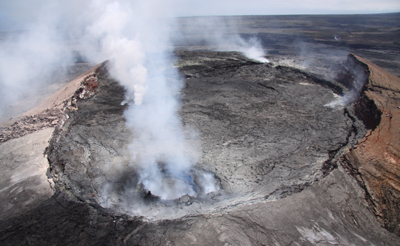
Can geothermal energy development be balanced with volcanic hazards in Hawai`i?
For decades, the State of Hawaii has been trying to reduce our dependence on fossil fuels. Energy from Hawai`i geothermal resources is but one of several alternate energy sources that have been explored.
In Hawai`i, geothermal resources depend on volcanic heat. Magma, stored in rift zones, heats groundwater which can be tapped by drilling. It is then pumped to the surface where its heat is extracted to drive electrical generators.
It makes sense that the most attractive geothermal target in the State of Hawaii is also the most active volcano—Kilauea. The nearly continuous supply of magma to Kilauea pumps heat into the geothermal resource, but it also fuels eruptions that could threaten structures on the volcano.
To make clear where future lava flows are most likely, Hawaiian Volcano Observatory (HVO) scientists published Lava-Flow Hazard Zone Maps as early as 1974, designating the summits and rift zones of Kilauea and Mauna Loa volcanoes as the most hazardous. For Kilauea, the summit and rift zones of the volcano also have the highest geothermal potential, so the Lava-Flow Hazard Map closely resembles the geothermal resource map.
Geothermal resources definitely exist on Kilauea, as established by the HGP-A pilot project in the 1970s. The Puna Geothermal Venture commercial power facility has produced 30 Megawatts (MW) from Kilauea’s heat, 20 percent of the annual electrical usage of the Island of Hawai`i, since 1993.
The most recent study in 2005 suggests that the potential of the Kilauea resource, excluding areas within national parks and state reserves, could be between 250 and 600 MW. Development of geothermal resources may also be possible on volcanoes with less frequent eruptions than Kilauea, such as Hualalai, Haleakala, or Mauna Kea.
If a resource of this size exists and is fully developed, the power generated from it would far exceed the need for electricity on the Island of Hawai`i. Therefore, the State of Hawaii is proposing the use of an undersea cable to link the islands between Hawai`i, the potential major energy producer, and O`ahu, the major energy consumer.
But what about the risk posed by volcanic eruptions? In a 1994 USGS publication (http://pubs.usgs.gov/of/1994/0553/report.pdf), HVO scientists estimated a high probability of eruptions from Kilauea’s lower east rift zone within any 50-year period. The publication also found a significant likelihood of lava inundation along the cable pathways linking the proposed Kilauea geothermal developments to the Honolulu energy grid, because the cable would have to pass across the northeast flank of Mauna Loa, Hawai`i’s other very active volcano.
These threats are real. In the last 200 years, eruptions have occurred three times in the lower east rift zone of Kilauea and six times on the northeast flank of Mauna Loa. The possibility of an eruption in the geothermal resource or state-wide cable path within any 50-year period is between 60 and 90 percent.
The effect of an eruption within a geothermal power development could be severe, and the site could be deeply buried by lava.
The power generated by the geothermal facility would be lost—possibly for weeks, months, or even years. The 1840, 1955, and 1960 eruptions in lower Puna continued for weeks to months. Power generation and transmission could not resume until after the eruption ceased, and it was safe to re-enter the area and re-establish the facilities and the cables carrying electricity away from the site.
With enough lead time before the eruption, however, much of the power-generation equipment might be moved offsite and saved for future use.
The effects of an eruption would be more profound as the geothermal power development increased in size. If a 500-MW power generation facility were developed within the lower east rift zone of Kilauea and power exported to O`ahu and Maui, a volcanic disruption would have state-wide effects.
As a community, we should explore all options in our quest for inexpensive, reliable electricity. There are down sides to the utilization of any energy source, and we must balance the negatives with the positives when making choices. This includes balancing the considerable benefits of geothermal resource development with the inherent volcanic risk of such development on active volcanoes.
SOURCE: Hawaiian Volcano Observatory

How about that right now we have zero likelihood to have a state-wide blackout, and with the cable, Hawaii can finally have a state wide blackout with these dangers.
No we can still pollute the earth with our existing coal plants(only in standby mode once the geothermal energy starts being tapped). But you’re probably right, we can continue with our use of fossil fuels until Hawaii becomes bankrupt. Wind turbines kill birds and are unsightly to many. And solar must have some NIMBY problems as well.
Gotta stay with fossil fuels…
If geothermal is covered over by a lava eruption, it means one location on one island, and doesn’t mean simultaneous lava flow in several locations on several islands.
That is why there is biofuel, which is incinerating eucalyptus trees, 68 new solar farms are in progress, and waste energy converters are starting to show municipal rubbish as gold for providing electricity to the grid. Wave power is being shaken out right now and should start showing up in a few years.
Please, give the chicken little hysteria a rest. PDF has everything all backwards and it is a wonder if the “leaders” suffer from dyslexia.
There are risks of prolonged blackouts to this island regardless of what energy source we use. The problem is we depend primarily upon only one, the least efficient, riskiest and costliest of them all. Fossil fuels.
Every argument I’ve read on the dangers of geothermal can be turned right against our existing behavior with little difficulty. It is the volcanoes that pose the greatest risk to all the residents, regardless of our energy source, and yet people continue to breath its pollutants and build within its danger zones, at a far greater human and financial risk than one lowly geothermal plant. We’ve been taking that risk for up to eighteen hundred years and we’re not going to stop now. Did not a king once make his home at the base of one not long ago? I suppose he thought the short term benefit was worth the long term risk.
Even the underwater cable concern is debatable, since if a geothermal plant were overrun by lava, the cable could still be available to temporarily provide power BACK to this island from our neighbors. The calculated odds of it all being destroyed at once are extraordinarily low.
In most cases around this country and abroad, when it is a debate between common sense and NIMBY, common sense nearly always prevails…eventually, and a far higher cost to the community than it might have otherwise had the debate been restricted to the ACTUAL problems, instead of political mythological hysteria.
In the long run, it won’t take fifty years for a geothermal plant to pay for itself many times. We could keep building new ones if that’s what Pele wished and still benefit. If the lava burns your home or steals your farm, you don’t tell your unaffected neighbors to stop farming and move away. You take a breath, collect the insurance and rebuild someplace else. It’s the same with a power plant.
Mahalo!