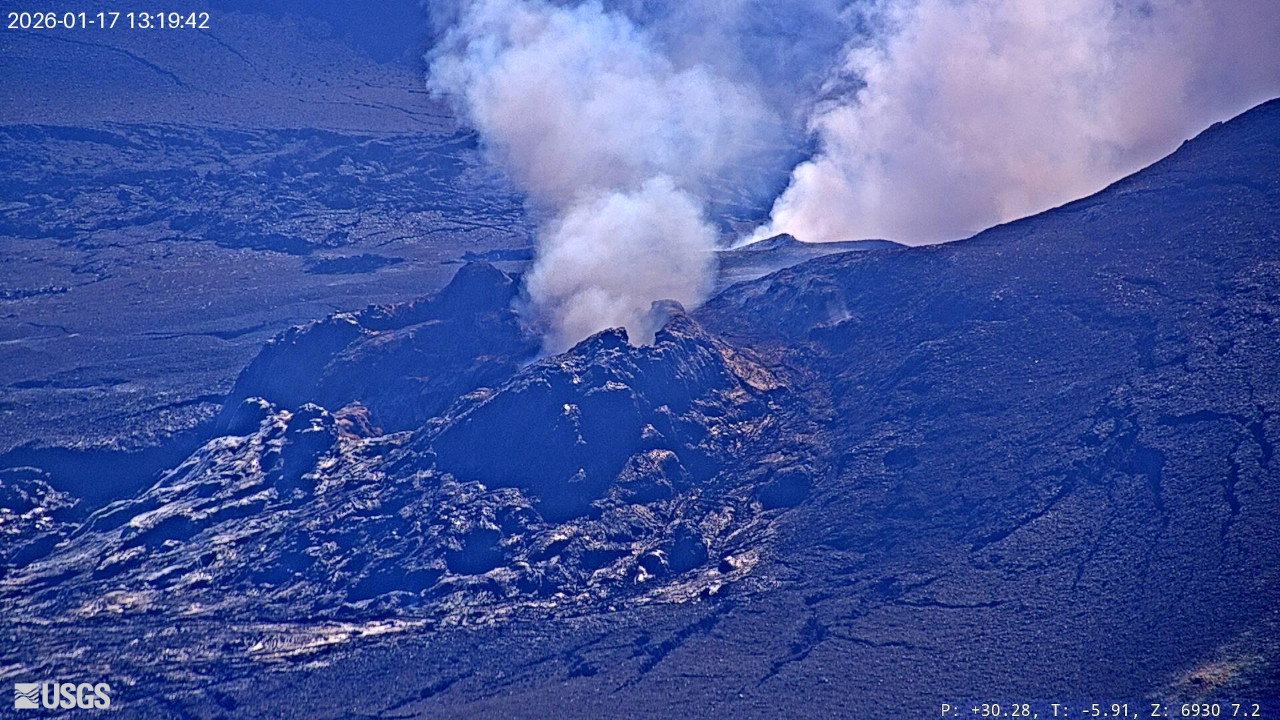
(BIVN) – The summit of Kīlauea volcano could be only a few days away from its next high lava fountaining episode.
Based on the current rate of inflation, the USGS Hawaiian Volcano Observatory on Saturday said models indicate episode 41 in the ongoing eruption could occur sometime between January 20th and January 25th.
Sporadic earthquake swarm activity continues at the summit, and although it is unclear if the seismicity will affect future eruptive activity, so far it has not had a significant impact on the overall inflation trend.
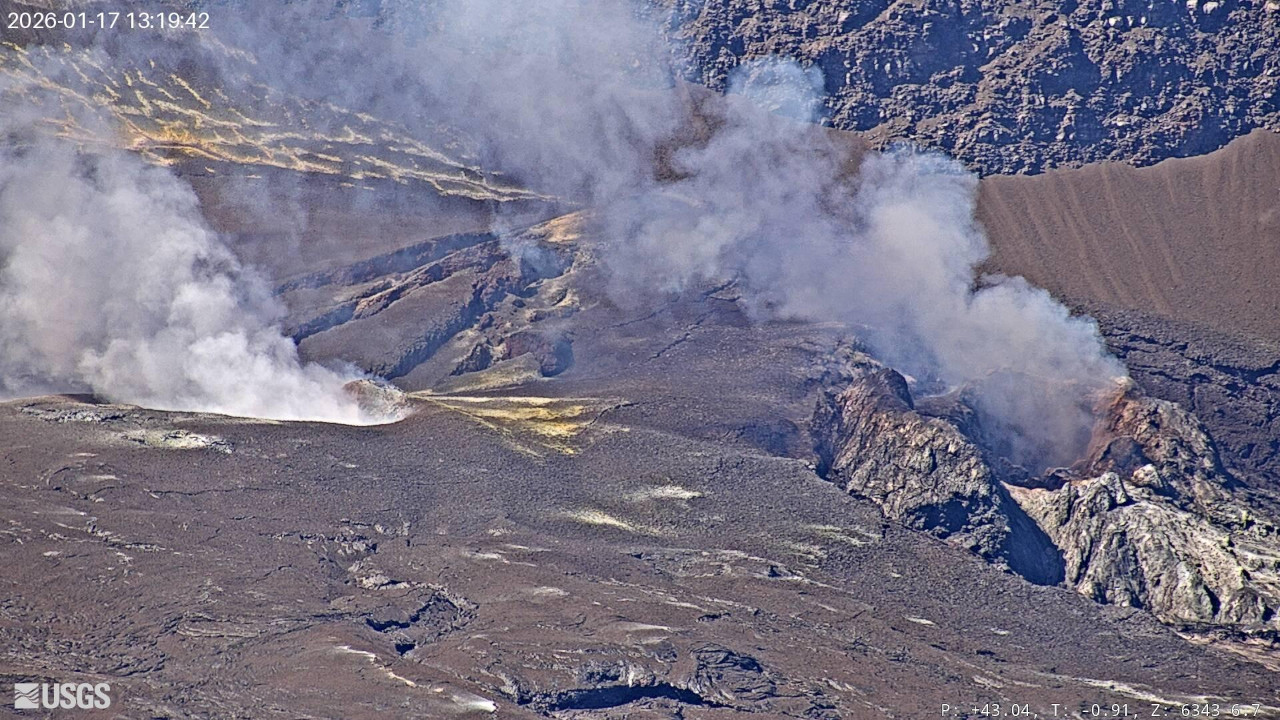
USGS webcam view of the Kīlauea summit vents within Halemaʻmaʻu on Sunday morning
From the USGS Hawaiian Volcano Observatory update posted on Saturday morning:
Overnight webcam views show consistent glow from the south vent and weak sporadic glow from the north vent. Seismic tremor spikes gradually became more ragged yesterday and were replaced by relatively constant tremor before midnight yesterday. Constant low-level tremor continues this morning.
Small seismic swarms continue at the summit, with one at 4:10 PM HST, January 16th and another this morning at 5:07 AM HST. Both were beneath the southeast part of Halemaʻumaʻu and lasted for 10-20 minutes. While the swarm earthquakes were close in time, the locations were spread fairly widely. There was also a magnitude 2.2 earthquake south of Halemaʻumaʻu at 8:22 AM HST this morning, but it is uncertain if this was related to the earlier activity. All of the detected earthquakes in swarms have been less than magnitude-2, with most being magnitude-1 or smaller and 0.5 to 2 miles (1-3 kilometers) deep. The swarms are related to migrating magmatic pressure within the summit region but their impact on the next episode of fountaining, if any, is unknown at this time. See this Information Statement for more details: USGS Volcano Notice – DOI-USGS-HVO-2026-01-15T06:34:34+00:00
Since the end of episode 40, the UWD tiltmeter has recorded 10 microradians of inflationary tilt, with an increase of 1.2 microradians in the past 24 hours. Summit tiltmeters began recording slightly deflationary tilt during the 5 AM HST swarm, before flattening. Other summit swarms have been associated with tilt drops, but the changes during the 5 AM HST swarm were longer and more gradual than previously.
The summit SO2 emission rate was last measured on January 15, at 1550 tonnes per day, which is within the typical range of 1,000 to 5,000 tonnes of SO2 per day observed during previous eruptive pauses and is considerably lower than rates observed during fountaining episodes.
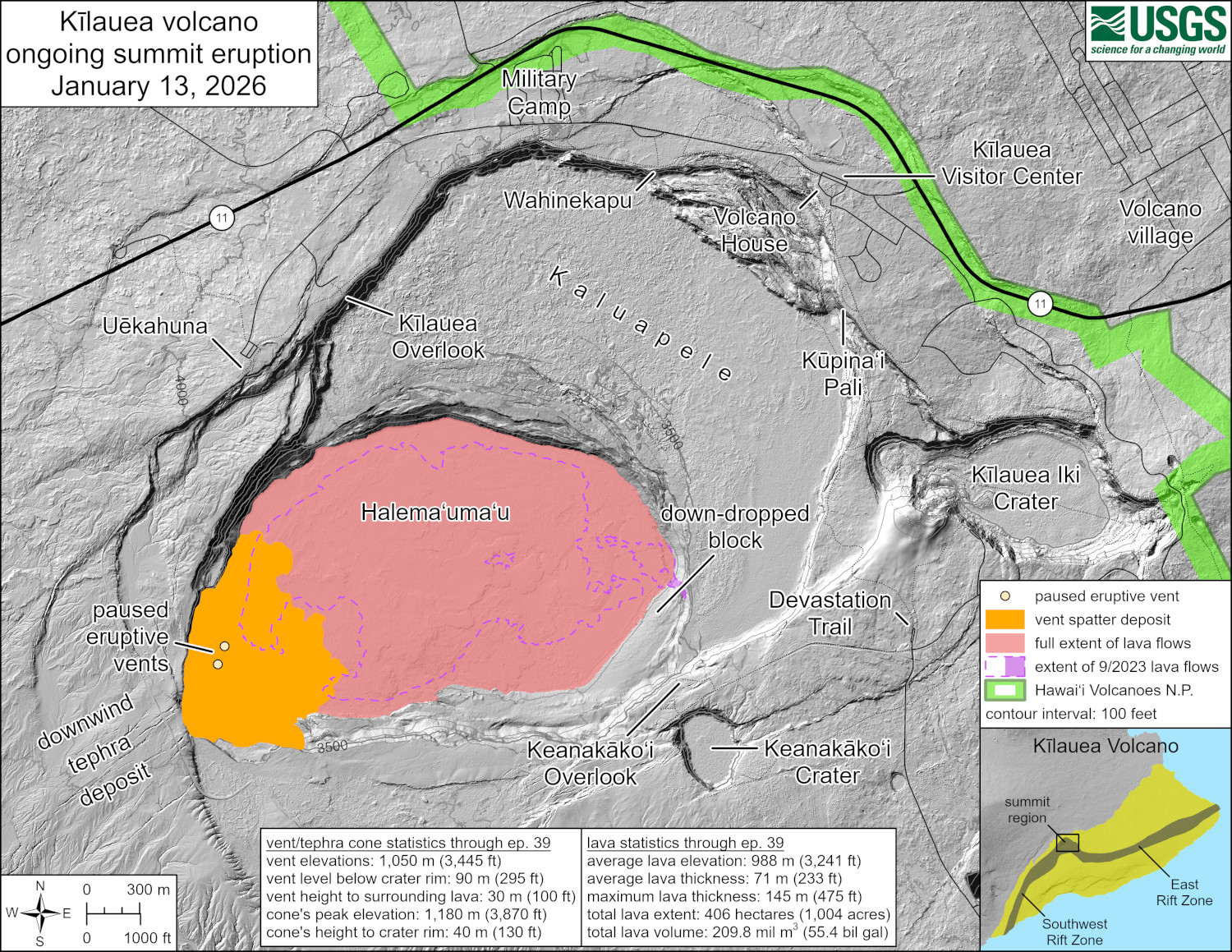
This USGS reference map depicts the Kīlauea summit eruption within Halema‘uma‘u crater that began on December 23, 2024. The data for this map were collected during a Hawaiian Volcano Observatory helicopter overflight on January 2, 2026; as such, the provided statistics are reflective of the first thirty-nine episodes of the eruption through December 24, 2025. Note that the map shows a significant expansion of the vent spatter deposit, which is the result of more comprehensive mapping of the episode 38 deposit in the southwest corner of Halema‘uma‘u. Additionally, the provided eruption statistics indicate a maximum lava thickness lower than that in previous maps; reanalysis of earlier overflight data showed that thickness measures near the eruptive vents were affected by the emitted volcanic gas plume. This has now been corrected for, and the new maximum lava thickness value should be considered more accurate at present.
Rift Zone Observations:
Rates of seismicity and ground deformation remain very low in the East Rift Zone and Southwest Rift Zone. SO2 emissions from the East Rift Zone remain below the detection limit.
Analysis:
The rapid rebound of inflationary tilt, glow from the vents, and presence of low-level volcanic tremor after episode 40 indicate that another lava fountaining episode is likely. Current rates of reinflation suggest that the next fountaining episode is likely to occur between January 20 and 25. This forecast is subject to change, however, depending on changes in behavior of the volcano.
Kīlauea has been erupting episodically since December 23, 2024, primarily from two vents (north and south) in Halema‘uma‘u. Eruptive episodes, which generally last for less than 12 hours, are separated by pauses that can be as long as over two weeks.
HVO continues to closely monitor Kīlauea and is in contact with Hawai‘i Volcanoes National Park and the Hawai‘i County Civil Defense Agency about eruptive hazards.

by Big Island Video News
on at
STORY SUMMARY
HAWAIʻI VOLCANOES NATIONAL PARK - The current rate of inflation indicates the next lava fountaining episode could occur sometime between January 20th and January 25th.