(BIVN) – This week’s Volcano Watch article was written by U.S. Geological Survey Hawaiian Volcano Observatory scientists and affiliates:
Visual observations have been a backbone in studies of volcanoes, from 2,000 years ago to now. They remain fundamental to understanding how volcanoes work, and technological advancements, such as livestreaming cameras, allow volcanic eruptions to be viewed from around the world.
Going back as far as the 79 A.D. eruption of Vesuvius, Pliny the Younger described the towering eruption plume near Pompeii as having “a very long trunk, and it then spread out … like branches.” Pliny tried to infer the mechanisms behind its changing appearance and his words were so impactful that volcanologists refer to such plumes as “Plinian” today.
Native Hawaiians witnessed countless eruptions and cycles of activity at Kīlauea’s summit over the centuries, and from these observations had deduced how magma is transported within the volcano. Standing at the summit crater (Kaluapele) in 1826, the early missionary Artemus Bishop was told by his Hawaiian guide that, if the crater continues filling with lava as it had been recently, it would “discharge itself as formerly towards the sea, through some aperture under ground.”
Visual observations are still crucial for understanding how volcanoes work, despite today’s arrays of high-tech equipment such as seismometers and GPS. But trail mix and coffee can only sustain field geologists so long, and continuous observations by the naked eye usually aren’t practical. Webcams, however, can provide 24/7 watch over the volcano, and have become an indispensable tool for monitoring over the past two decades.
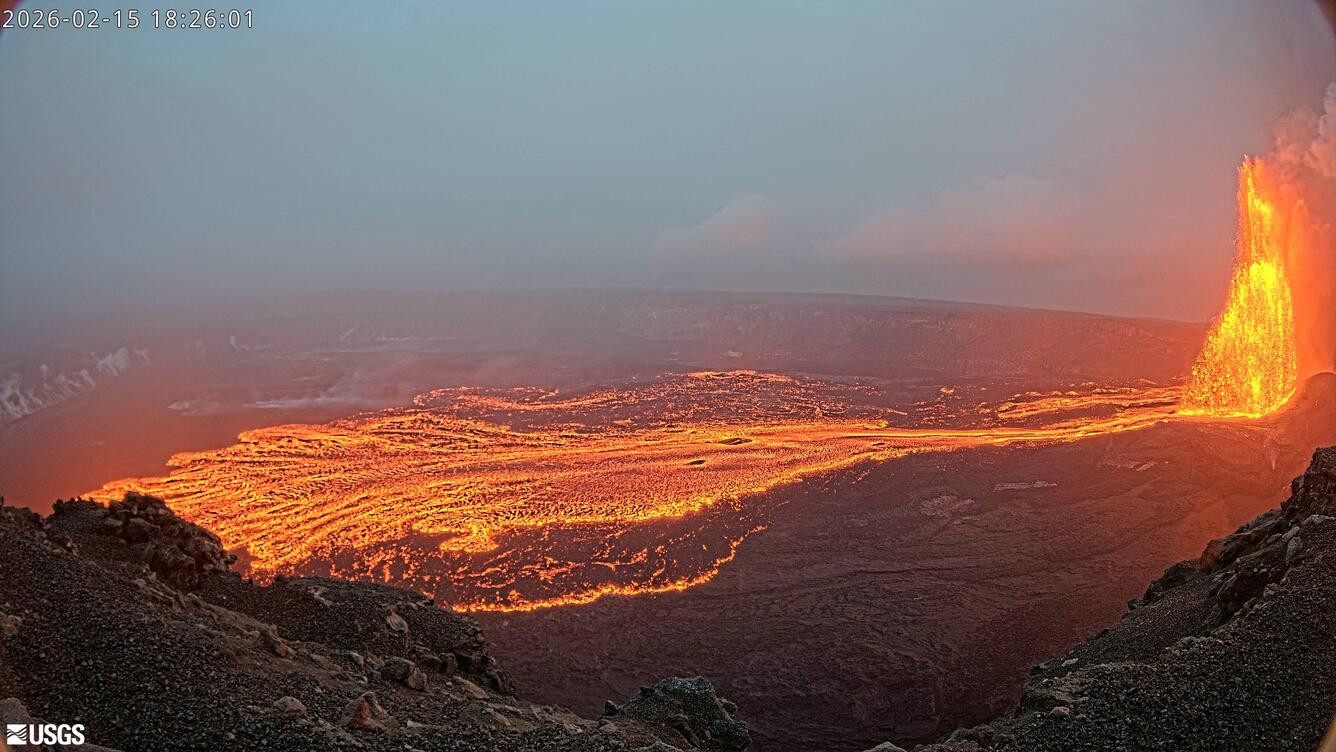
Most webcams used by the USGS Hawaiian Volcano Observatory (HVO) take a snapshot every few minutes to conserve bandwidth, but three webcams are currently “livestreaming”—meaning they transmit real-time video to the public. All three have been a vital part of monitoring the ongoing episodic lava fountains at the summit of Kīlauea.
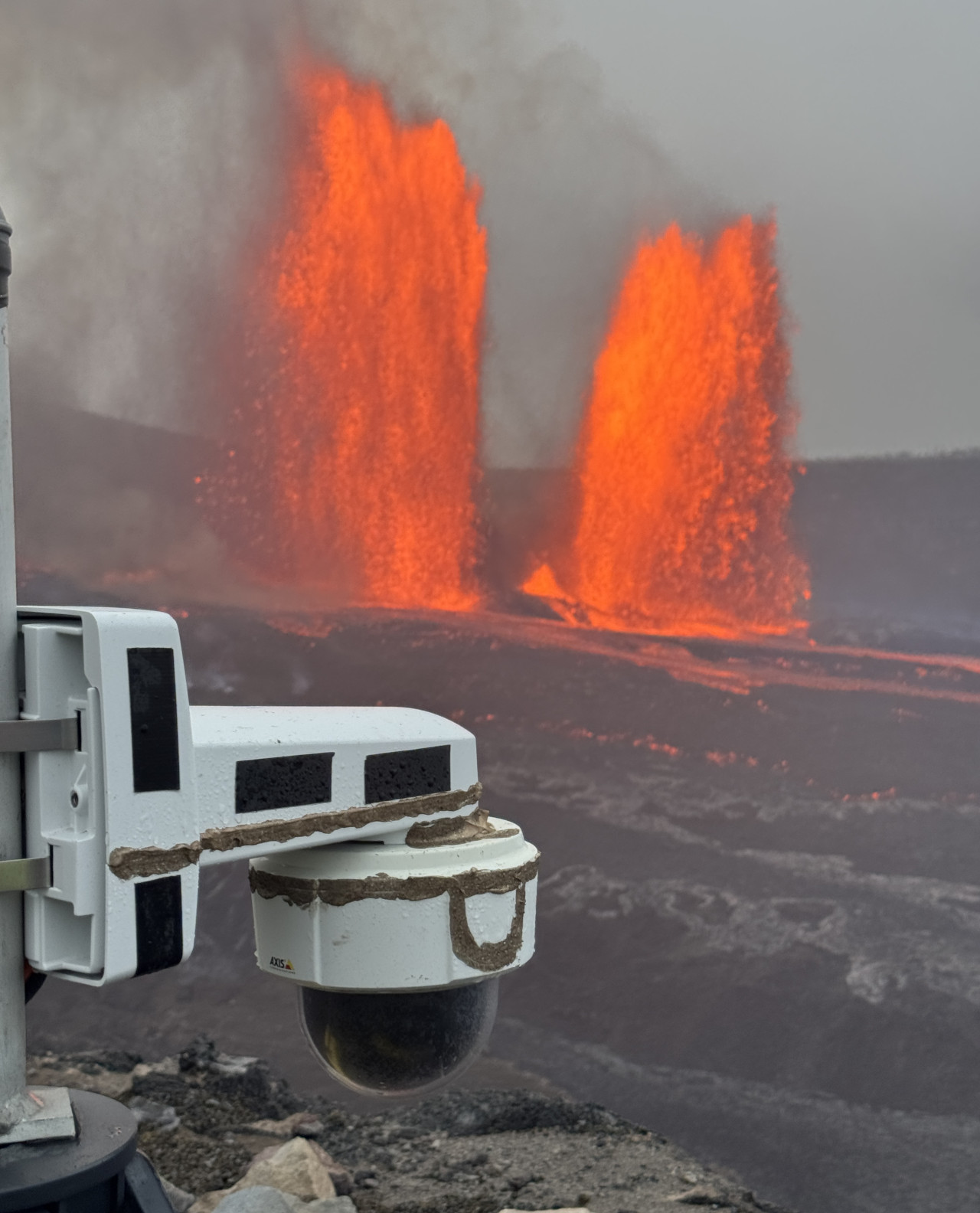
USGS: The V3cam livestream webcam monitors the episode 42 lava fountaining from the south rim of Kīlauea caldera, USGS photo by M. Patrick on February 15, 2026.
The original livestreaming camera, V1cam, went online in 2023, and in the past year HVO staff added the V2cam and V3cam to provide different angles on the eruption. Each of these viewpoints around the summit caldera has its strengths and weaknesses, but together they provide excellent “situational awareness” on the precursory overflows and high lava fountains that comprise each episode.
Maintaining these cameras can be a lot of work, and HVO field engineers, IT specialists, and geologists keep a close eye on them to make sure they are running efficiently.
Upgrades have been needed too, and livestream viewers will occasionally see HVO staff (normally in high-vis yellow or orange) in front of the camera adjusting things. Sometimes the telecommunications equipment needs an upgrade, or the camera’s internal data storage cards have to be swapped out. We are still working on testing microphones, which are challenging due to the high winds around the caldera rim.
One livestream camera (V3cam) was destroyed by the episode 38 lava fountain from the south vent on December 6, 2025. A broad arcing fountain extended over 600 yards (meters) and buried the camera under ten meters (yards) of tephra. HVO staff were able to deploy a new V3cam in a safer spot relatively quickly because we maintain a cache of monitoring equipment that can be deployed rapidly for eruption response.
The livestreaming cameras allow viewers around the world to experience Hawaiian volcanism, even from the comfort of their homes (certainly more comfortable than the cold wind and rain volcano watchers on the caldera rim experienced with episode 42 on February 15, 2026). If you’re in a restaurant in Hilo or elsewhere on the Island of Hawai‘i, you might even see one of the livestream views up on TV screen.
The livestream provides lessons on volcanic activity that are, in many ways, better than any textbook or lecture. Viewers can watch the patterns of activity unfold and test hypotheses. There is no replacement for watching something with your own eyes—even with the help of a webcam. It follows the Hawaiian proverb “I ka nānā no a ‘ike” (By observing, one learns).
Livestream cameras are also popular at Etna (Italy), Merapi and Semeru (Indonesia), and Fuego (Guatemala), amongst other volcanoes, helping countless people around the world witness how dynamic the Earth can be. Perhaps someday, a young livestream viewer will help us better understand some aspect of volcanic activity and, like Pliny, lend their own name to the field of volcanology.

by Big Island Video News
on at
STORY SUMMARY
HAWAIʻI VOLCANOES NATIONAL PARK - The USGS HVO details how field engineers, IT specialists, and geologists keep a close eye on webcams to make sure they are running efficiently.