

UPDATE – (11 a.m.) – About an hour after this story was published, the USGS Hawaiian Volcano Observatory raised the Volcano Alert Level for Kīlauea from ADVISORY to WATCH, and the Aviation Color Code from YELLOW to ORANGE, as episode 52 precursory low-level activity began around 10:22 a.m. HST on July 28, 2026.
“The north vent has been continuously overflowing since 10:22 am HST,” the Observatory noted. “Overflow is being fed by a small dome fountain 5-10 feet high. Summit continues to inflate at this time.”
(BIVN) – The window for the next episode of lava fountaining at the summit Kīlauea has shifted again.
Episode 52 could begin at any time between now and July 30th, scientists say. The USGS Volcano Alert level remains at ADVISORY, as of Tuesday at 10 a.m. HST.
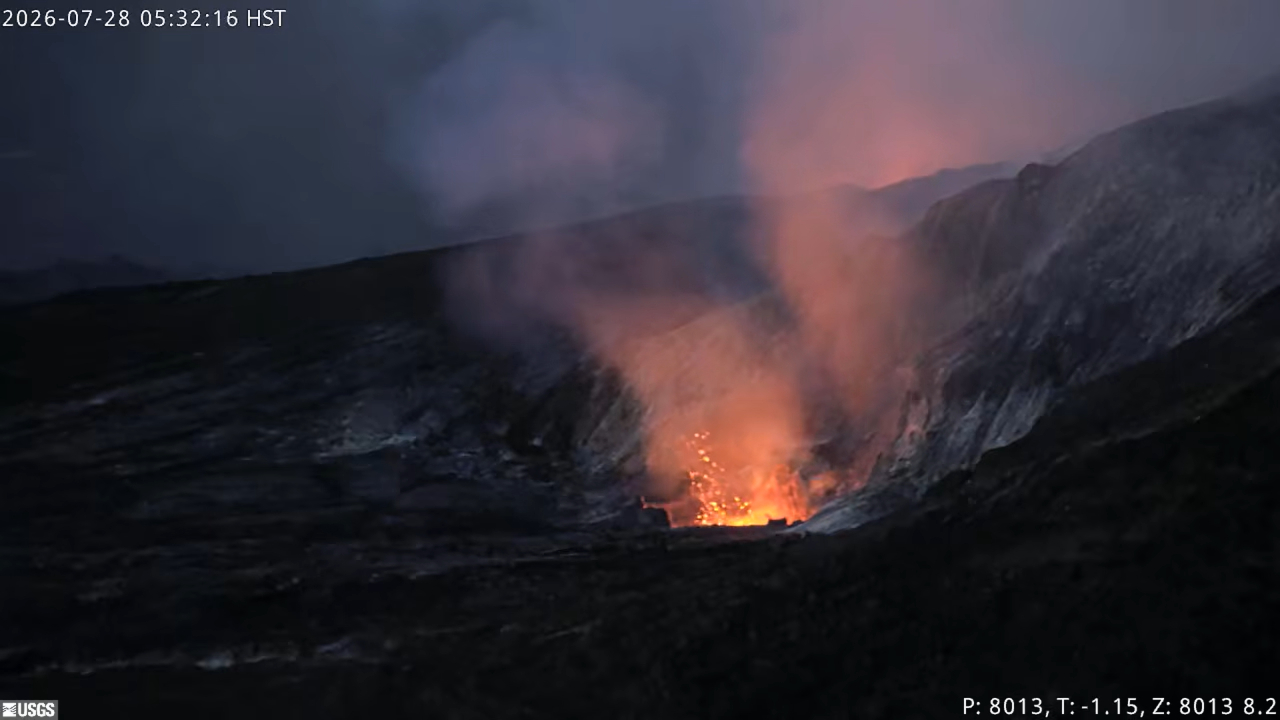
The USGS Hawaiian Volcano Observatory reports precursory lava spattering began overnight from both the north and south vents in Halemaʻumaʻu.
Summit tiltmeters have recorded rapid inflation since the summit started reinflating Monday morning.
“Current conditions have shifted the modeled forecast time window for episode 52 fountains to between today and July 30,” the Observatory stated on Tuesday morning. “If the inflation rate slows significantly again, it may push the forecast window back again.”
From the USGS HVO on Tuesday morning:
Summit Observations:
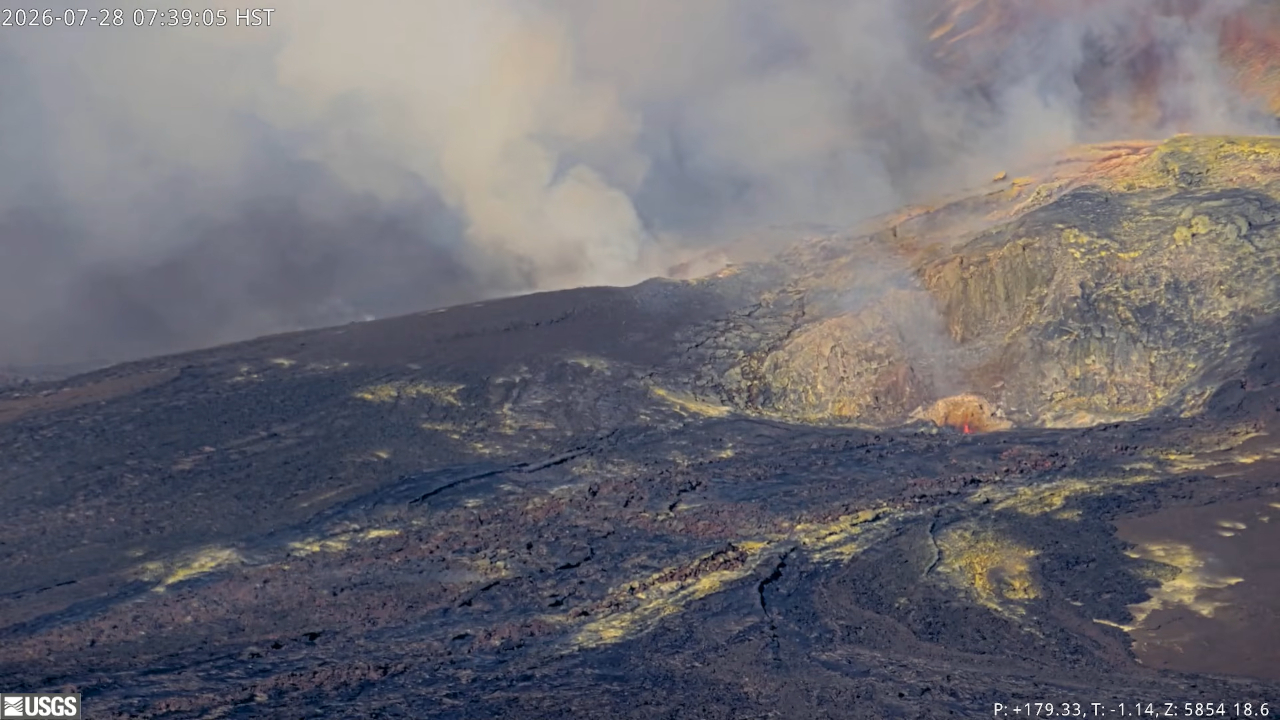
Overnight, north vent had persistent glow, south vent had intermittent glow related to gas piston events, and both vents produced occasional spatter. Starting around 8 a.m. this morning, north vent has displayed persistent spattering.
Tremor remains relatively continuous with occasional tremor bursts associated with glow, flames, and rare spatter from the south vent, corresponding to gas-pistoning drainback events. One earthquake was located beneath the summit of Kīlauea summit in the past 24 hours.
Since episode 51 ended, inflation resumed and has recovered 14.4 microradians of tilt at the summit tiltmeter at Uēkahuna (UWD).Over the past 24 hours, UWD has recorded 4.1 microradians of inflation. Kīlauea summit deflation totaled 14.7 microradians during episode 51.
The sulfur dioxide (SO2) emission rate from the summit is likely now varying within a typical range of 1,000 to 5,000 tonnes per day. Degassing plumes from both vents are being blown toward the southwest this morning.
Rift Zone Observations:
Rates of seismicity and ground deformation remain low in the East Rift Zone and Southwest Rift Zone. SO2 emissions from the East Rift Zone remain below the detection limit.
Analysis:
The abrupt switch from summit deflation to inflation at the end of episode 51 along with continued glow from the vents indicates that another fountaining episode is likely. Inflation since the end of episode 51 was relatively smooth without significant deflations until very early on Tuesday, July 21, when inflation paused and was flat for over a day. Around midnight the night of July 23 to 24, summit tiltmeters started recording minor deflation, which continued through the day of July 26 at a slower rate and flattened out overnight. Inflation resumed starting around 6 a.m. H.S.T. on July 27 (yesterday) and has been rapidly inflating since. As of this morning, the UWD tiltmeter has recovered 14.4 microradians of the 14.7 microradians lost to deflation during episode 51. However, both episode 50 and 51 fountains required an additional microradian of inflation to trigger eruption. Recalculated forecast models based on the recent rapid inflation have brought forward the forecast window for the start of episode 52 fountains to today through July 30. Future periods of slow inflation or deflation may cause the forecast window to be adjusted.
Kīlauea has been erupting episodically since December 23, 2024, from two vents (north and south) in Halema‘uma‘u. Lava fountaining episodes, which generally last for less than 12 hours, are separated by pauses that can be longer than three weeks.
HVO continues to closely monitor Kīlauea and is in contact with Hawai‘i Volcanoes National Park and the Hawai‘i County Civil Defense Agency about eruptive hazards.
