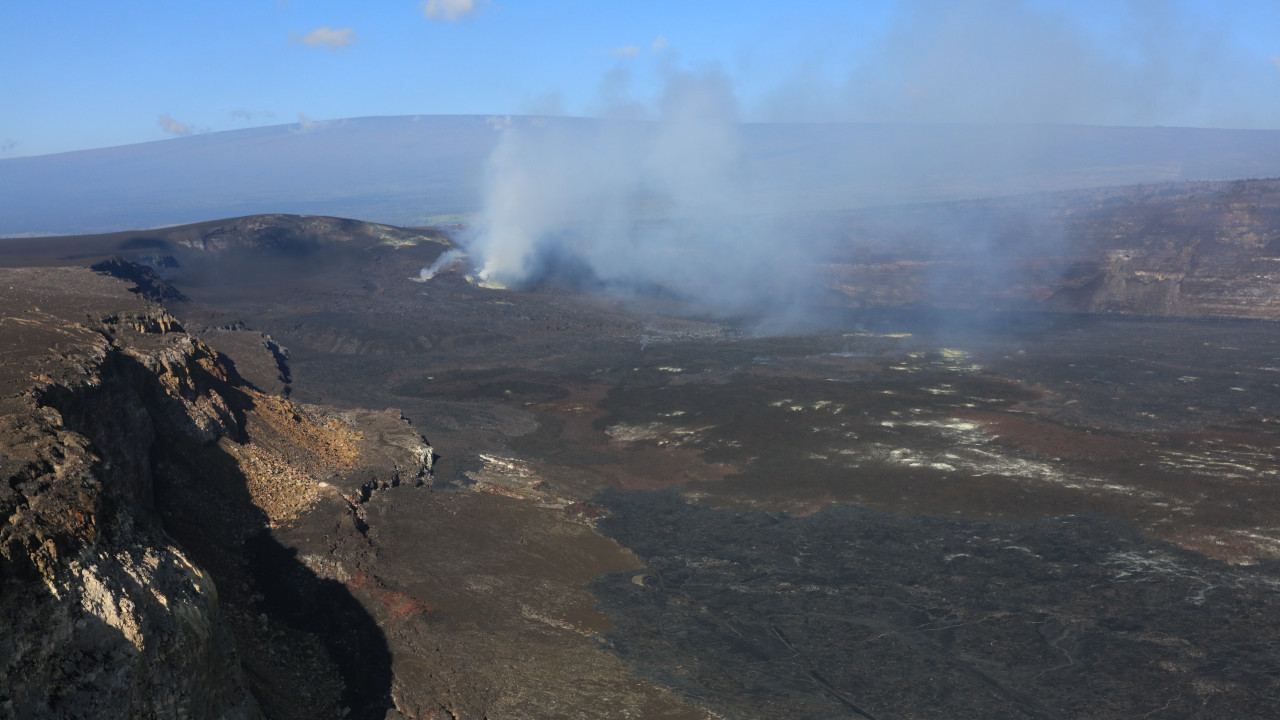
(BIVN) – Scientists say the next episode of high lava fountaining in the ongoing eruption of Kīlauea volcano is approaching, and in the latest Volcano Watch article, the USGS Hawaiian Volcano Observatory introduces a new tool to track falling tephra.
From the Observatory:
During Kīlauea summit lava fountaining episode 41, residents and visitors shared their observations of tephra falling via email, phone calls, and on social media. A new online tool, “Is Tephra Falling?” will allow people to share their observations in a more systematic way.
This new tool is borrowed from our colleagues at the Alaska Volcano Observatory, though the USGS Hawaiian Volcano Observatory made some small updates to reflect different volcanic conditions here in Hawaii.
Like the “Did You Feel It?” earthquake reporting tool helps to make maps of areas affected by shaking, “Is Tephra Falling?” will be used to help scientists make maps of areas affected by tephra fallout.
Tephra is a word that Kamaʻāina (Hawaii residents) have become familiar with over the past year. It describes anything that erupted out of a volcano and traveled through the air before landing on the ground. Many communities on the Island of Hawaiʻi downwind of the eruptive vents at the summit of Kīlauea have been affected by tephra fall since the episodic lava fountaining eruption at the summit of Kīlauea began on December 23, 2024.
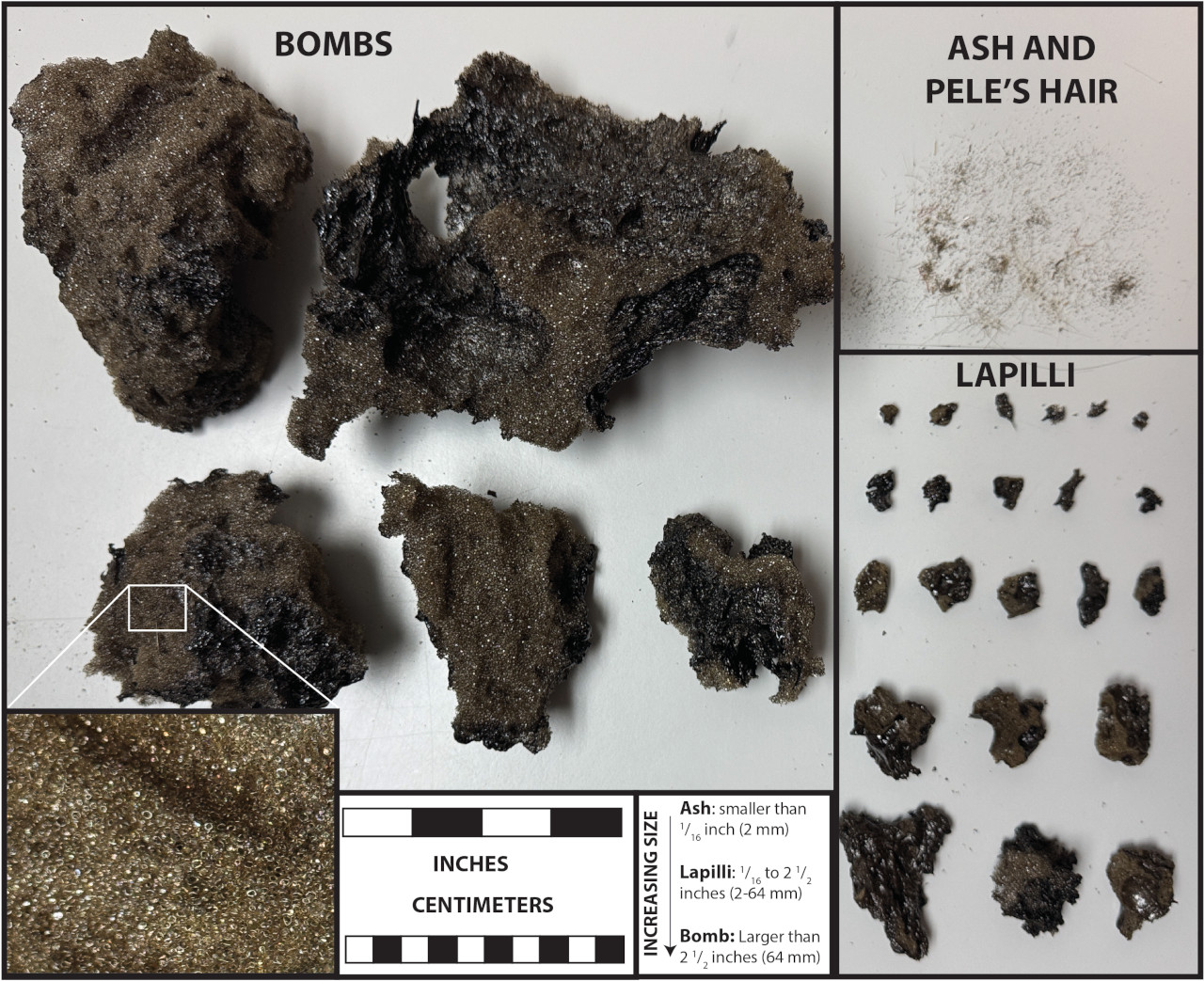
This annotated photograph shows the different size categories of tephra associated with recent lava fountaining episodes at the summit of Kīlauea. The inset photo on the bottom left shows the vesicular (bubble-rich) texture of most of these clasts. (USGS photo)
Tephra can range in size and density (which is related to the vesicularity, or bubble abundance). There are different names for certain size ranges, and special names for certain vesicularities. This characterization system helps scientist to map deposits such as those being created during Kīlauea lava fountaining episodes.
The smallest particles of tephra are volcanic ash, and they are smaller than 1/16 of an inch (2 mm). Tephra that is between 1/16 of an inch and 2 ½ inches (2–64 mm) in size is called lapilli. Any tephra larger than 2 ½ inches (64 mm) is called a bomb or a block, depending on whether it is fresh lava or older material. Lava fountains also create a special type of tephra; the long, thin strands of volcanic glass that make up Pele’s hair, which is hard to classify by size.
In Alaska, the tool is called “Is Ash Falling?” because the communities there have mostly seen fallout of ash-sized particles. Up to bomb-sized tephra fell in populated areas closer to Kīlauea’s summit during episode 41, while ash-sized particles fell in communities farther away, which is why the tool will be called “Is Tephra Falling?” in Hawaii.
The bomb-sized pieces that fell on communities around Kīlauea’s summit were very lightweight and frothy. We call these reticulite, and they are made up mostly of bubbles (geologists call them vesicles). Other types of bombs that have different vesicle abundances are called pumice and scoria in order of decreasing vesicle abundances. Cinder is a word that is often used synonymously with scoria.
These types of tephra are full of bubbles because gas exsolving out of the lava is a large part of what is driving the lava fountaining process. That, in combination with the narrow conduits of the north and south vents, allow the tall lava fountains to form.
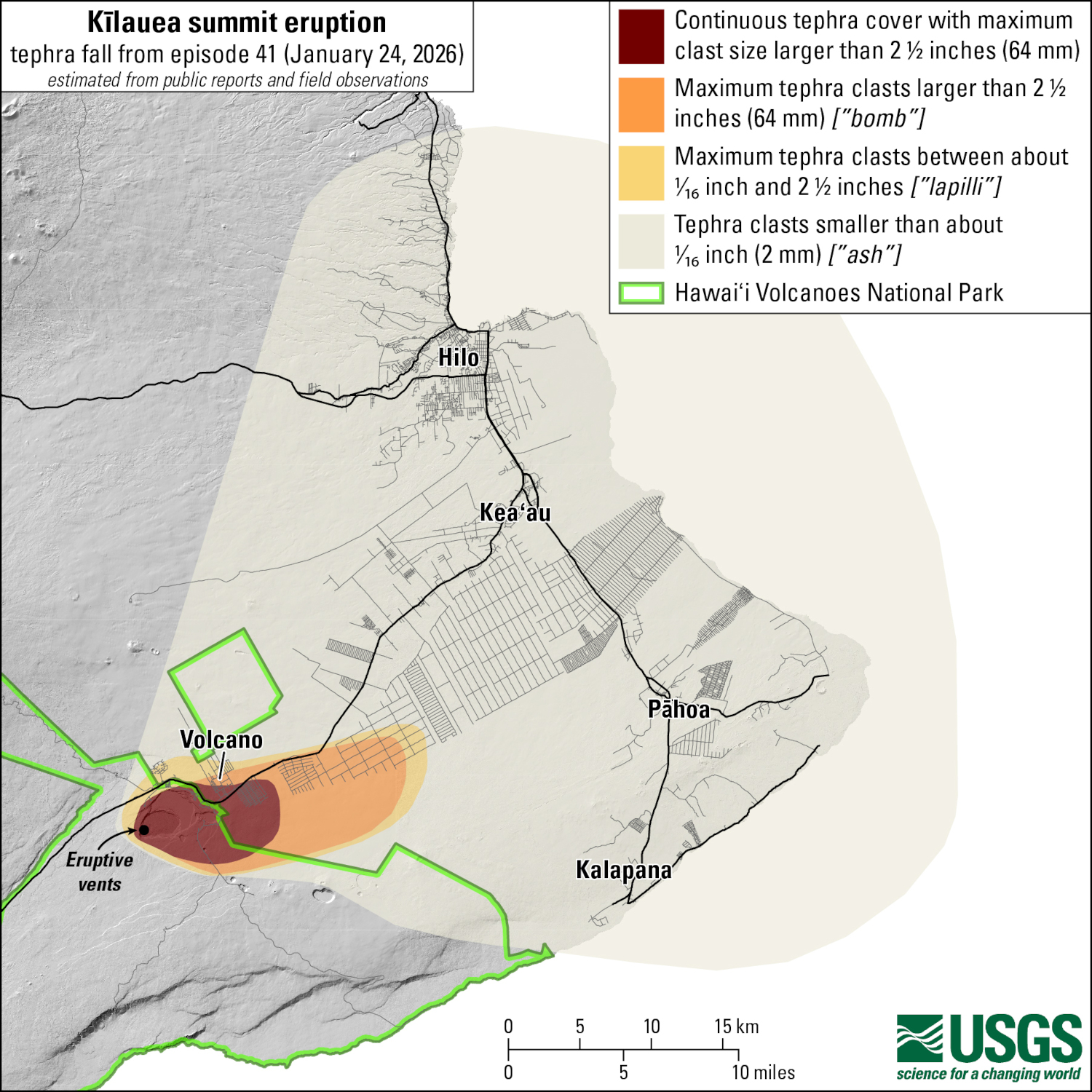
USGS: “This map shows the tephra fall associated with episode 41 of Kīlauea’s episodic summit eruption, on January 24, 2026. Tephra is a generic word for any material erupted by a volcano that travels through the air before landing on the ground. During episode 41 on January 24, lava fountains from the north and south vents in Halemaʻumaʻu at the summit of Kīlauea reached up at least 450 m (1475 feet). Weak surface winds in combination with stronger upper-level winds blowing to the east and north resulted in widespread tephra fall in communities to the northeast and east within the Districts of Kaʻū, Puna, and South Hilo.”
Where the tephra lands is dependent on the fountaining dynamics and wind conditions. Aspects of fountaining dynamics include whether both vents are fountaining, how tall the fountains are, and whether the lava fountains are inclined. Aspects of wind conditions include what the wind speeds and directions are at different levels in the atmosphere.
Episode 42 lava fountaining is forecast to start between February 11 and 16. Currently, the weather forecast for that timeframe shows that trade winds may be present, which blow to the southwest. Communities in the Districts of Kaʻū and South Kona have been affected by ash fall during past fountaining episodes during trade wind conditions.
Forecasts can change, however, so it’s important to stay aware of the weather forecast and eruption forecast if you live in an area that can be affected by tephra fall. If you do experience tephra fall, please consider letting us know (here). You can describe the size and percentage of a given area that is covered with tephra, and even share a photo.
Your observations will be used to assess the character and size of the Kīlauea eruption plumes, and the dispersal pattern of tephra fall. We will share your observations with the Hawaii County Civil Defense Agency and National Weather Service. We appreciate any information you can share.
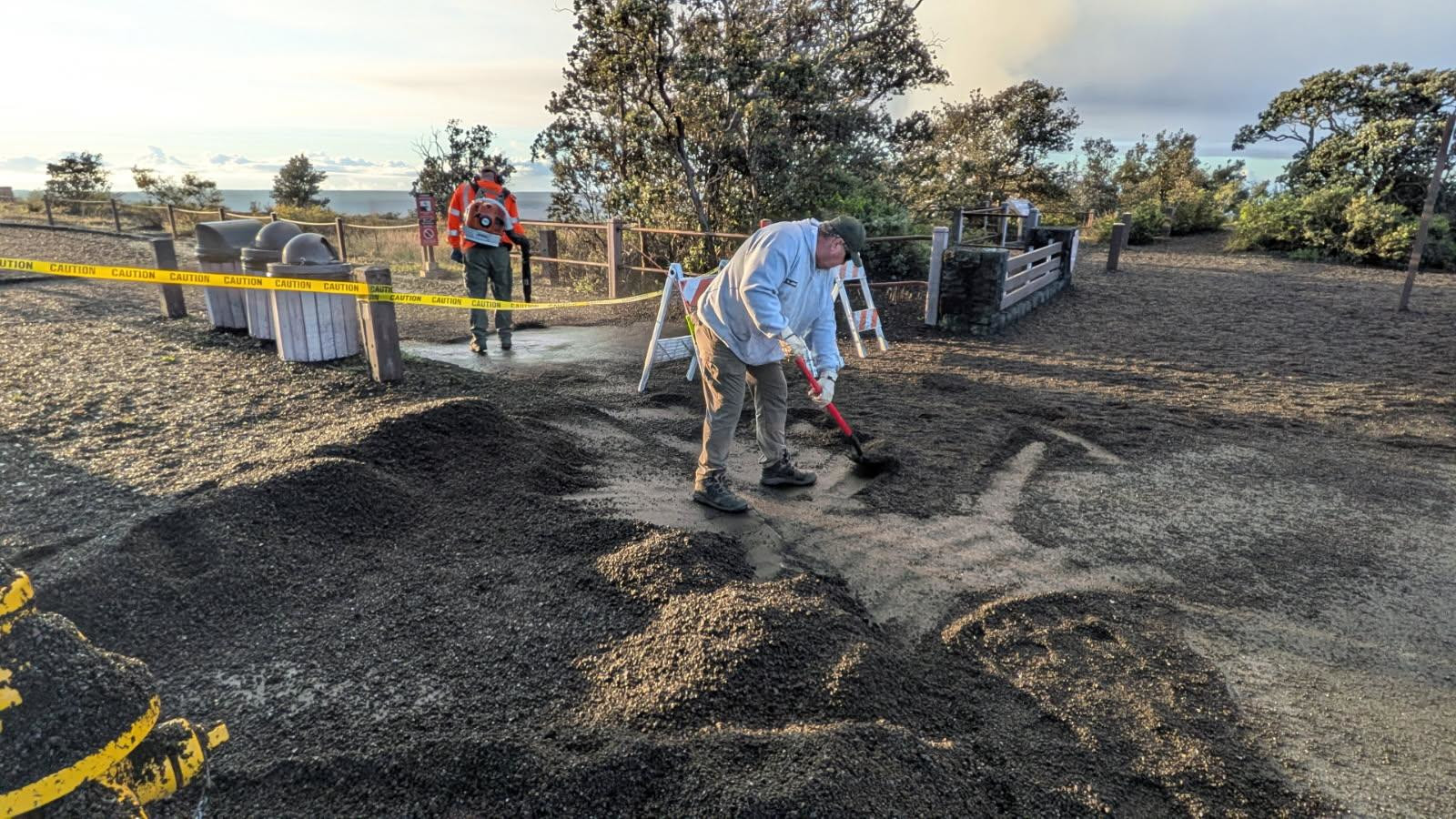
National Park crews were working to clear tephra from the public viewing areas near the summit of Kīlauea on Sunday morning (photo by Daryl Lee)

by Big Island Video News
on at
STORY SUMMARY
HAWAIʻI ISLAND - A new online tool will allow residents and visitors to share their observations in a systematic way.