
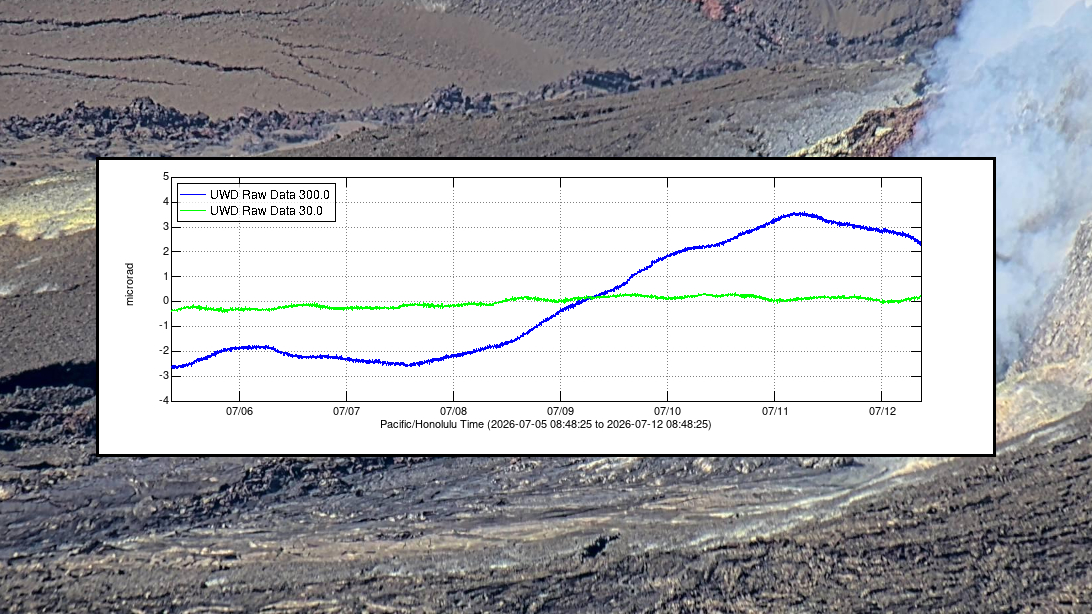

(BIVN) – The eruption at the summit of Kīlauea volcano remains paused. Deformation continues as of Sunday morning, likely delaying the anticipated start of eruptive episode 51.
Previously, the forecasted window for high lava fountaining was this weekend, but inflationary tilt flattened Saturday morning before shifting to deflation.
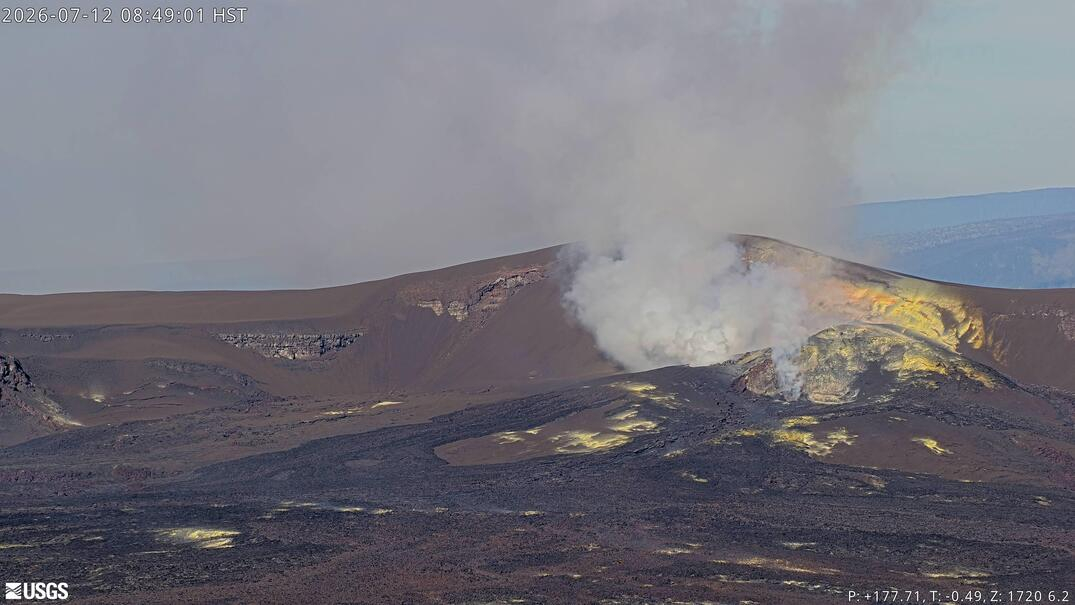
There has been strong glow at the summit vents overnight, but the vigorous lava spattering that was seen early Saturday morning is no longer present.
The USGS Volcano Alert Level for Kīlauea is a ADVISORY and the Aviation Color Code is YELLOW.
UPDATE – (10:15 a.m.) – From the USGS HVO update on Sunday morning:
Summit Observations:
Strong glow was visible from the north vent overnight, with intermittent and variable glow from the south vent. No spatter has been visible from either vent since yesterday morning. Low-level precursory activity started around 12:00 a.m. HST on July 11, with nearly continuous spattering in the north vent. The north vent spattering became less vigorous following the start of slow summit deflation around 7:00 a.m. HST yesterday morning, with the last spatter visible around 10:15 a.m. HST. Less spattering was seen from the south vent yesterday morning, but there was a tiny short-lived overflow of lava around 7:03 a.m. HST.
Steady, low-level seismic tremor became continuous around 3:00 a.m. HST this morning. Previously, steady tremor was alternating with short periods of reduced tremor followed by spikes related to gas piston activity in the south vent. Earthquake activity beneath Kaluapele (Kīlauea caldera) remains low.
Kīlauea summit has recorded about 1 microradian of deflationary tilt over the past day on the UWD tiltmeter and is continuing to deflate at an increased rate since 6:00 a.m. HST. Tilt recovery since the end of episode 50 has dropped from 15.4 microradians yesterday to 14.4 microradians today. Summit deflation totaled 15.3 microradians on UWD during episode 50.
The sulfur dioxide (SO2) emission rate from the summit is likely now varying within a typical range of 1,000 to 5,000 tonnes per day.
Rift Zone Observations:
Rates of seismicity and ground deformation remain low in the East Rift Zone and Southwest Rift Zone. SO2 emissions from the East Rift Zone remain below the detection limit.
Analysis:
Summit deflation continues since yesterday morning, pushing back the forecast window for episode 51. Two similar deflationary trends have interrupted the overall inflationary pattern following episode 50 and each lasted 1-2 days. Each of these pushed the forecast window back 1-2 days. Strong glow from the north vent along with variable glow from the south vent overnight, indicates that magma remains relatively close to the surface. The current forecast suggests that episode 51 will occur sometime between tomorrow, July 13, and Wednesday, July 15, but depends on when the current deflationary period ends.
