
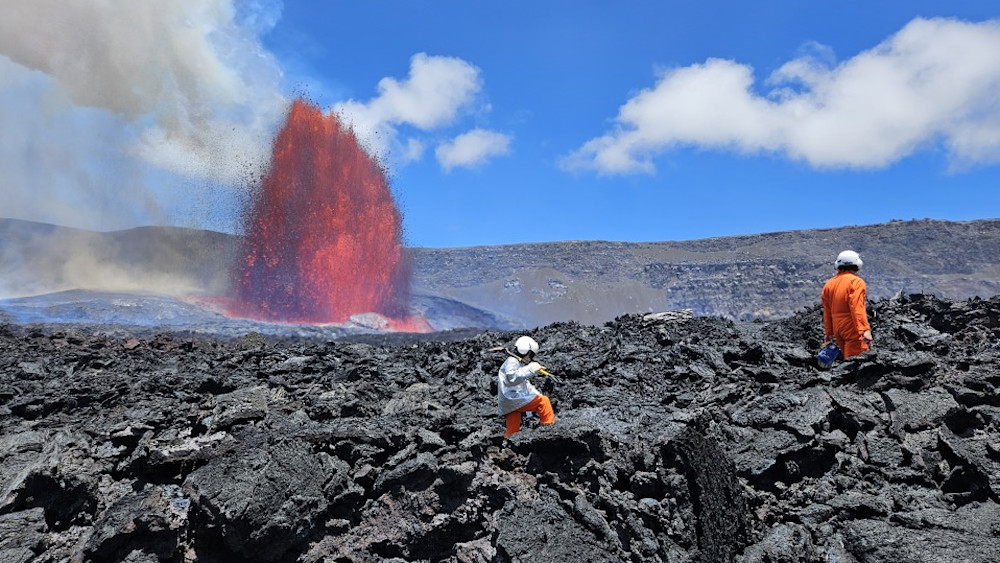

USGS: "Halemaʻumaʻu crater is the home of Pele, the Native Hawaiian elemental force associated with lava, and numerous eruptions have taken place in the crater. With permission from Hawaiʻi Volcanoes National Park, USGS Hawaiian Volcano Observatory scientists landed briefly on the crater floor on Wednesday, July 9, to collect lava samples of episode 28. Here, two scientists are walking across earlier, cooled lava searching for a safe point to access the active episode 28 flows for a molten sample. Analyses of molten lava samples provides information on magma storage conditions, which aid in ongoing hazard assessments." (USGS photo by M. Zoeller)

Kīlauea Volcano Eruption Update for Thursday, June 10

Big Island Video News

Jul 10, 2025

STORY SUMMARY

HAWAIʻI VOLCANOES NATIONAL PARK - Episode 28 of the ongoing summit eruption ended abruptly at 1:20 p.m. HST on Wednesday, July 9, after 9 hours of continuous fountaining.

(BIVN) – The ongoing eruption at the summit of Kīlauea is once again paused, after a 9-hour episode of lava fountaining that began and ended on Wednesday.

Episode 28 ended abruptly at 1:20 p.m. HST on July 9th, after 9 hours of continuous fountaining, the final 8 of which were high fountaining, the USGS Hawaiian Volcano Observatory reported.

From the USGS HVO Volcanic Activity Notice issued after the episode had ended:

The north vent stopped erupting at approximately 1:20 p.m. HST, marking the end of the episode. The south vent did not appear to activate at all during this episode and has been completely covered by new deposits. The growing cone around the north vent has begun to connect with the top of the surrounding cliff in some places.
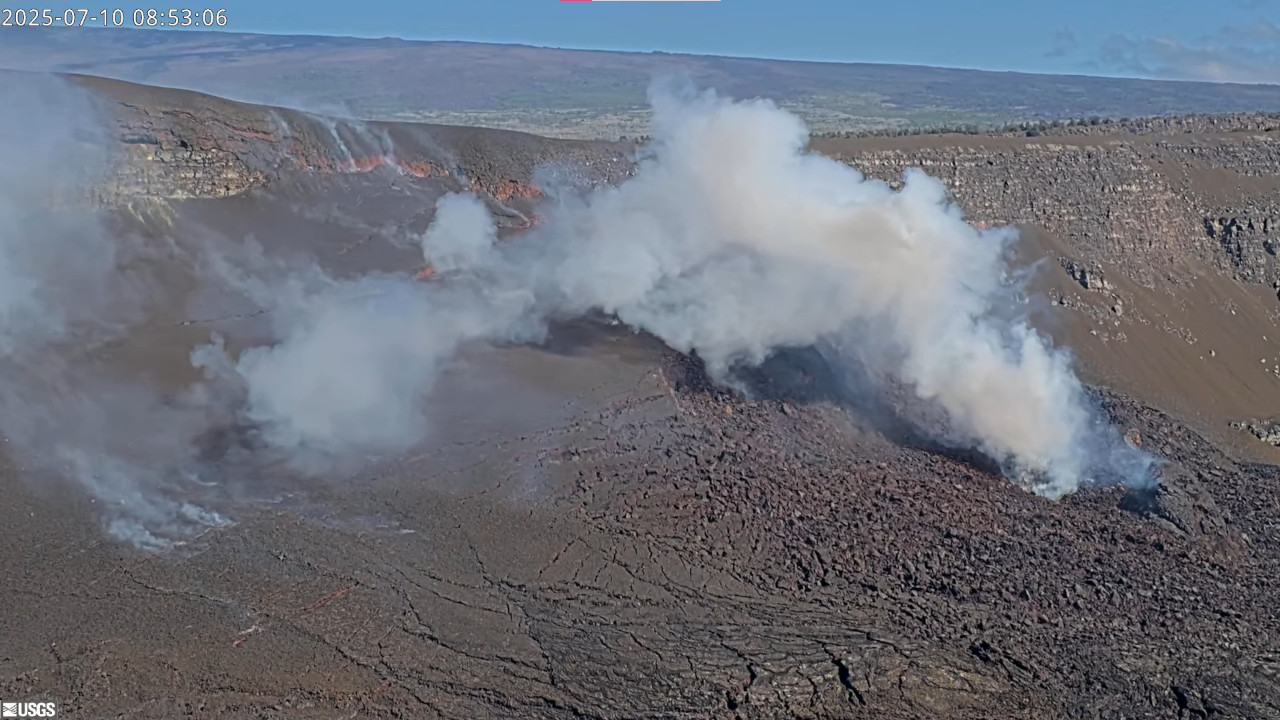
USGS webcam on Thursday morning


Lava fountains reached up to approximately 1200 ft (365 m) during this episode. Volcanic gas emissions have greatly decreased since the end of fountaining. Lava flows from this episode on the floor of Halemaʻumaʻu within the southern part of Kaluapele (Kīlauea caldera) may continue to exhibit slow movement or incandescence as they cool and solidify over the coming days. Slumping of molten cone material around the vent may also continue for the next 24 hours and can produce small, localized lava flows.

The Uēkahuna tiltmeter (UWD) recorded about 15 microradians of deflationary tilt during this episode. The end of the eruption was coincident with a rapid change from deflation to inflation at the summit and a decrease in seismic tremor intensity.
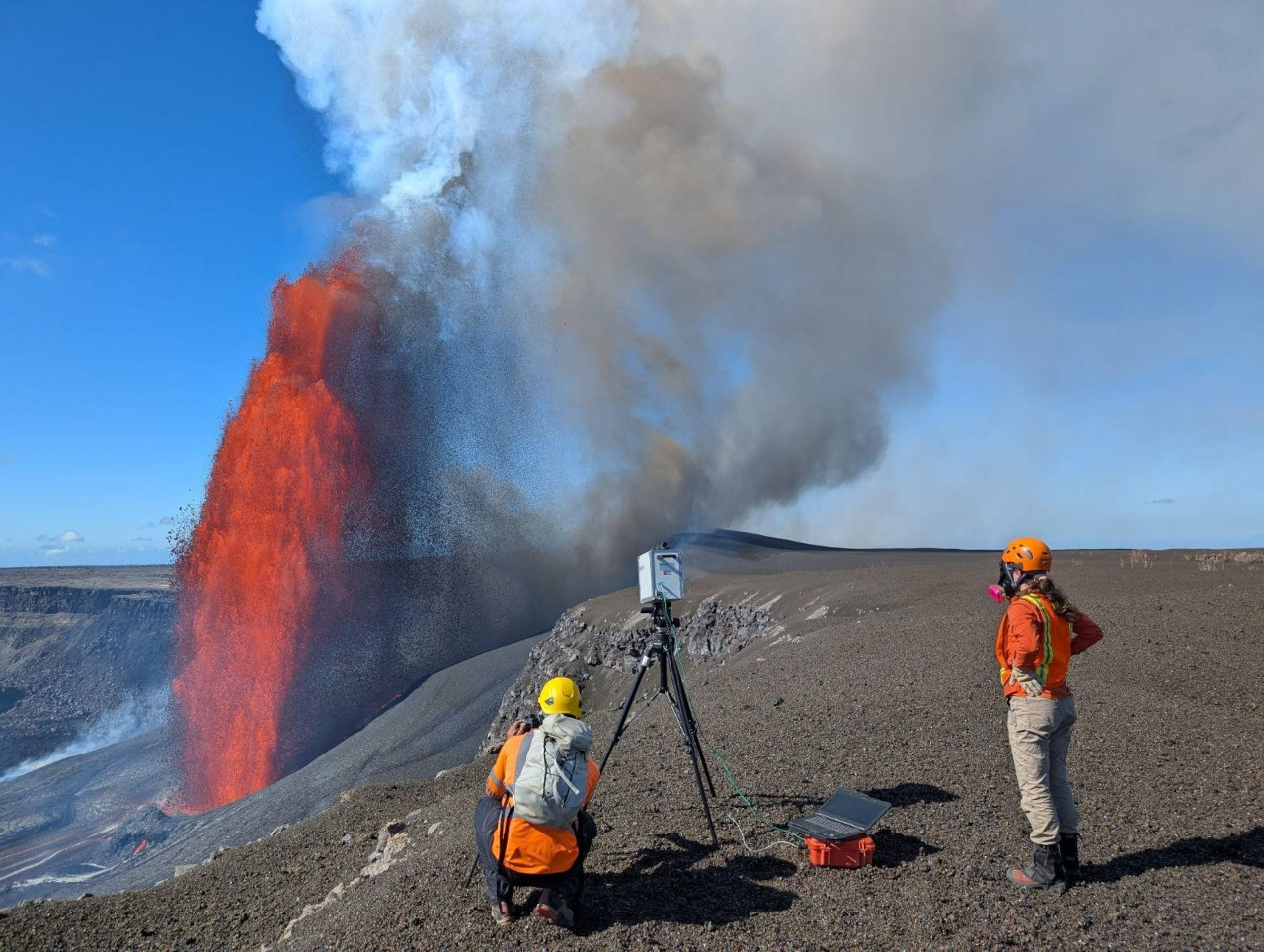
USGS: “USGS scientists use an FTIR (Fourier transform infrared spectrometer) to measure the chemical composition of volcanic gas during episode 28 of the ongoing Kīlauea summit on July 9, 2025.” (USGS photo by M. Cappos)

No changes have been detected in the East Rift Zone or Southwest Rift Zone. The USGS Volcano Alert Level/Aviation Color Code for Kīlauea remain at WATCH/ORANGE.

About The Featured Image

USGS: "Halemaʻumaʻu crater is the home of Pele, the Native Hawaiian elemental force associated with lava, and numerous eruptions have taken place in the crater. With permission from Hawaiʻi Volcanoes National Park, USGS Hawaiian Volcano Observatory scientists landed briefly on the crater floor on Wednesday, July 9, to collect lava samples of episode 28. Here, two scientists are walking across earlier, cooled lava searching for a safe point to access the active episode 28 flows for a molten sample. Analyses of molten lava samples provides information on magma storage conditions, which aid in ongoing hazard assesssments." (USGS photo by M. Zoeller)


Image placeholder

Big Island Video News has been serving Hawaiʻi island since 2008.