
The following news article was first published on July 17, 2008. The article was refurbished on March 1, 2026 as a part of our Archive Restoration Project. Article content remains the same, although there may be some non-substantive changes and corrections, such as the inclusion of proper diacritical markings. New images from the original story media may also be included. Also, when appropriate, we will include a transcript of the featured video. Transcripts were generally not included in the original published story.
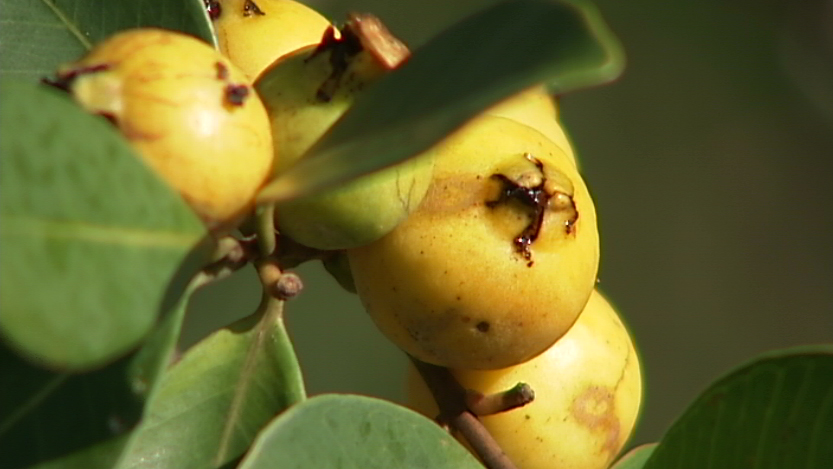
(BIVN) – The government has considered introducing a Brazilian insect into the environment in the hopes that it would eradicate an invasive plant. Locals, who have learned to live harmoniously with strawberry guava, or waiawi, and see it as a useful food source, oppose the measure.
The USDA Forest Service is holding a series of statewide public information and listening sessions about the proposed release of the insect Tectococcus ovatus, to slow the spread of strawberry guava. Listening sessions begin this September and will help the public to become familiar with the proposed biocontrol insect, to ask questions, and to provide input prior to completion of a new draft Environmental Assessment (EA).
The following is a transcript of the above featured video:
Lloyd Case: But to bring in an insect, biological warfare, when people get waiawī in their backyard that they use for home use, is crazy.
Dr. Fred Holschuh: As a former County Councilmember, I am very disturbed that government agencies are going to do all this, in spite of the huge public outcry against it.
Dominic Yagong, Hawaiʻi County Council : We had a really great meeting tonight. We really wanted to make sure that we provide an avenue for the people to express their concerns in regard to this proposal by USDA Forestry Division in regard to releasing this Brazilian insect. Obviously, tonight was a great opportunity for people to hear the other side, and more important to hear from people that are recreational users of the forest. People that utilize the waiawī for personal reasons, and I thought it was a great discussion.
With the waiawī, I think it’s been noted it’s been here for over 100 years. So it’s been part of our culture. Some people of Hawaiian ancestries have expressed how it’s been part of their culture and people have expressed how the people use it in terms of burning wood. Gentleman talked about using it as stick for a hoe, and so forth. But, you know, it’s a food source.
Christy Martin, PIO – Coordinating Group on Aline Pest Species : I think we can all agree that strawberry guava is in the forest and it is spreading. We all know that it’s got lots of fruits. We all know it’s got lots of seeds, and it spread around very quickly. They are replacing native plants over vast landscapes. We’re talking hundreds of thousands of acres, and this means loss of native plants. And that’s another reason why this – sort of rash – study was undertaken; to look at a biocontrol.
Sydney Ross Singer: Brazil is where the this plant originates from. At least that’s as far as we know in modern times. Thats where it’s been found. And there are insects in Brazil that attack this tree, which is Tectococcus. When you bring in an insect A, Tectococcus, to attack the strawberry guava, what’s going to control it? It’s going to go to town on the strawberry guava. Their populations will explode. That’s a common thing in biocontrol. You can read this on the internet. It’s a controversial thing, biocontrol. It causes problems. Now, there are some success stories. But there are a lot of failures, and nightmares, that this has caused.
Dr. Holschuh: As a physician, I’m extremely concerned about the release of a biological agent which may well cause mass destruction of plants on private land.
Case: We still use this. This is Hawaiʻi. This is not the mainland.
Yagong: One of the things that we need to be very careful about is, we need to make sure that we are looking forward towards food sustainability. And I think that’s one of the biggest things that people are concerned about.
I had a a guava farmer actually come to me personally. He said ‘Dominic, can someone guarantee me that this insect will not attack my livelihood, which is to produce guava. Will government be financially, legally liable if I lose my livelihood? And will they pay me? What guarantees do I have?’ Unless someone can guarantee that farmer that it will not harm your crop, it’s a risky thing. I think we need to really take that into consideration.
Singer: These insects are going to be unstoppable, and the government has the audacity to tell us to spray pesticide to kill the insect that they’re releasing. Or bulldoze. And they’re not offering to give you any money to do this? So, this is called – actually, it’s like an eminent domain takeover. A taking of our waiawī, on our property, without compensation. Which is illegal. They haven’t calculated that.
We were told how cheap bio control is. It’s expensive to go in and manually remove. It’s cheap to release a bug. Let them do all the work. That’s actually a lie because they’re going to be monitoring, not controlling, but watching this spread across the island for the next three decades. The guys proposing this have a grant in mind that’s coming down, these are long-term projects. They’ve already spent millions. This has been going on since 1993. They’ve been looking at Tectococcus. 15 years. They’re ready to release it and suddenly the public gets wind of it and says ‘stop’ and all that money, all that time, all that effort these scientists see going down the drain, with their careers, because they are entomologists. They study insects. Biocontrol with insects is their job. It’s their passion. It’s their livelihood. And when we stop them, they’re thinking: oh my God what am I going to do? Am I going to move to Oregon? I mean, what am I going to do? I have a grant. I have a whole bunch of concerns for my family.
These people have a conflict of interest because they’re not looking at alternative methods. They’re looking at biocontrol. And biocontrol is really what’s on trial here.
Kihei Soli Niheu: And one perfect example is the mongoose and the rat. Mongoose, daytime. Rat, nighttime. And if and if just so happen, they get a chance to meet… Mongoose look at the rat, the rat look at the mongoose, and guess what happens? They go opposite ways. How do you explain that?
Waltham Johansen: Look at the banana poka. The bug that was released to kill the banana poka is now in our backyards, killing our lilikoi.
Case: It looks like we never learned a damn thing from the past.
Yagong: There’s a lot of mistrust out there, and I think it was evident tonight. And some way, somehow, we need to get the scientific community and the public together to really understand it and work together, really, to address this issue.
Martin: I’d like to say that we are going to hold public listening sessions, and I’m going to call them that because we’d like to spend just a few minutes trying to clarify some of the misconceptions with this insect. But then spending the majority of time listening to you and collecting comments.
Johansen: I respectfully request that our government officials will listen to us and not release this scale insect. Mahalo.